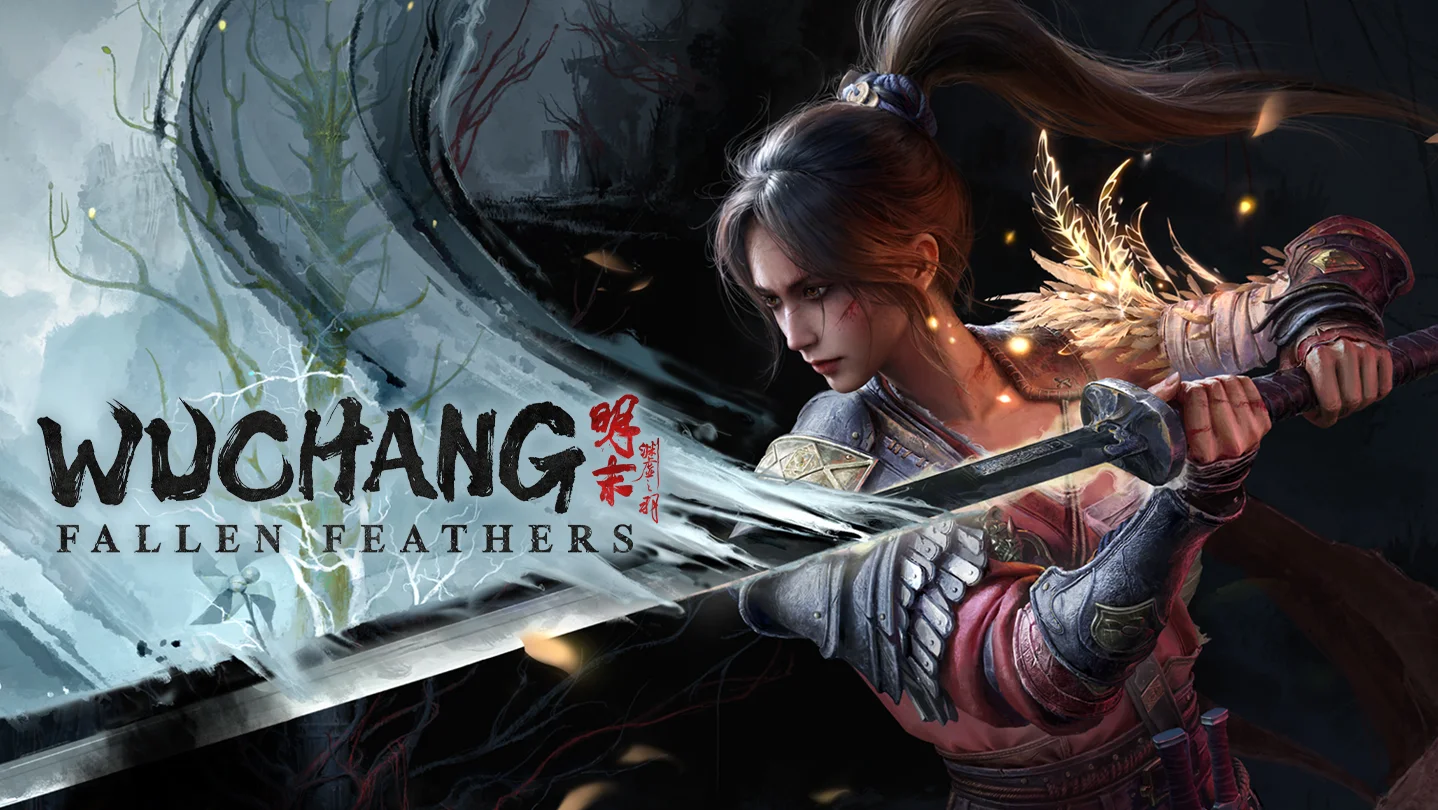
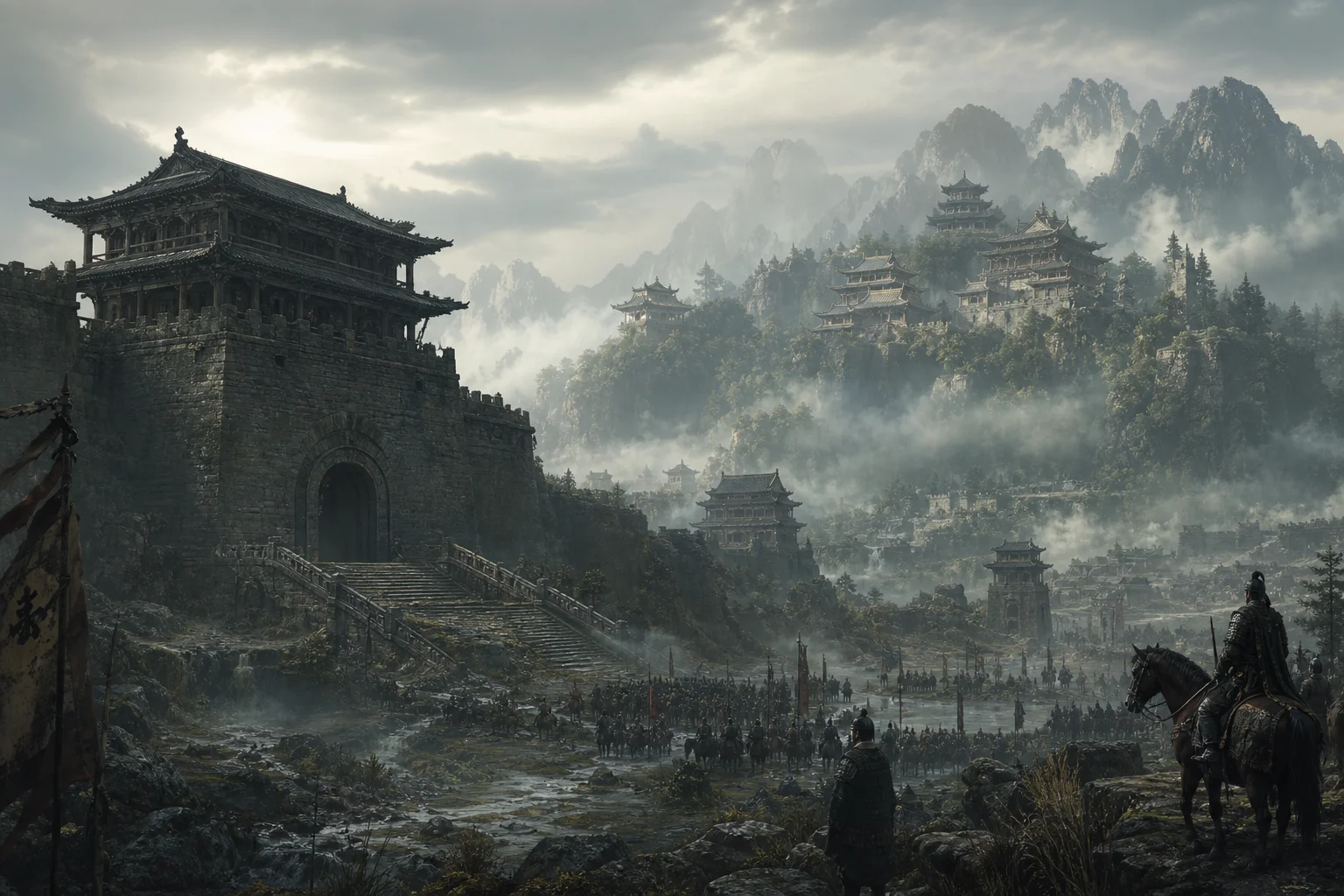
You know what the bronze masks mean — see Sanxingdui & Jinsha. This article maps where you walk: the four main regions, which real Sichuan landmarks they echo, and how to tell a Ming battlefield from a Han ritual gate from a Taoist mountainside. Light spoilers for region and shrine names only; no ending or boss-strategy walkthroughs.
The map is a stack, not a atlas
Leenzee compresses millennia into one playable basin. A single vista may show:
- Late Ming armor, refugee camps, Zhang Xianzhong holdouts — our 1647 primer
- Han dynasty stone gate towers (Han que, 汉阙) and cliff grottoes
- Ming-Qing temple architecture — Taoist altars, Buddhist halls, mixed like real Bashu sites
- Ancient Shu / Bo strata — deepest in Bo Capital; overlaps with archaeology article
Treat names as cultural quotation, not coordinates. Worship's Rise is not one documented town; Mt. Zhenwu quotes a famous Yibin mountain without copying its floor plan. The goal is recognition: “This feels like Han gate country” or “This is the Zhang Xianzhong chapter.”
Region 1
Worship's Rise (拜愿升) — temples, mansions, Tang Palace ruins, coast-adjacent lowlands
Region 2
Cloudspire — snowy passes, mines, rebel camps, Snowfall Palace
Region 3
Mt. Zhenwu (真武山) — battlefield pass, refugee camp, Zhenwu Temple, Zhang Xianzhong arena
Region 4+
Worship's Rise in Ruins · Bo Capital (僰都) — collapsed town, ancient Shu heart
Han que: the stone gates in the fog
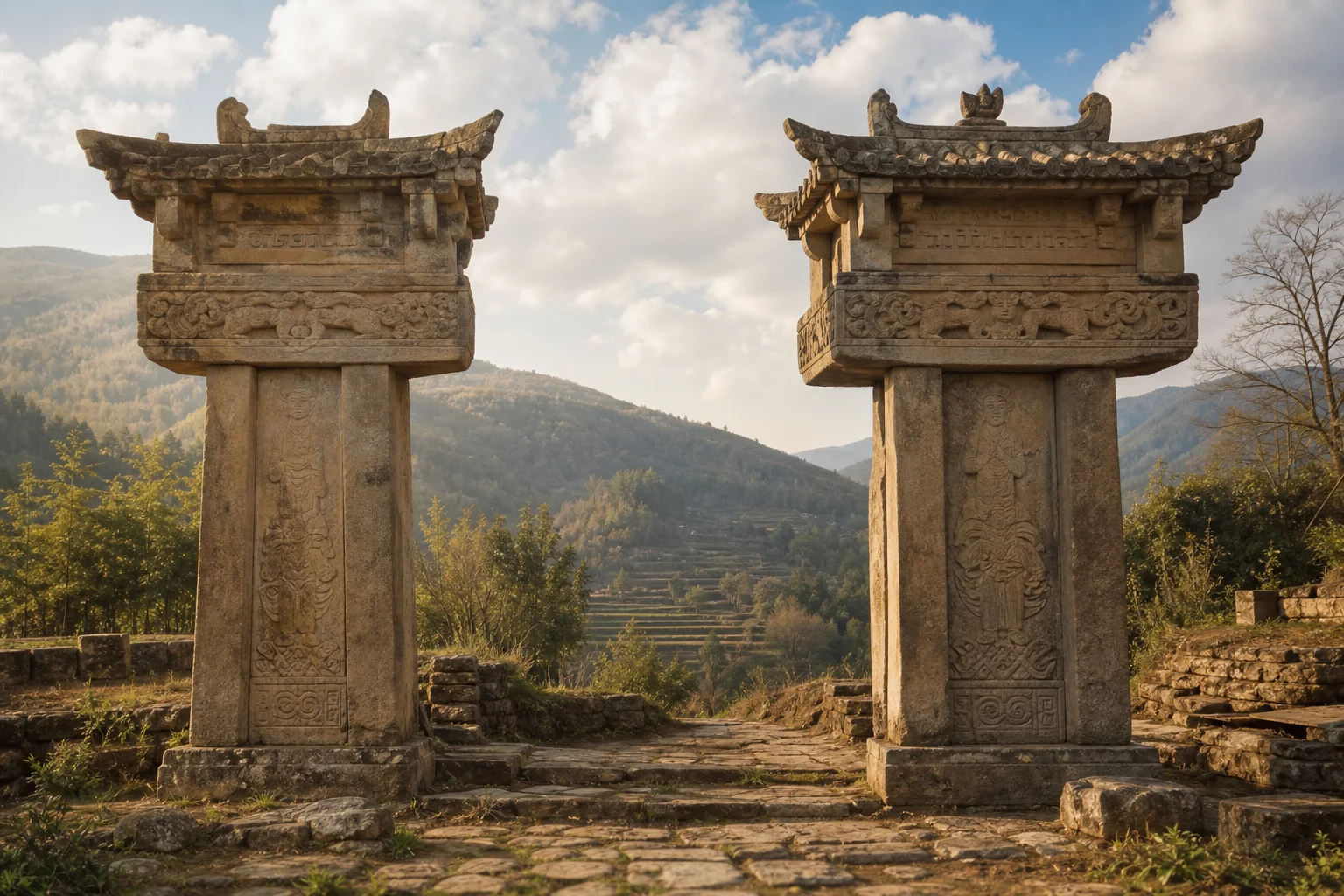
A que (阙) is a ceremonial gate — two towers flanking a gap — built before Han palaces, temples, or tombs to display rank. Sichuan preserves more que than almost anywhere else in China; the county of Quxian (渠县) alone holds six sites with seven towers, earning the nickname “Home of Han Que.” Saying “most Han que are in Bashu” (天下汉阙巴蜀多) is standard cultural shorthand.
Why they matter for WUCHANG:
- They are above-ground Han architecture — rare, carved stone mimicking wood brackets and rooflines
- Reliefs show daily Han life — hunting, carts, mythic beasts — the same era when Shu was absorbed into imperial networks
- Visually distinct from Ming brick or bronze-age Sanxingdui — when you see que-shaped ruins in-game, the art team is marking Han layer, not 1647 camp life
Other famous Sichuan que include examples at Zitong (梓潼) and scattered sites across the basin. You will not match each in-game prop to Fuhuan Que or Shen Fujun Que — treat them as genre reference.
Region 1: Worship's Rise — temples, cliffs, and imperial ghost
The opening region mixes sacred and domestic space:
- Reverent Temple (敬元寺) — hub cave and Taoist rescue; temple-as-sanctuary fits late Ming reality when monasteries sheltered refugees
- Buddha Cliffs — cliff-face Buddhist carving tradition; Sichuan and Chongqing borderlands host famous grotto routes (e.g. larger sites like Dazu); here the mood is condensed cliff-shrine horror
- Lu Mansion — gentry courtyard burned by plague; echoes Ming literati estates that became looting targets
- Tang Emperor's Palace (唐皇宫) — not a specific excavated Tang palace in Chengdu; a fictional name for older dynasty ruins under late Ming occupation. Tang armies did contest Shu historically, but this building is narrative set-dressing: “empire before empire fell.”
- Mercury Workshop — fictional Red Mercury mine tying geology to Feathering mechanics
Worship's Rise also frames Wuchang's pre-game tragedy — the Luo mansion resurrection horror — before she wakes amnesiac near Reverent Temple. Culturally: a river-town / temple-town composite resembling southern Sichuan and Yangtze-affiliated trade settlements, not a 1:1 Chengdu street map.
Region 2: Cloudspire — mountains, mines, and winter war
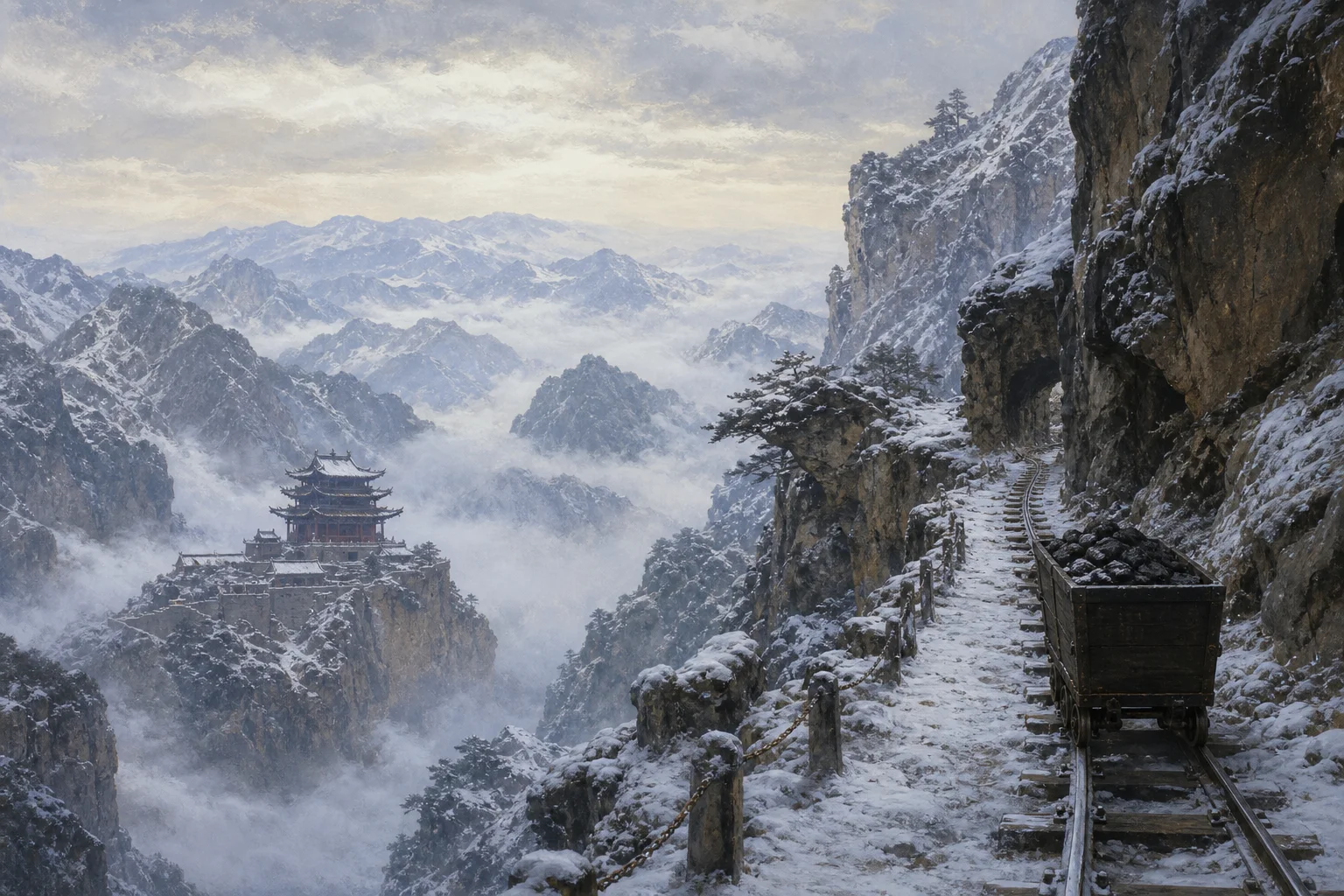
After Tang Palace, the map climbs into Cloudspire — snowy courtyards, hidden mines, corruption pillars, and military camps. Real-world echoes:
- Mountain warfare geography — Sichuan campaigns in the 1640s–50s hinged on passes (剑阁, 夔门, and countless lesser gaps); Cloudspire's bridges and elevators dramatize vertical choke points
- Mining folklore — Sichuan has ancient salt wells and metal extraction; Red Mercury exaggerates cinnabar / ore mystique into plague fuel
- Snowfall Palace — elite pavilion in ice; evokes Tang-Song poetic “snow palace” tropes and Ming luxury rotting under siege
- Rebel Camp / Cloudspire City — named factions holding urban blocks; mirrors how Southern Ming, Qing, and bandit banners shared ruined towns without clear law
Commander Honglan (鸿岚) and the stolen Jade Ancient Chisel pivot the plot here — linking place to artifact quest (developed further in module C3). Light spoiler only: Fang Ling's wedding hall tragedy connects this region to sister / resurrection themes.
Region 3: Mt. Zhenwu — the real mountain behind the chapter
Mt. Zhenwu (真武山) is the clearest real-landmark quotation in the game. The Zhenwu Mountain historic complex in Yibin (宜宾), Sichuan — on the Yangtze / Min River confluence — is a national protected site:
- Taoist temples from Ming expansions; local saying “North Qingcheng, South Zhenwu” (北青城,南真武) ranks it among Southwest sacred mountains
- Stone stairways and three gate towers (一天门, 二天门, 三天门) modeled after famous ascent routes — the game's shrine ladder rhythm echoes this pilgrimage architecture
- Huayang Guo Zhi already mentions early cult sites in the region — literary depth predating Ming buildings
- Local records note destruction during the late Ming wars, including devastation associated with Zhang Xianzhong's campaigns — then later rebuilding
In-game landmarks mapped to cultural logic:
- Battlefield Pass — transition from Cloudspire; literal war front
- Refugee Camp — civilians trapped between armies; historical 1640s Sichuan saw mass displacement
- Zhenwu Temple / Antechamber / Pavilion of Knowledge — Taoist-Buddhist mixed halls like the real complex; Storyteller NPC anchors lore delivery
- Zhenwu Altar — appears after the Fierce Tiger boss (Zhang Xianzhong); see Warlords & Factions for historical Zhang vs game avatar
- Ferry Overlook / Bai Mansion docks — river commerce and pirate-era memory tying back to Wuchang's sea years
Designer intent (inferred): Placing Zhang Xianzhong at Zhenwu Altar links documented late Ming trauma to a site whose real temples were burned in the same era — geography as emotional argument, not trivia.
Region 4: Worship's Rise in Ruins & Bo Capital
The final overworld collapse returns to the starting biome — now ash and underground palaces:
- Worship's Rise in Ruins — the Bo Magus, Storyteller choice, and optional Bo successor ending branch
- Bo Capital — buried ancient Shu heart under the worship town; Sanxingdui-adjacent bronze grammar at maximum density
- Shu Sanctum (蜀祠) — early-story sacred infrastructure revisited; “Shu cult neglected” framing
- Gate of Truth / Burning Cave — endgame metaphysical space; less geography, more cosmology
Narratively: you descend from Ming recognizable world into Bo / ancient Shu fiction the chronicles describe — the same vertical move as archaeology (surface Han/Ming over deep bronze age).
Grottoes, pagodas, and battlefield debris
Recurring props and what they signal:
| In-game feature | Real Bashu reference | Read as |
|---|---|---|
| Cliff Buddha niches | Sichuan grotto temple routes | Faith carved into rock — later corrupted by Feathering |
| Pagoda + cave shrine pairs | Mountain temple layouts (Zhenwu, Emei-style mixes) | Taoist/Buddhist cohabitation, common in Southwest China |
| Stone que fragments / gate towers | Quxian, Zitong Han que | Han imperial memory in farm country |
| Abandoned Ming banners and cannon rust | 1647 multi-faction fronts | Present-war layer — who still claims legitimacy? |
| Bronze trees and mask walls | Sanxingdui / Jinsha | Deep Shu — see archaeology article |
| Shrines (save points) | Way-shrine / local temple tradition | Soulslike mechanic dressed as roadside folk religion |
How to use this while exploring
- See paired stone towers → think Han que, not Sanxingdui
- See snow + mine + camp → Cloudspire = mountain war economy
- See Taoist gates on a river mountain → Zhenwu quotation; expect Zhang Xianzhong lore
- See bronze mask density spike → you are in ancient Shu fiction layer (Bo Capital)
- Hear cuckoo audio in ruins → Du Yu poetry layer — preview for module C4
If a location name sounds like a real city but the terrain feels wrong, trust the terrain: Leenzee prioritizes emotional geography (siege, pilgrimage, burial) over OpenStreetMap fidelity.
Further reading on places
- Reading Order — museum and documentary links
- Glossary — Zhenwu Mountain, Shu, Xichong
- How WUCHANG Blends History and Myth — when to stop treating a ruin as historical fact
Next in this series: The five chisel fragments — divine tool, broken power, and the macguffin behind every resurrection rumor.