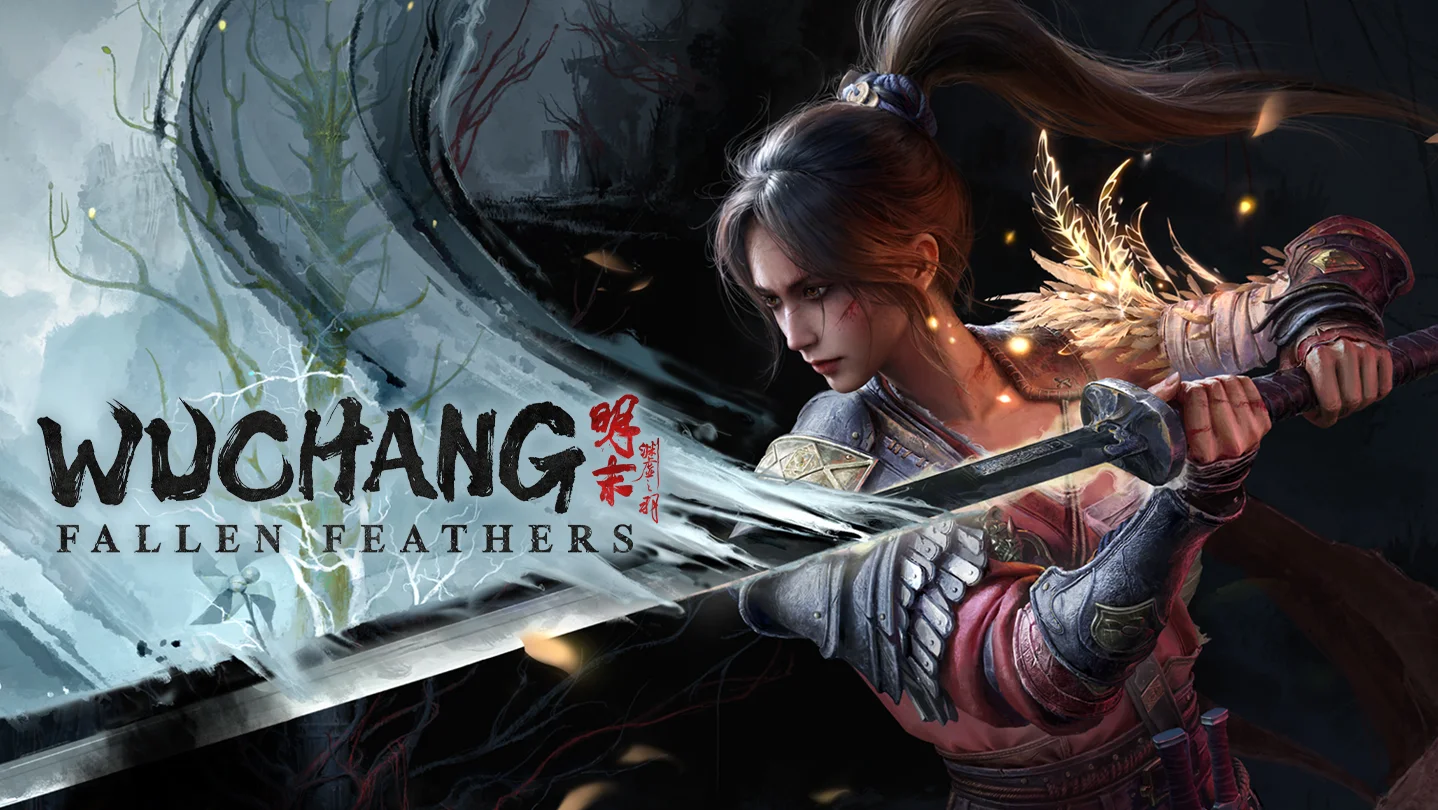
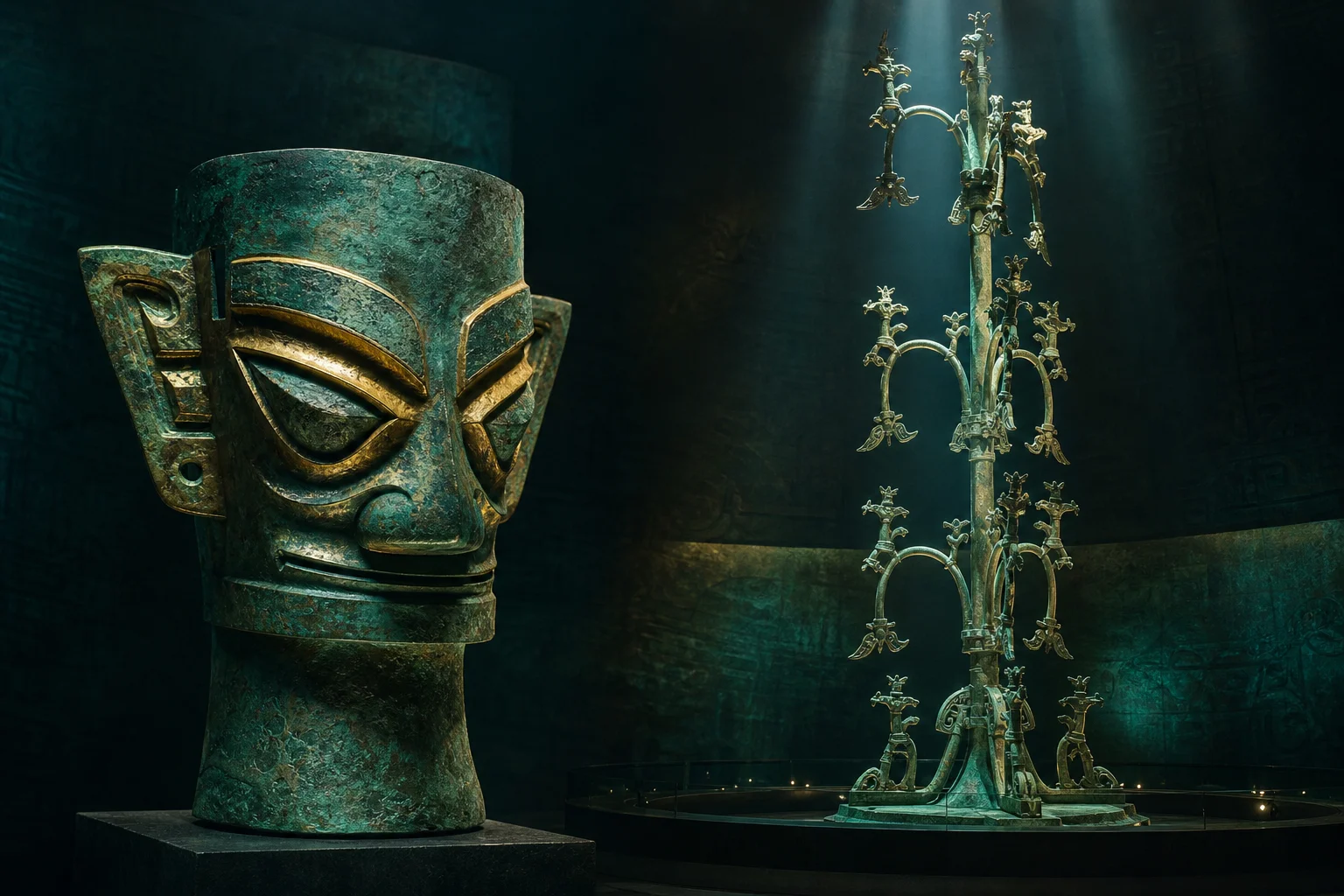
Module A already introduced ancient Shu as myth plus archaeology. This article zooms in on the digs: what Sanxingdui and Jinsha actually unearthed, why the masks look so alien next to Shang-dynasty bronzes from the north, and how to read game ruins without treating every bronze face as a documented god. No main-quest spoilers — only visual literacy for exploring Shu.
If you need the broader stack (Du Yu, Shanhai Jing, Feathering symbolism), start with Ancient Shu & the Feather People Legend. Here we stay mostly in the museum case — with occasional glances at Unreal Engine ruins.
Why archaeology matters for this game
Leenzee is a Chengdu studio. Sanxingdui sits roughly forty kilometers north of the city; Jinsha was found inside modern Chengdu. When global marketing shows bronze masks and bird totems, Chinese players recognize local heritage branding the way a French studio might quote Chartres or Carcassonne. Western players often lack that anchor — so mask-heavy levels can feel like generic dark fantasy unless you know the reference layer.
Sanxingdui
Sacrifice pits · massive bronzes · no surviving texts · ~12th–11th c. BCE
Jinsha
Chengdu urban site · Golden Sun Bird · cultural continuity with Sanxingdui
Game layer
Visual quotation + horror exaggeration — not an excavation simulator
Sanxingdui: the 1986 shock
Workers at a brick factory near Guanghan (广汉) struck Pit 1 in 1986, then Pit 2 — two deposits packed with broken and whole bronzes, jades, gold leaf, elephant tusks, and cowrie shells. The scale rewrote assumptions: Sichuan was not a Bronze Age backwater copying the Central Plains. It hosted a parallel ritual world with its own aesthetics and technology.
Key facts (archaeological consensus, not game lore):
- Objects were deliberately broken and burned before burial — ritual termination, not a simple tomb cache
- No readable writing from the culture itself survives at Sanxingdui — names of deities remain unknown
- Recent work (2021–2024) expanded the site complex; new pits continue to yield mask fragments and sacrificial evidence
- Visual style — angular faces, zoomorphic hybrids, oversized bronze — differs sharply from contemporaneous Shang ritual bronzes
That last point is why the masks feel “sci-fi” to newcomers: they were never meant to be realistic portraiture. They are ceremonial faces — possibly for priests, spirits, or ancestors — scaled for impact in firelight.
Bronze masks: what you are looking at
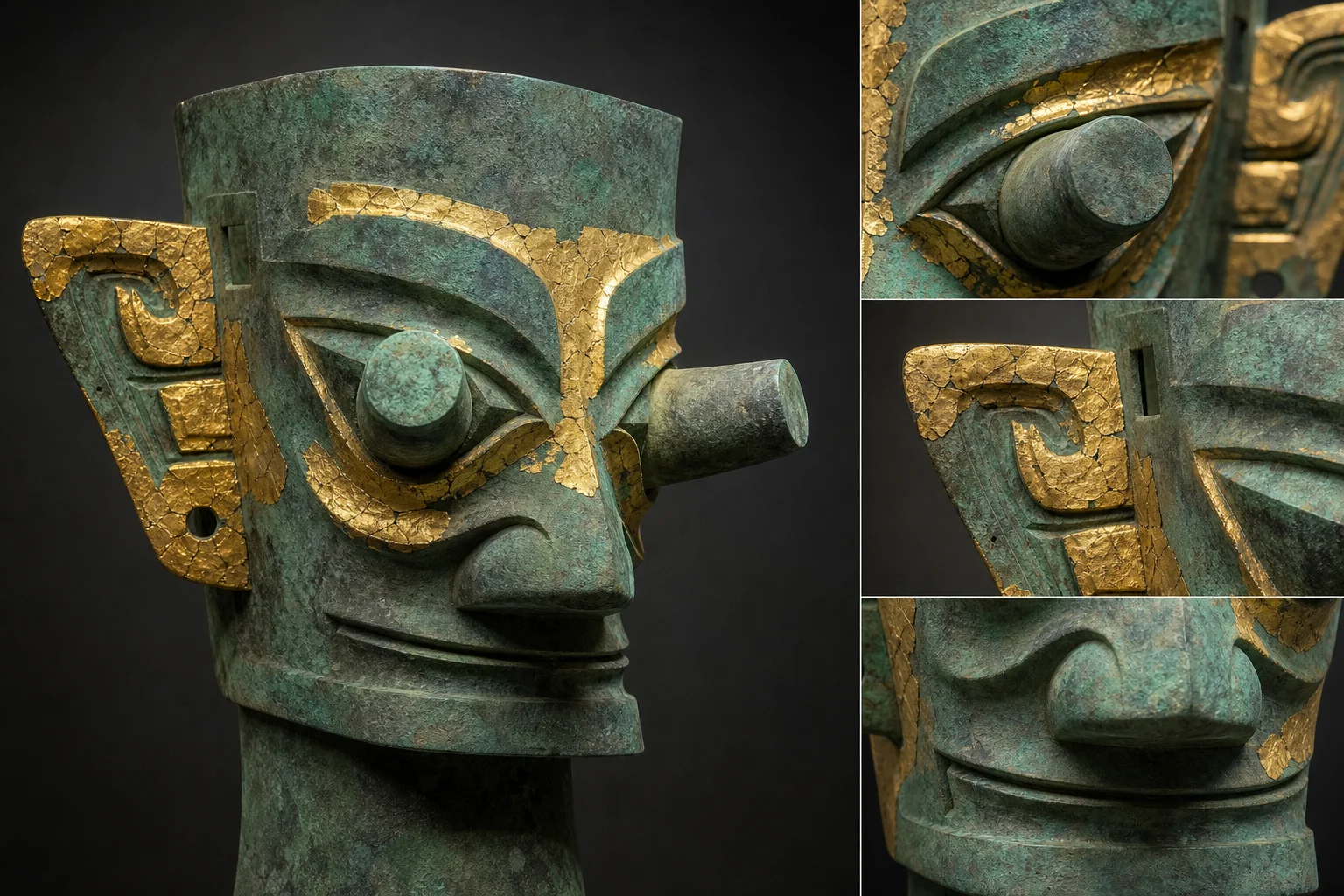
The iconic Sanxingdui bronze mask (青铜面具) combines several exaggerated features:
- Protruding eyes — cylindrical or columnar; scholars have linked them to the legendary Cancong (蚕丛, Cán Cóng) of Shu chronicles, said to have “protruding eyes,” but that link is interpretive, not proven by inscription
- Large ears — possibly hearing the divine, or simply stylized proportion for ritual visibility
- Angular mouth and jaw — mask-like even when attached to a partial head; some pieces include gold-leaf overlays on brows or lips
- Human scale or larger — masks could be worn, mounted, or displayed in composite figures; we still debate exact performance use
Popular explanations include: shamanic spirit vision, ancestor impersonation, solar or stellar symbolism, or hybrid human-animal theology. Responsible reading holds multiple theories at once. Archaeology confirms the craft; literature written centuries later supplies competing names.
In-game: When you see oversized bronze faces in collapsed halls — especially around the Shu Sanctum (蜀祠) and deeper Bo Capital (僰都) strata — treat them as quoting Sanxingdui's visual grammar, not as labeled portraits of Cancong or Du Yu. The game merges periods freely.
The bronze sacred tree
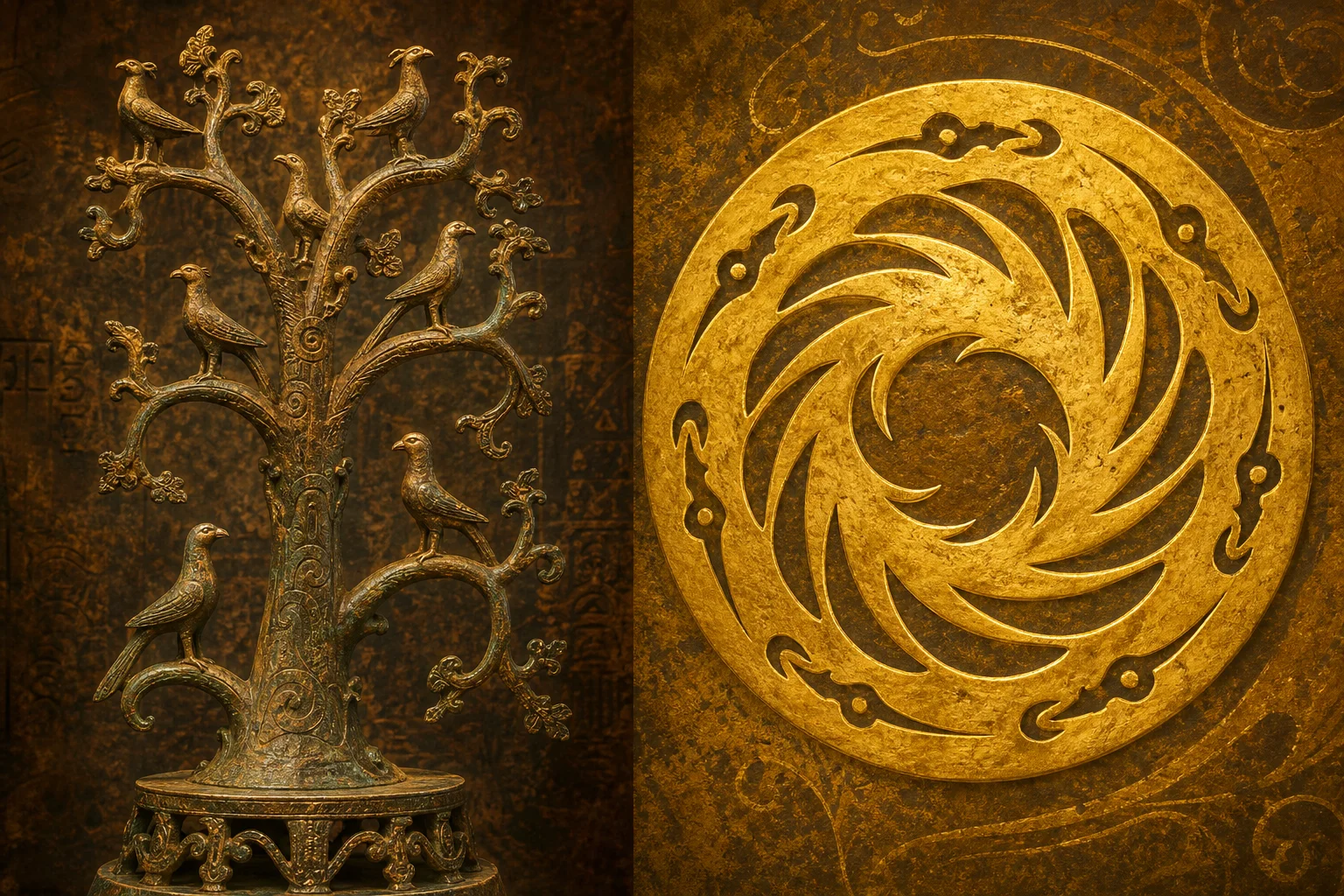
Among Sanxingdui's most dramatic finds is a bronze sacred tree — a multi-tiered trunk with branches, small human or spirit figures, and birds perched like fruit. Reconstructed examples stand nearly four meters tall in museum display.
Interpretations (again, not settled):
- A cosmic axis linking earth, mountain, and sky — common in many cultures' ritual art
- A sun-tree motif — birds as solar messengers; echoes later Chinese tales of crows or golden birds carrying the sun, but direct continuity is debated
- A stage for community ritual — the tree as prop in performances we cannot replay
WUCHANG uses tree-shaped set dressing in overgrown sanctuaries and Bo-era ruins — often paired with Red Mercury glow or Feathering corruption. Culturally: the tree reads as ancient Shu holiness overwritten by plague. Archaeologically: remember the originals were elite ritual objects smashed and buried, not living forest gods.
Standing figures, zhang scepters, and gold
Beyond masks and trees, pits yielded:
- Bronze standing figures (立人像) — robed officiants with empty hands or ritual poses; some over 2.6 meters with base
- Bronze zhang 杖 — staff-like objects with ornate tops; authority symbols whose exact rank meaning is unclear
- Gold scepters and gold-leaf face appliqués — rare metal in a bronze-heavy assemblage; signals high ritual investment
- Ivory, seashells, bronze vessels — proof of long-distance exchange into the basin
Game armor and boss silhouettes sometimes borrow the vertical posture and wide sleeves of these figures, then add Ming weapons or feathered mutation. That hybrid costume design is the point: late Ming soldiers stumbling through Bronze Age iconography.
Jinsha and the Golden Sun Bird
The 2001 Jinsha (金沙) discovery in Chengdu produced a thinner, more portable icon: the Golden Sun Bird (太阳神鸟金饰) — a gold foil disk about twelve centimeters across, with four birds flying counterclockwise around a central sun. It is now a symbol of Chengdu itself (you will see it on airport signage and metro cards).
Jinsha and Sanxingdui share bird-and-sun grammar but different media — monumental bronze versus delicate gold. Many archaeologists treat Jinsha as a later phase or related polity in the same cultural sphere. For players, the takeaway is simple: birds in Shu art mean cosmology, not decoration — which makes Feathering's winged horror a deliberate inversion of a beloved civic emblem.
What archaeology does not tell us
Keep these gaps in mind when fan theories get confident:
- We do not have Sanxingdui-language names for gods, kings, or diseases
- Chronicle kings like Du Yu and Bie Ling are literary figures — useful for game plot, not proven rulers of the pit culture
- Connecting every mask to Shanhai Jing “Feather People” is thematic, not genealogical
- Leenzee's Red Mercury and five chisels are game fiction layered atop real bronze craft traditions
Good Culture Hub reading holds two truths: the mask is authentically ancient; the plague story around it is modern horror writing.
Archaeology ↔ game: a quick lookup table
| Archaeological find | Museum where to see it | How WUCHANG typically quotes it |
|---|---|---|
| Bronze mask with protruding eyes | Sanxingdui Museum, Guanghan | Wall reliefs, broken statues, elite enemy faceplates in Shu ruins |
| Bronze sacred tree | Sanxingdui Museum (reconstruction) | Central set pieces in sanctuaries; branches + birds + vertical climb spaces |
| Standing bronze figure | Sanxingdui Museum | Silent guardians, boss scale references, robed NPC silhouettes |
| Golden Sun Bird | Jinsha Site Museum, Chengdu | Gold circular motifs, sun-bird decals, warm metal accents in jade-heavy zones |
| Ritual pit deposit (broken bronzes) | Excavation reports; museum displays | Scattered artifact piles, lootable lore objects, “excavated then corrupted” mood |
Where to look while you play
Without walkthrough spoilers, watch for these patterns:
- Shu Sanctum — early hub that frames Shu as neglected sacred infrastructure; bronze greens and ritual architecture before the open map widens
- Bo Capital strata — deepest ancient layer; Sanxingdui quotation is strongest here because the narrative labels it pre-dynastic Shu heartland
- Mask + bird + tree triads — if all three appear in one arena, the art team is signaling archaeology, not generic dungeon
- Contrast zones — Ming stone, Han gate towers, and bronze-age faces stacked in one vista = the game's “layered Sichuan” thesis from How WUCHANG Blends History and Myth
Enemies discussed in Feathered Monsters & Transformation often spawn in these spaces — the horror is not that archaeology was wrong, but that Feathering weaponizes symbols people once prayed to.
Go deeper after this article
Digital first steps (no travel required):
- Sanxingdui Museum official virtual exhibitions — search for the current English portal; mask and tree galleries match in-game art direction closely
- Jinsha Site Museum — Golden Sun Bird and jade-heavy assemblages
- Our Reading Order — curated books and documentaries
- Glossary entries for Sanxingdui, Jinsha, and Shu
Mythic kings and the five chisel fragments belong to chronicle literature more than to pit deposits — see Du Yu, Bie Ling & the Kings of Ancient Shu for that layer.
Next in this series: From museum icons to playable geography — Sichuan landmarks, temples, battlefields, and which real places the map echoes.