Spoiler warning: this article summarizes major plot beats from Journey to the West — including identity twists, deaths, and the pilgrimage's ending. If you want zero story exposure, stop at our primer and glossary.
Black Myth: Wukong scatters references across its world — boss shapes, item names, environmental mood — without retelling the novel chapter by chapter. Western players who recognize the iconic episodes below get instant context: why a disguise feels tragic, why a fan matters, why two monkeys fighting is a cosmic crisis. Here are the trials Chinese audiences grew up knowing, in the order that helps most when playing.
How the novel is structured
The pilgrimage is framed as 81 tribulations (八十一难) — symbolic Buddhist trials on the road to enlightenment. In practice the book is episodic: the party walks west, meets a yaoguai, nearly loses Tang Sanzang, Wukong solves it (often violently), and they move on. Comedy, satire, and moral debate repeat inside that loop.
Pre-pilgrimage
Origin + Havoc in Heaven + Five Elements Mountain — Wukong's solo epic
Early road
Disguise trials, borrowed treasures, recruitment of disciples
Mid & late road
Family-scale demon lords, kingdom satire, identity crises, Western Heaven finale
Wukong's pre-pilgrimage arc is covered in Havoc in Heaven and Sun Wukong: From Stone to Monkey King. This article focuses on the pilgrimage episodes Western players encounter most often in adaptations, fan talk, and game echoes.
The episodes everyone cites
You do not need all 100 chapters. These twelve arcs cover most “why is this boss famous?” moments — and the patterns Black Myth most often riff on.
| Episode | Chinese | Why it is iconic |
|---|---|---|
| White Bone Spirit | 三打白骨精 | Three disguises, three beatings — Wukong expelled for “murder”; headband conflict at its worst |
| Yellow Wind Demon | 黄风怪 | Blinding sandstorm — early showcase of a cultivated beast with a title and a wind gimmick |
| Golden & Silver Horn Kings | 金角 / 银角 | Borrowed fabao from Lord Lao — gourds, ropes; Wukong wins by theft and trickery |
| Red Boy | 红孩儿 | Flame-spewing child; son of Bull Demon King; pushes Wukong to his limits |
| Five Villages Abbey | 五庄观 | Immortal ginseng fruit — Wukong steals, offends Zhenyuan Daxian, and owes a cosmic apology |
| Flaming Mountains | 火焰山 | Family feud with Bull Demon King; Banana Leaf Fan borrowed three times |
| Spider Spirits | 盘丝洞 | Seduction-and-trap folk horror; seven spider sisters |
| False Sun Wukong | 真假美猴王 | Two identical monkeys — no one can tell them apart until the Buddha reveals the impostor |
| Three Princesses of Tiger, Elk, Antelope | 狮驼岭 | Three demon kings on Lion Camel Ridge — darkest, most apocalyptic trial before the end |
| Scriptures delivered | 取经成功 | Party reaches Western Heaven; Wukong becomes Victorious Fighting Buddha (斗战胜佛) |
Note: episode names vary by translation. The table uses the names most common in English fan and academic discourse.
Three trial shapes — read any episode faster
Most chapters reuse a handful of structures. Recognizing the shape helps when Black Myth presents a boss arena that “feels familiar” without naming the chapter.
Pattern A
The disguise trial 三变
Yaoguai shape-shifts into harmless humans — old woman, maiden, child. Wukong sees the truth; Tang Sanzang sees compassion. The monk punishes violence; the demon escapes until the last strike.
Pattern B
The fabao puzzle 法宝
Enemy owns a treasure with one strict rule — absorb if you answer your name, fan that puts out fire, ring that catches weapons. Victory means learning the rule, not out-muscling it.
Pattern C
The family war 亲族
Demon lord with spouse, child, and in-laws — Bull Demon King, Red Boy, Iron Fan Princess. Politics and old grudges with Wukong, not just hunger for monk flesh.
Pattern D
The recall 收妖
After defeat, a bodhisattva or sage arrives: “That was my mount / boy / pet.” Explains why heaven never cleared the road in advance — trials were assigned.
White Bone Spirit — the disguise trial that breaks the party
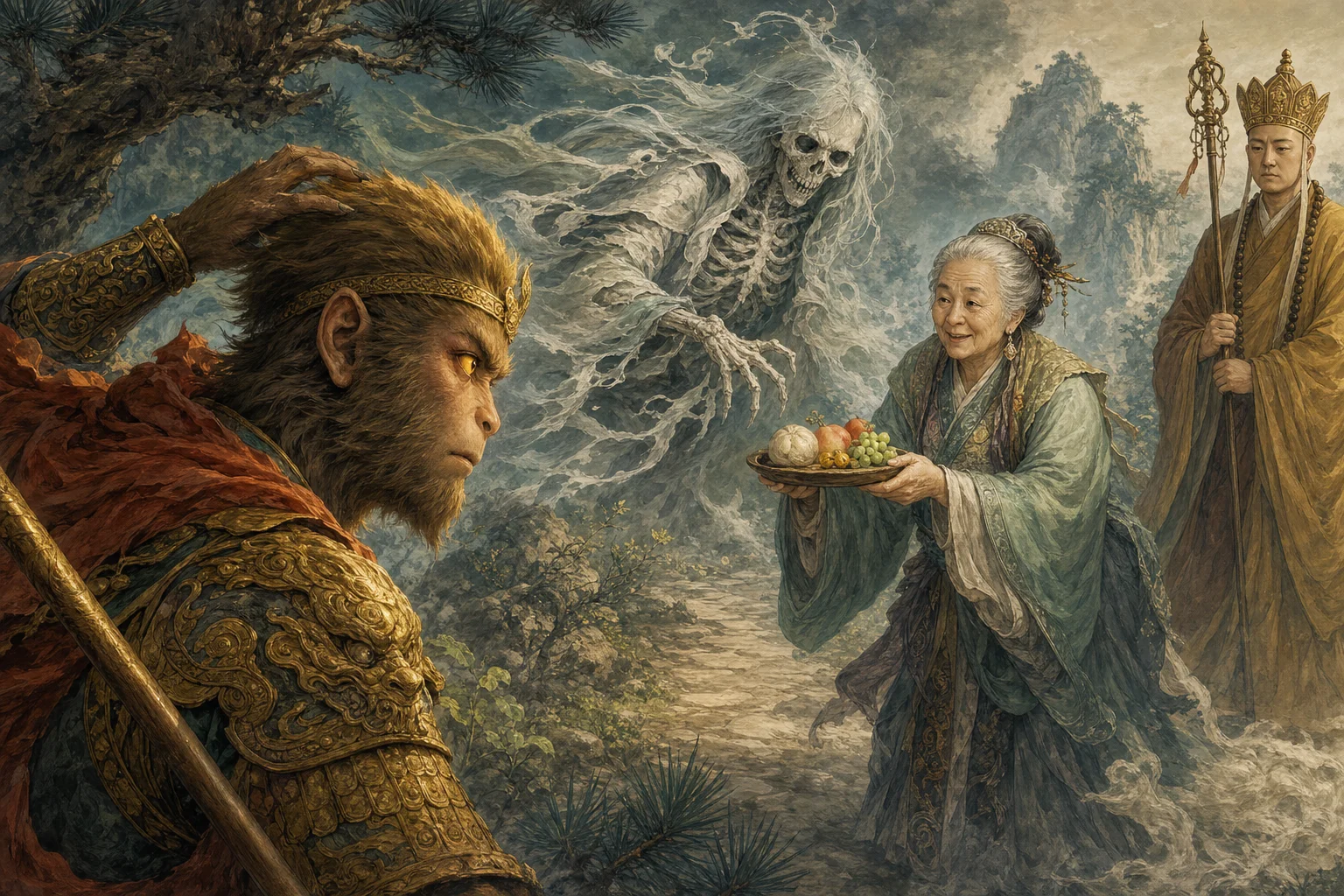
The White Bone Spirit (白骨精, Báigǔ Jīng) appears three times as three different humans — bringing food, then as a mother searching for her child, then as an old man. Wukong kills each disguise. Tang Sanzang, furious at what he sees as murder of innocents, recites the Tightening Spell and drives Wukong away.
It is the novel's sharpest conflict between mercy and perception. Sanzang's compassion is genuine — and exploitable. Wukong's golden eyes see through every mask — and his violence looks cruel to a monk who cannot verify the truth. Every adaptation retells this arc because it defines the headband's cruelty and the party's fragile trust.
Red Boy and the Flaming Mountains — family-scale war
Red Boy (红孩儿, Hóng Hái'ér) breathes true fire — not mere flame, but Samadhi Fire that even Wukong cannot shrug off. He is the son of the Bull Demon King (牛魔王) and Iron Fan Princess (铁扇公主), old associates of Wukong from his rebel days. Defeating Red Boy requires Guanyin's intervention; subduing him converts the child into a disciple of the bodhisattva.
The later Flaming Mountains arc reunites the feud: the party needs the Banana Leaf Fan (芭蕉扇) to pass. Wukong must negotiate with a family that remembers his past arrogance. Heat, fan, and family grudge tie together — see Famous Locations for the geography.
Golden Horn Kings — when the puzzle is the weapon
The Golden Horn (金角) and Silver Horn (银角) kings hold treasures lent by Lord Lao (太上老君): gourds that absorb anyone who answers when called, ropes that bind, swords that cut anything. Wukong survives by impersonation, swapping treasures, and exploiting each item's single rule — comedy and danger in the same chapters.
This arc is the clearest example of fabao logic in the novel. For the weapon system in myth, see Ruyi Jingu Bang & Divine Weapons.
False Sun Wukong — the identity crisis
In the True and False Monkey King episode (真假美猴王, Zhēnjiǎ Měihóuwáng), a second Wukong appears — identical in speech, staff, and skill. They fight to a stalemate. Heavenly officials, Guanyin, and even Tang Sanzang cannot tell them apart. Only the Buddha names the impostor: Six-Eared Macaque (六耳猕猴), who dies in the revelation beat.
The episode asks whether identity is body, memory, or authorization from higher powers. It also restores Wukong to the pilgrimage after earlier expulsions — a narrative reset with philosophical weight. Western players who know only one Monkey King are often surprised this arc exists at all.
Lion Camel Ridge — the darkest stretch
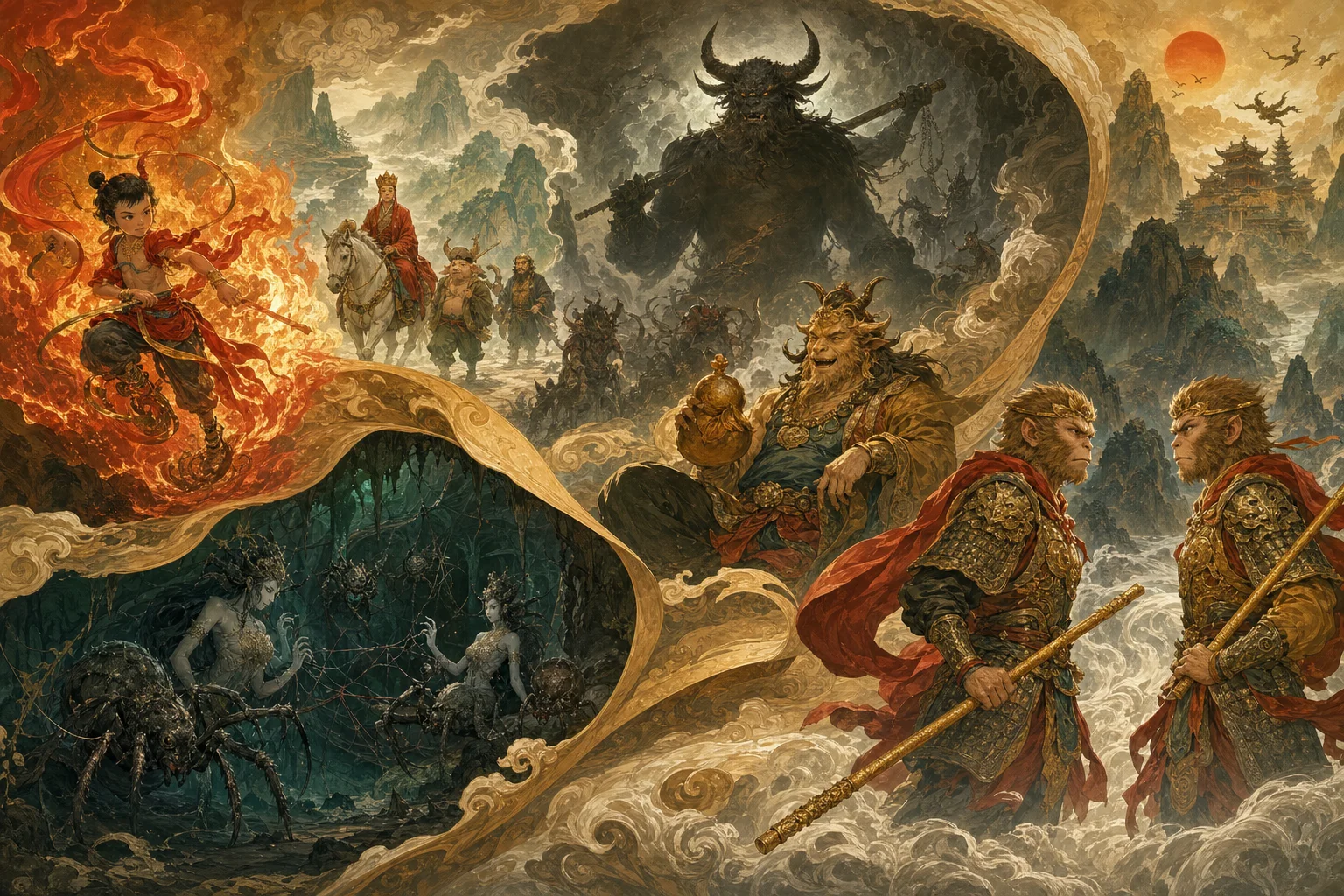
The three demon kings of Lion Camel Ridge (狮驼岭) — the Azure Lion, the White Elephant, and the Great Peng — run a kingdom built on eating humans at industrial scale. Tang Sanzang is captured; the party faces genuine annihilation. The tone turns horror-adjacent: this is where the novel reminds you the pilgrimage is mortal danger, not only slapstick.
Black Myth's darker regions often feel spiritually adjacent to episodes like this — yaoguai not as quirky roadblocks but as systemic predation. The game does not retell Lion Camel Ridge directly, but the mood overlap is deliberate genre conversation.
The ending — titles and what changes
The party reaches the Western Heaven, receives the scriptures (after a final bureaucratic bait-and-switch with fake scrolls), and returns east. Each survivor earns a Buddhist title — Wukong becomes Victorious Fighting Buddha (斗战胜佛, Dòuzhànsheng Fó), the rebel finally named inside enlightenment vocabulary.
Knowing the ending reframes the whole novel: the tribulations were curriculum. That does not make individual episodes less painful — White Bone still hurts, Red Boy still burns — but it explains why bodhisattvas assign trials instead of clearing the road.
Major beats worth remembering
- → White Bone — trust vs truth; Wukong expelled.
- → Red Boy / Flaming Mountains — Wukong's old network becomes the enemy.
- → False Wukong — duplicate hero; Six-Eared Macaque destroyed.
- → Finale — scriptures delivered; Wukong becomes Douzhansheng Fo.
In Black Myth
Game Science treats these episodes as a myth pool, not a checklist. Boss designs, chapter pacing, and environmental storytelling appear to draw from disguise horror, fabao puzzles, family-scale yaoguai lords, and pre-pilgrimage rebellion — often combined and darkened. Naming in-game enemies or regions after novel figures is usually homage, not proof of a one-to-one plot map.
Because Black Myth frames a new story around Wukong's legend, recognizing an episode can enrich a fight without predicting the next cutscene. For how far the game diverges, see How Black Myth Reimagines the Novel. For yaoguai motives behind many of these trials, see Yaoguai, Demons & Why Everything Wants the Monk.
While you play
- → Disguise + monk + punishment motifs often nod to White Bone–style trust conflicts.
- → Fire, fan, bull imagery clusters around Red Boy and Flaming Mountains lore.
- → Duplicate Wukong themes signal the 真假美猴王 identity arc — rare but explosive when used.
- → 斗战胜佛 points to post-pilgrimage Wukong — a different era of the character.
Further reading
- Anthony C. Yu, Journey to the West — vol. 2 (White Bone, early trials); vol. 3 (Flaming Mountains); vol. 4 (False Wukong).
- 1986 CCTV Journey to the West TV series — still the default visual reference for many of these episodes in China.
- What to Read (and Watch) After You Play — where to go after this spoiler-heavy overview.