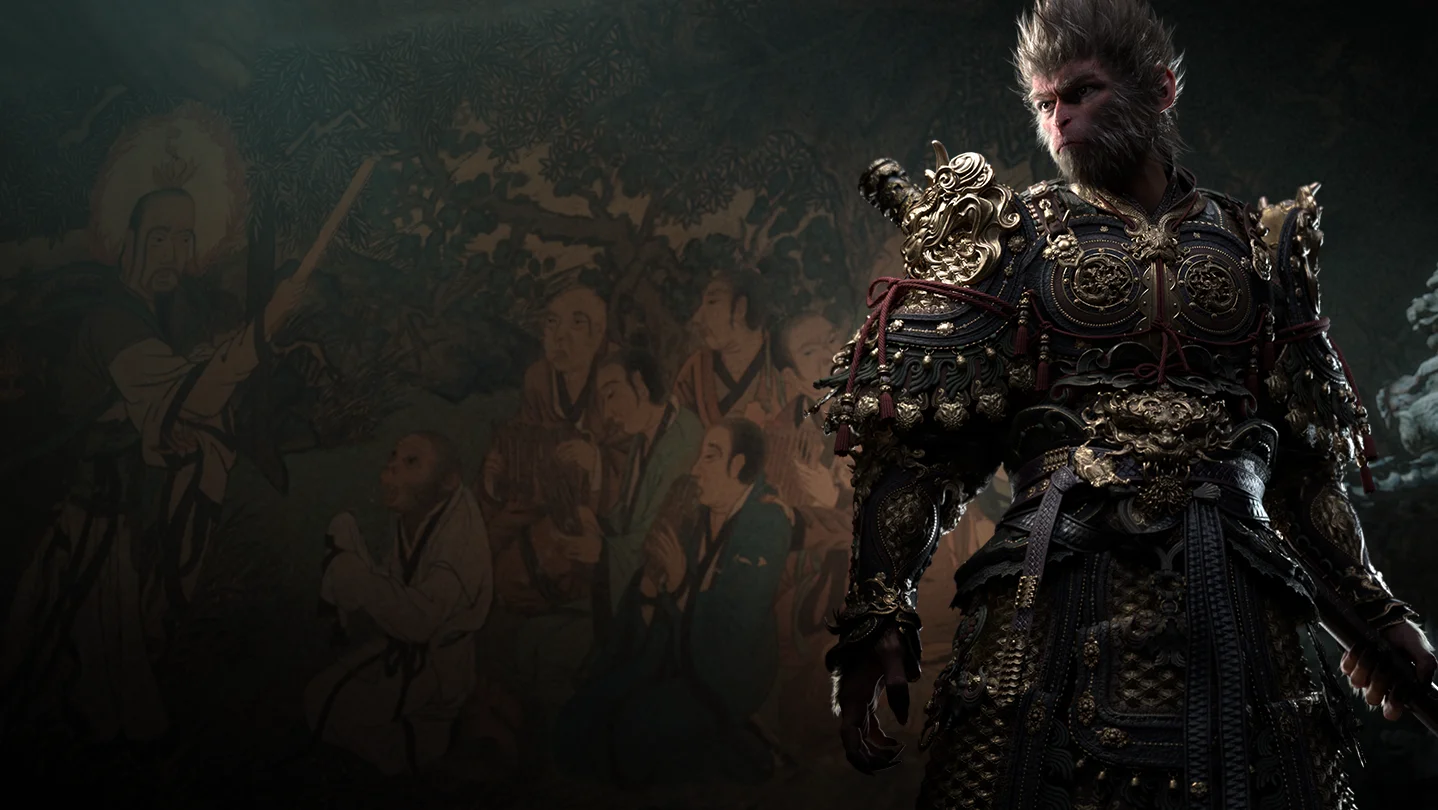
If Black Myth feels like a game about defiance as much as adventure, this is why. Havoc in Heaven (大闹天宫, Dà Nào Tiāngōng) is the novel's loudest pre-pilgrimage set piece: Sun Wukong picks a fight with the Jade Emperor (玉皇大帝), trashes heaven's bureaucracy, raids immortal feasts, and only stops when the Buddha intervenes. This article walks through the full arc so you can recognize every echo in the game.
What “Havoc in Heaven” actually means
The phrase is both a story title and a cultural shorthand. In English you will see Havoc in Heaven, Upheaval in Heaven, or Wrecking the Heavenly Palace — all pointing to the same chapters in Journey to the West (roughly chapters 3–7 in Anthony C. Yu's translation).
It is not the whole novel. It is the origin climax: the moment a stone-born monkey proves he can outfight heaven's armies, outsmart its officials, and steal its treasures — until a higher Buddhist power draws a line. Every later reference to Wukong as Great Sage Equal to Heaven (齐天大圣) or Protector of the Horses (弼马温) points back here.
Chinese
大闹天宫 — literally “great disturbance / havoc in the heavenly palace”
When it happens
Before the scripture quest — Wukong is a free agent, not yet Tang Sanzang's disciple
Outcome
Trapped under Five Elements Mountain for ~500 years until Guanyin recruits him for the pilgrimage
How the rebellion starts
The arc has a clear trigger chain. Wukong already has immortality arts from Subhuti, divine gear from the Dragon King, and his name crossed out of the underworld ledgers. Heaven decides the safest move is to bring him inside the system — give him a job, keep him close, hope he behaves.
They appoint him Bimawen (弼马温) — essentially a celestial stable keeper. Wukong enjoys the work until he learns the title is the lowest rung on heaven's ladder, a polite way to contain a troublemaker. He storms back to Flower-Fruit Mountain (花果山), declares himself Great Sage Equal to Heaven (齐天大圣), and raises an army of monkeys.
Why the Bimawen insult matters
- → Heaven tries management, not respect — a bureaucratic fix for a cosmic problem.
- → Wukong's rage is about rank and recognition, not salary. He wants parity with the Jade Emperor.
- → 齐天大圣 becomes his permanent identity — still used centuries later in games, memes, and fan art.
Act by act: the havoc unfolds
The novel treats the rebellion as a sequence of escalations. Heaven underestimates Wukong at every step; he keeps collecting power until only Buddhist authority can end the fight.
| Stage | What happens | Why it escalates |
|---|---|---|
| The title deal | Heaven grants “Great Sage Equal to Heaven” to stop the fighting — but gives him an empty job guarding the Peach Garden | Honor without real authority; Wukong feels mocked again |
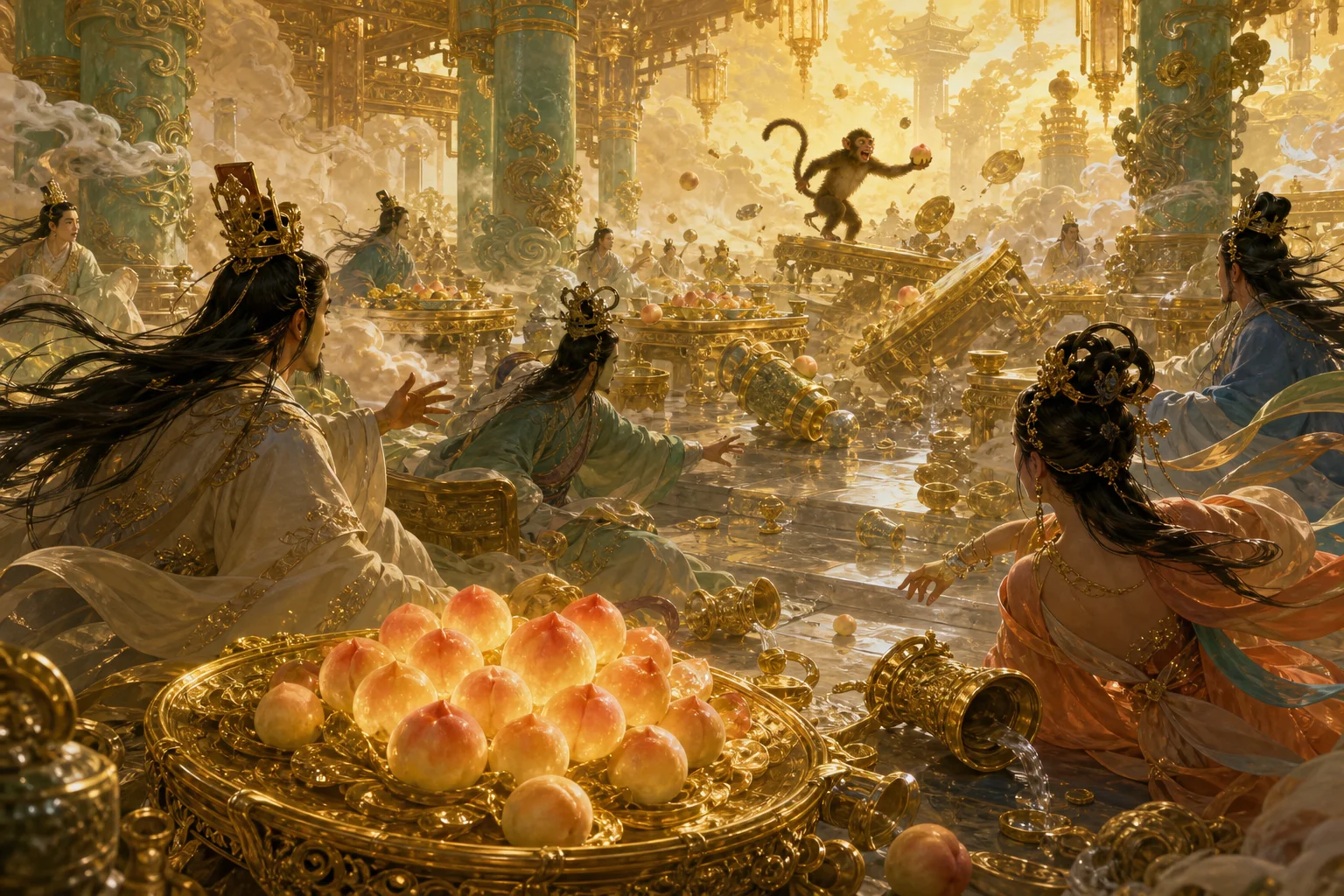
| Peach Garden raid | He eats the immortal peaches (蟠桃) meant for the Jade Emperor's banquet | Each peach adds longevity; he treats heaven's most sacred resource as a snack |
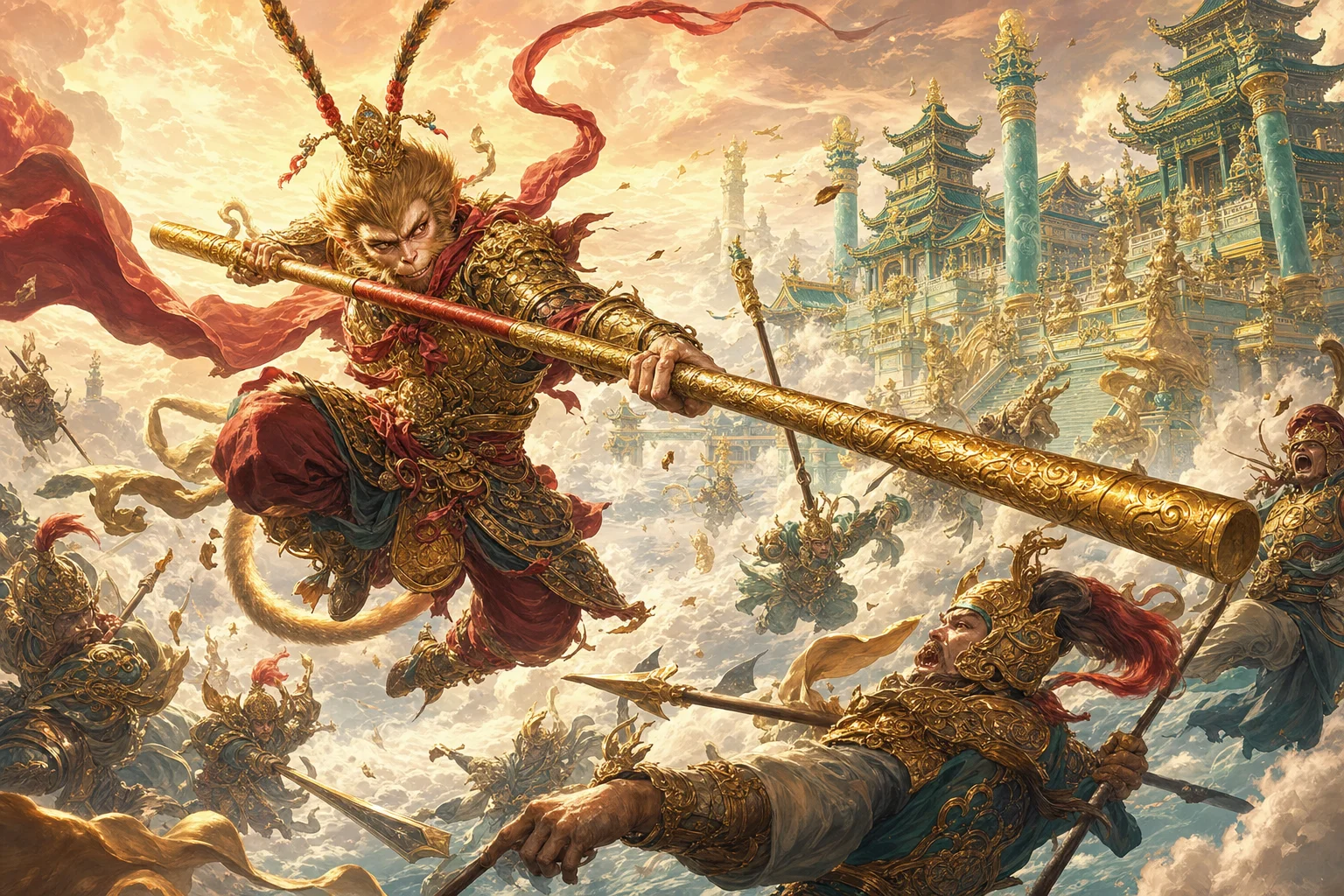
| Heavenly war | Celestial marshals and generals march on Flower-Fruit Mountain; Wukong defeats them | Heaven's military layer fails — the bureaucracy must call stronger allies |
| Peach Banquet crash | Wukong crashes the Peach Banquet (蟠桃会), drinks immortal wine, steals Lord Lao's elixir pills | Stacks immortality on immortality; heaven has nothing left to bargain with |
| Erlang Shen & allies | Erlang Shen (二郎神) and his forces finally pressure Wukong — a rare near-match | Even elite heaven needs backup; the fight becomes mythic in scale |
| The Buddha's palm | Tathagata wagers Wukong cannot leap out of his hand; Wukong loses and is sealed under Five Elements Mountain | Taoist heaven exhausted; Buddhist cosmos outranks the rebellion |
Who heaven sends — and why they fail
The Heavenly Court is a military bureaucracy. When Wukong rebels, it deploys ranked generals the way an empire sends legions — each defeat humiliates another department. You do not need to memorize every name, but these anchors appear constantly in adaptations and fan discussions.
Heaven's commander
Nezha 哪吒
The lotus-root warrior prince — young, fierce, and heavily armed. He leads early assaults against Wukong and loses. In Chinese pop culture Nezha is his own franchise; here he is heaven's shock troop.
The near-equal
Erlang Shen 二郎神
A powerful god with a third eye and a celestial hound. One of the few opponents who can pressure Wukong in open combat. Their duel is among the most adapted fights in the entire arc.
Heaven's ruler
Jade Emperor 玉皇大帝
Supreme Taoist sovereign — he does not personally brawl. He panics, convenes councils, and eventually asks the Buddha for help. His helplessness is part of the satire.
The final stop
Tathagata Buddha 如来佛祖
Ends the war with a bet, not a sword. Wukong thinks he somersaults to the edge of the universe; he never left the Buddha's palm. Cosmic hierarchy beats raw talent.
Why Wukong is so hard to kill
By the time the Buddha arrives, Wukong has stacked multiple immortality cheats: Subhuti's teachings, peach longevity, wine from the banquet, and Lord Lao's (太上老君) alchemical pills. The novel almost jokes about it — heaven keeps throwing weapons and spells at a monkey who has already become functionally unkillable through theft and study.
That is why Havoc in Heaven feels like a power fantasy before the novel pivots to repentance. Wukong wins until the story needs a force above Taoist heaven to teach him limits. For the court structure he attacks, see Heaven, Hell, and the Buddhist Cosmos.
The Buddha's palm and Five Elements Mountain
The rebellion's famous ending is deceptively simple. The Buddha offers a wager: if Wukong can leap out of his palm, the Jade Emperor will yield heaven. Wukong somersaults on his cloud, sees five pillars at the edge of the cosmos, marks them with graffiti, and returns to claim victory.
The Buddha shows him the marks — on the Buddha's fingers. Wukong never left. The Buddha turns his hand into Five Elements Mountain (五行山, often called Five Finger Mountain in English) and seals the Monkey King beneath it for five centuries.
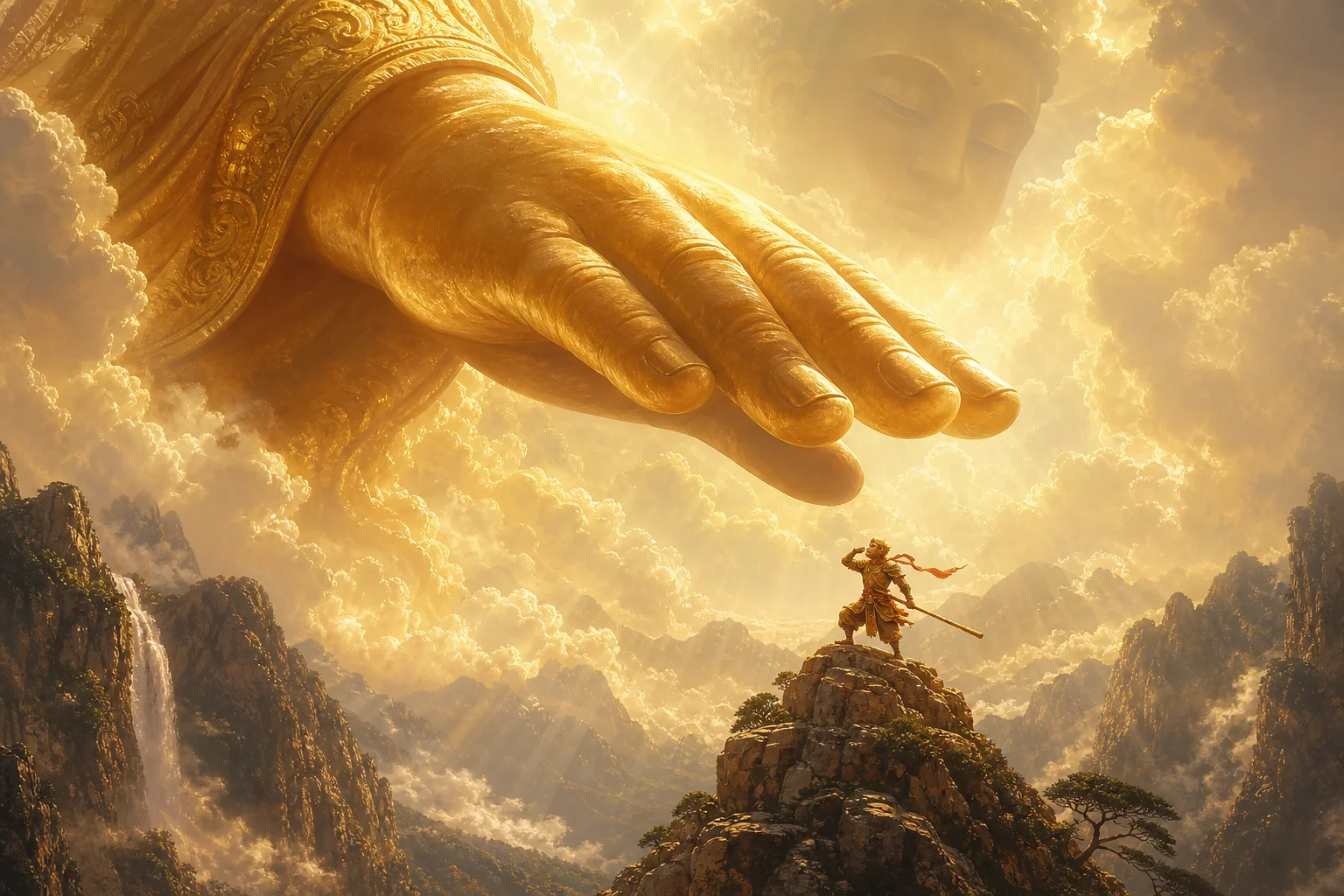
The scene is one of the most quoted moments in Chinese literature. It says something the whole novel repeats in softer keys: unchecked brilliance without humility hits a ceiling. Wukong's later service under Tang Sanzang only makes sense because this ceiling exists.
Why this episode still matters
Havoc in Heaven is not a side quest — it is the Monkey King's complete heroic phase. Chinese audiences know it from the 1964 animated film Havoc in Heaven, the 1986 TV series, countless opera versions, and modern games. When someone says 齐天大圣, they usually mean this Wukong: golden staff, cloud somersaults, laughing at heaven's generals.
The pilgrimage Wukong — headband, patience tests, protecting a fussy monk — is a sequel personality. Black Myth often feels closer to the rebel legend than the obedient disciple, which matches how Game Science markets the character. For Wukong's full origin path including Subhuti and the staff, see Sun Wukong: From Stone to Monkey King.
| Term | Chinese | Quick meaning |
|---|---|---|
| Havoc in Heaven | 大闹天宫 | The rebellion arc — Wukong vs the Heavenly Court |
| Great Sage Equal to Heaven | 齐天大圣 | Wukong's self-declared rank; still his iconic title |
| Bimawen | 弼马温 | Heaven's insulting stable-keeper appointment — the spark |
| Peach Banquet | 蟠桃会 | Immortal feast Wukong crashes; source of peaches and wine |
| Five Elements Mountain | 五行山 | Prison mountain after the Buddha's palm; later renamed for Tang Sanzang's rescue |
In Black Myth
Game Science built Black Myth around the Wukong who already fought heaven — not the monk's polite bodyguard. Celestial architecture, golden armor motifs, staff combat, and titles like Great Sage all read as Havoc in Heaven DNA. The game appears to treat the rebellion as unfinished business: gods and buddhas still arguing over what Wukong owes the cosmos.
Parallels are echoes, not a chapter-by-chapter retelling. When a region feels like a ruined court, a sealed mountain, or a memory of war in the clouds, the novel's heaven arc is usually the reference pool — filtered through a darker, more fragmented lens, as discussed in How Black Myth Reimagines the Novel.
While you play
- → 齐天大圣 / Great Sage Equal to Heaven almost always signals pre-pilgrimage, rebellious Wukong.
- → Peach, elixir, and cloud motifs often nod to the immortality thefts of this arc.
- → A headband or Tang Sanzang reference means the later disciple phase — different tone, same legend.
- → Look up unfamiliar terms in our glossary.
Further reading
- Sun Wukong: From Stone to Monkey King — the full origin including Subhuti, the staff, and the road to rebellion.
- Heaven, Hell, and the Buddhist Cosmos — the court Wukong attacks and the Buddha who outranks it.
- Anthony C. Yu, Journey to the West, vol. 1 — chapters 3–7 for the complete Havoc in Heaven text.
- 1964 Wan Laiming animation Havoc in Heaven (大闹天宫) — the visual template many Chinese audiences grew up with.