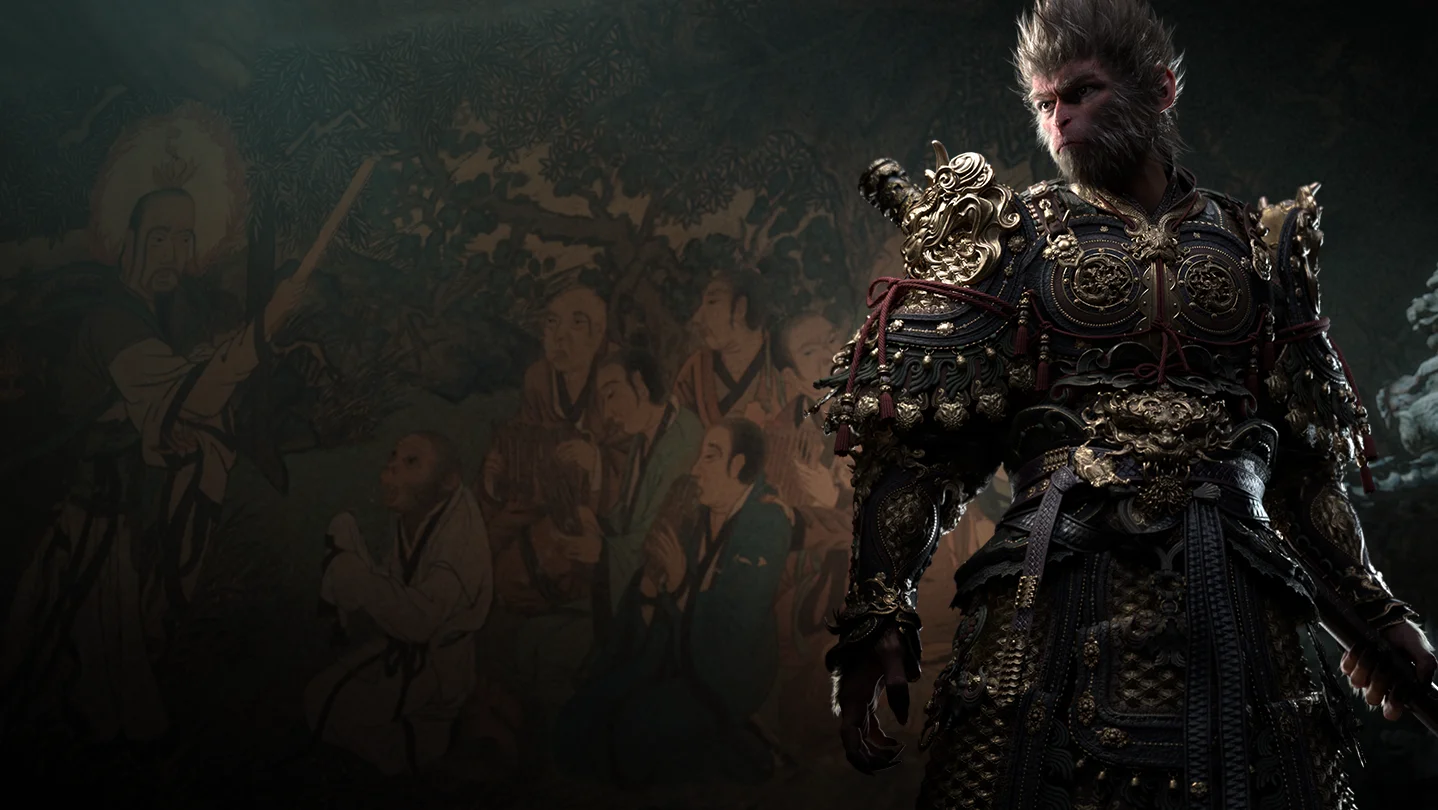
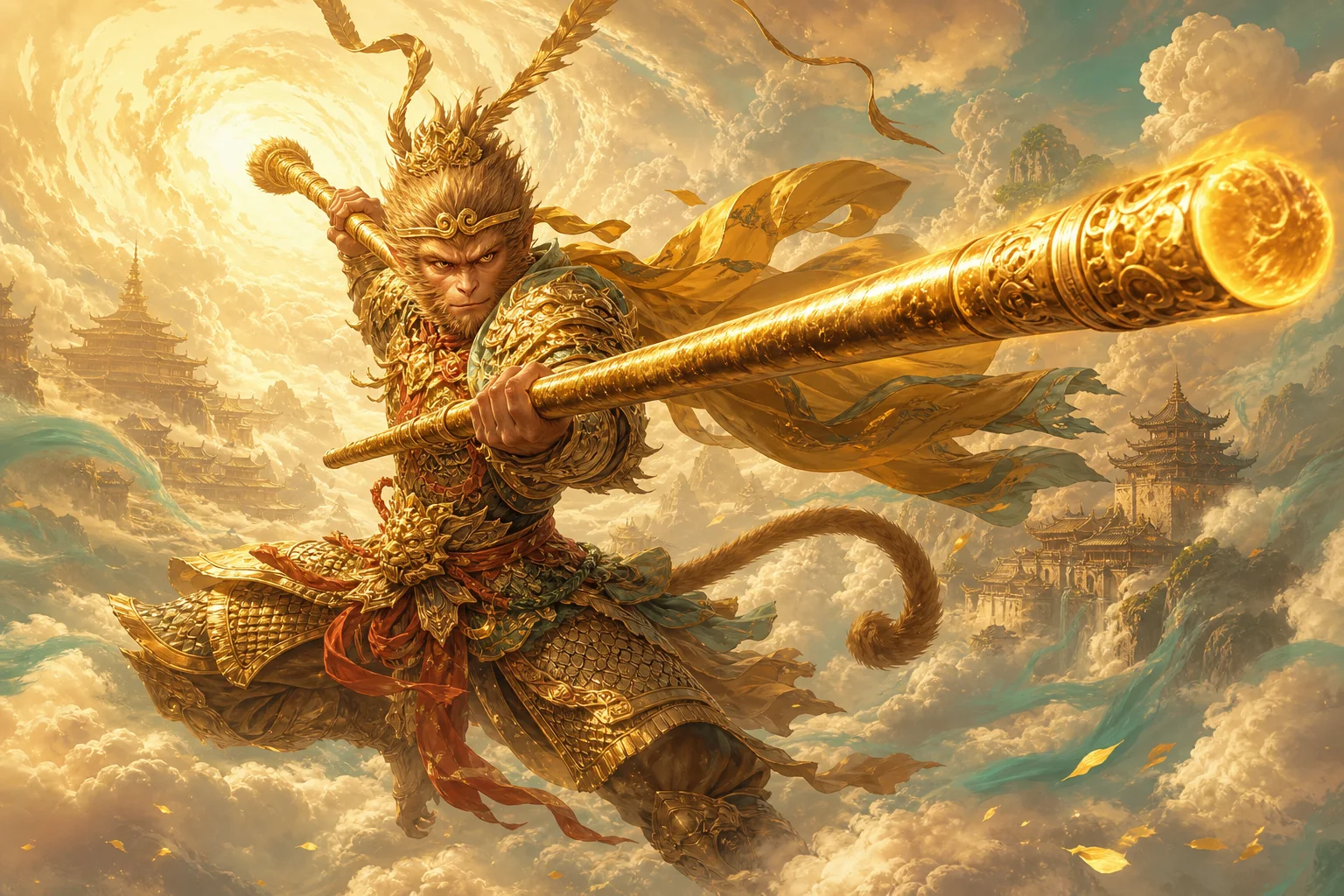
Black Myth: Wukong is built around staff combat — heavy, mythic, and unmistakably Wukong. That staff has a name: the Ruyi Jingu Bang (如意金箍棒, Rúyì Jīngū Bàng). This article explains what it is, where it came from in Journey to the West, and how Chinese myth treats divine weapons (法宝, fǎbǎo) as objects with their own rules — so you can read gear, boss drops, and item names with the right context.
Breaking down the name
The staff's name is a sentence in miniature:
Ruyi (如意)
“As-you-wish” — obeys the wielder's intent; grows, shrinks, and responds to command
Jin (金)
Gold — not always literal gold metal; marks divine rank and celestial origin
Gu / Bang (箍棒)
Banded staff — iron rod with golden rings; the classic Monkey King silhouette
English translations vary: Golden-Hooped Rod, As-You-Will Gold-Banded Cudgel, or simply Monkey King's Staff. In fan and game discourse you will most often see Ruyi Jingu Bang or Jingu Bang kept untranslated — the Chinese name carries the meaning.
Where the staff comes from
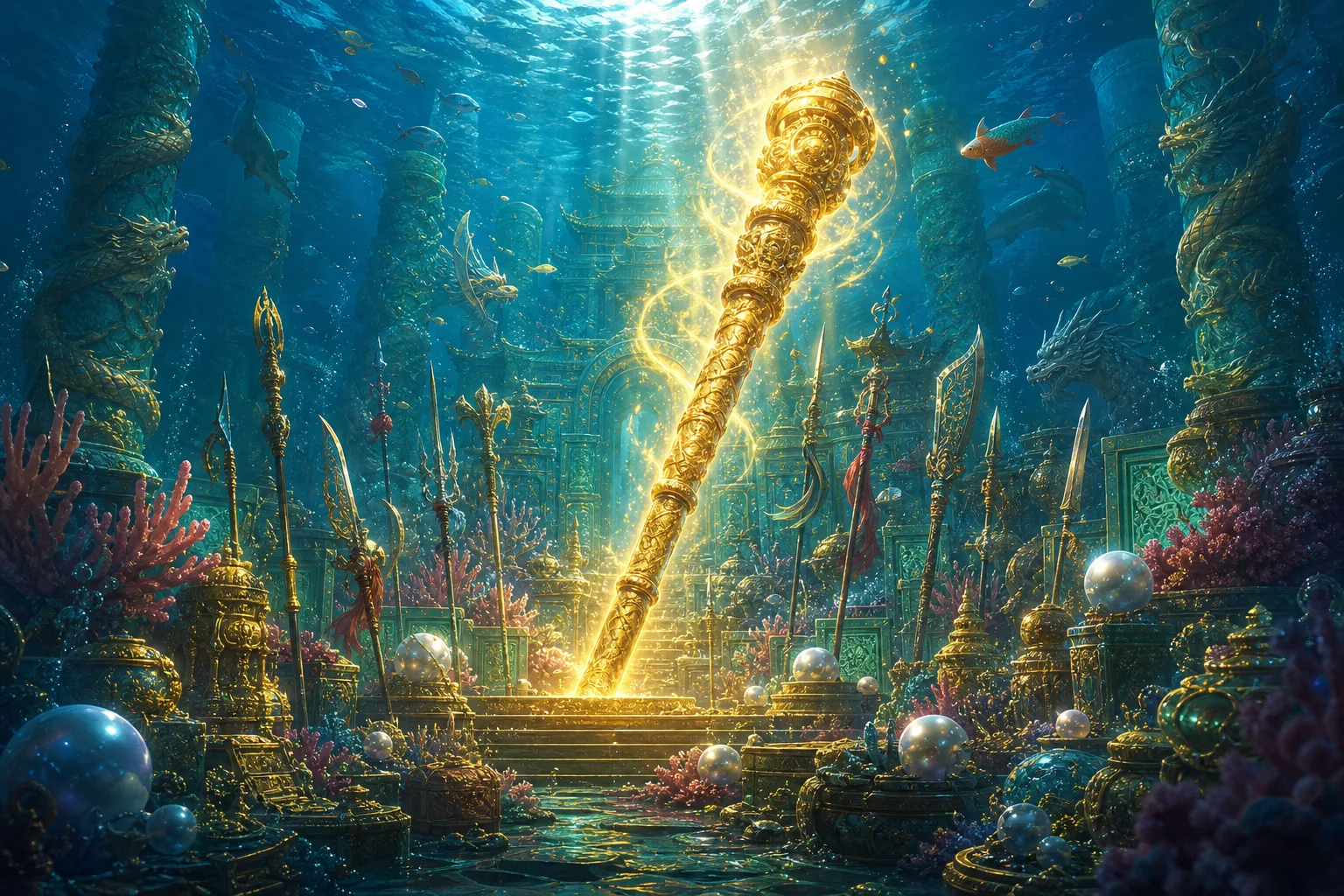
Before heaven, before the pilgrimage, Wukong visits the Dragon King of the Eastern Sea (东海龙王, Dōnghǎi Lóngwáng) looking for a weapon worthy of his power. The Dragon King offers swords and halberds; Wukong rejects them all as too light.
Then they show him a pillar of divine iron in the treasury — the Pillar that Stabilizes the Ocean (定海神针, Dìnghǎi Shénzhēn). It was forged to measure and calm the depths of the sea; when Wukong approaches, it glows. He lifts it, commands it to shrink, and tucks it behind his ear. The Dragon King, terrified, also gives him cloud-walking boots, a phoenix-wing cap, and golden chain-mail — a full set of stolen divine gear.
What makes it special
The novel gives the staff concrete properties that every adaptation inherits:
Jingu Bang rules in the novel
- → Weight: 13,500 jin (斤) — impossibly heavy for anyone except Wukong; a joke about his strength.
- → Size: Grows to fill the universe or shrinks to needle size; stored behind his ear when not in use.
- → Origin: Cosmic measuring rod — tied to the sea, the sky, and the order of the world.
- → Identity: Once claimed, only Wukong wields it properly; it is part of his body language in every fight.
For the full origin path — Subhuti, the Dragon King visit, and the road to Havoc in Heaven — see Sun Wukong: From Stone to Monkey King.
What is a divine weapon (法宝)?
In Chinese myth and in Journey to the West, a fabao (法宝) is not a generic magic sword. It is a named treasure with a specific function, often tied to a god, sage, or dragon king. Many were forged in heaven, borrowed from a bodhisattva, or refined over centuries. They have rules — and those rules drive plot.
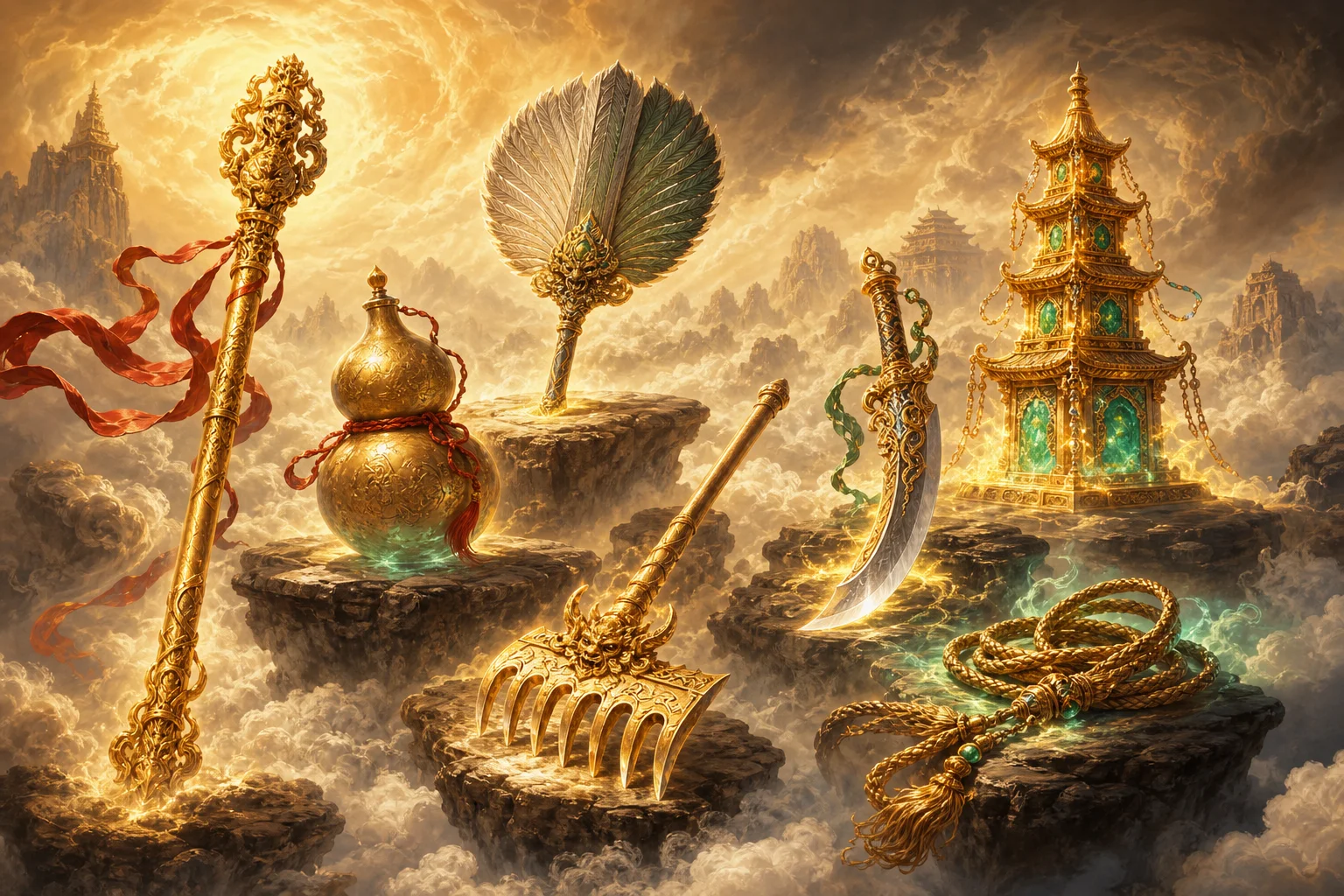
Think of fabao as artifact-as-mechanic: a gourd that traps you if you answer wrong; a fan that puts out any fire except one; a ring that catches any thrown weapon. Battles become puzzles about which treasure counters which, not just who hits harder.
Offensive
Staves & blades 棒 / 刀
Wukong's Jingu Bang, Zhu Bajie's nine-tooth rake (九齿钉耙), Sha Wujing's demon-repellent staff (降妖宝杖) — each disciple carries a signature weapon matched to their nature.
Trapping
Gourds & vessels 葫芦 / 瓶
The Golden-Horn Kings' gourds absorb enemies who speak their name; the Jade Vase catches souls. Capture mechanics centuries before video games named them.
Elemental
Fans & winds 扇 / 风
The Banana Leaf Fan (芭蕉扇) extinguishes the Flaming Mountains — but only the right fan, wielded the right way, after the right family drama.
Defensive
Armor & rings 甲 / 圈
Golden chain-mail from the Dragon King; the Tightening Fillet (紧箍) on Wukong's head — not a weapon, but a divine control device with its own cruel logic.
Famous treasures in the novel
You do not need to memorize dozens of names. These anchors cover most fan discussions and the kind of mythic items a Wukong game might echo — borrowed treasures, elemental counters, and signature disciple gear.
| Weapon / treasure | Chinese | What it does |
|---|---|---|
| Ruyi Jingu Bang | 如意金箍棒 | Wukong's staff — resize at will, cosmic weight, the icon of the legend |
| Nine-Tooth Iron Rake | 九齿钉耙 | Zhu Bajie's weapon — heavy, crude, matched to a former marshal's strength |
| Demon-Repellent Staff | 降妖宝杖 | Sha Wujing's staff — simpler than Wukong's, still a ranked divine weapon |
| Plantain / Banana Leaf Fan | 芭蕉扇 | Extinguishes the Flaming Mountains — three fans, three powers, one epic arc |
| Crucibles & gourds | 紫金葫芦 等 | Golden and Silver Horn Kings — absorb anyone who answers when called by name |
| Somersault Cloud | 筋斗云 | Not a weapon, but a fabao-class mobility tool — one flip, 108,000 li |
Borrowed treasures — why so many weapons have owners
A recurring joke in Journey to the West: the heroes beat a demon, then a bodhisattva or sage arrives and says, That was my golden-haired dog / bronze boy / escaped mount. The demon's weapon was borrowed from a higher power — which explains both its strength and its eventual recall.
The Golden Horn (金角) and Silver Horn (银角) arc is the clearest example. Their gourds, ropes, and swords are treasures lent by Lord Lao (太上老君). Wukong wins by trickery and theft as much as combat — swapping treasures, impersonating owners, and exploiting each fabao's specific rule. That is how the novel treats divine weapons: know the item, know the fight.
Staff combat in Chinese storytelling
The staff (棍 / 棒) has a long history in Chinese martial arts and folk performance — monks, wanderers, and tricksters favor it because it is a tool as much as a weapon. Wukong's Jingu Bang elevates that folk image to cosmic scale: the same object that fits in his ear can sweep armies off a cloud.
Black Myth leans into this tradition. Heavy staff animations, ground slams, and spinning combos are not generic action-game choices — they connect to centuries of Monkey King stage fighting, opera choreography, and the 1986 TV series that fixed the staff in global popular culture.
In Black Myth
Game Science put the staff at the center of the player fantasy. Transformations, stances, and spell-like abilities extend the weapon beyond a simple stick — but the silhouette remains Wukong: gold-banded rod, overwhelming reach, mythic weight. When the game names a craft material, a relic, or a boss weapon in Chinese myth terms, it is often invoking the fabao tradition — objects with lineage, not random loot tables.
Not every item maps one-to-one to a novel treasure. Treat parallels as echoes: a fan-shaped spell, a gourd-like capture mechanic, or a rake-heavy enemy may nod to the pilgrimage party or to demon kings who stole heaven's gear — without claiming a specific chapter beat.
While you play
- → Jingu Bang / 金箍棒 on screen almost always means Wukong — or someone stealing his identity.
- → Gourd, fan, ring, and pagoda motifs often signal fabao logic — special rules, not just damage numbers.
- → “Borrowed from a sage” is a classic novel pattern — powerful boss gear with a higher owner waiting offstage.
- → Look up unfamiliar terms in our glossary.
Further reading
- Sun Wukong: From Stone to Monkey King — Dragon King visit, full gear set, and the staff's first appearance.
- Havoc in Heaven (大闹天宫) — the staff in open war against the Heavenly Court.
- Anthony C. Yu, Journey to the West, vol. 1 — chapter 3 for the Dragon Palace; vol. 2 for Golden Horn treasures.