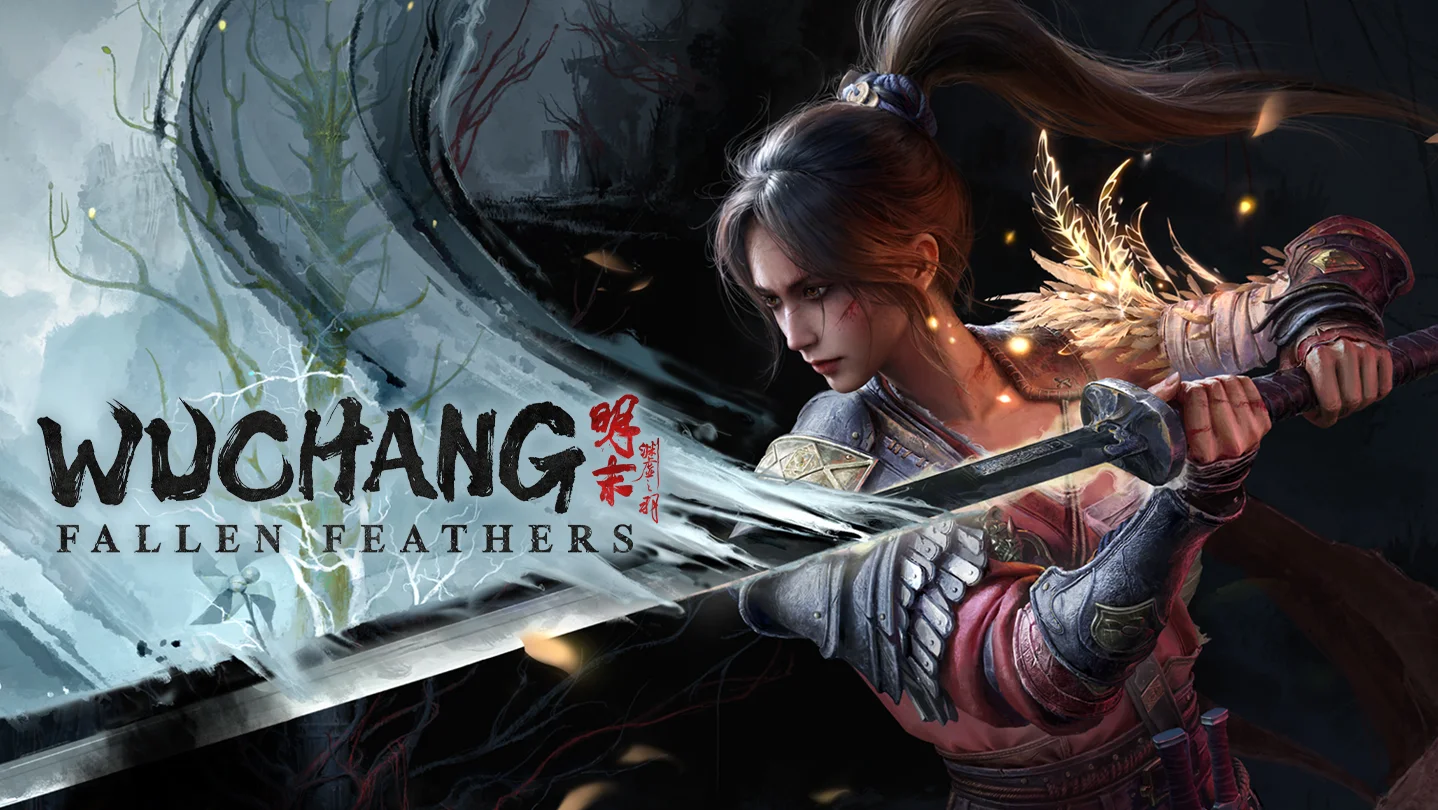
WUCHANG: Fallen Feathers asks you to hunt fragments of a god's chisel (凿子) in 1647 battlefields. That plot only makes emotional sense if you know the Shu kings (蜀王) — especially Du Yu (杜宇) and Bie Ling (鳖灵) — rulers from regional chronicles who warred over forbidden power long before Zhang Xianzhong marched into Chengdu. This article unpacks their stories as literature and folklore, then shows how the game bends them — without spoiling the main quest's final reveals.
Where these kings come from
Unlike Sanxingdui bronzes, Shu kings arrive to us primarily through text — especially the Huayang Guo Zhi (华阳国志, Huáyáng Guó Zhì, Chronicle of the States South of Mount Hua, 4th century CE) and fragments of the Shu Wang Benji (蜀王本纪, Annals of the Kings of Shu) preserved in later encyclopedias.
These works were compiled centuries after the kingdoms they describe. They mix:
- faded historical memory of Bronze Age polities in the Sichuan Basin
- origin myths for place names and crops
- moral parables about hubris, succession, and the cost of power
For Culture readers, the question is not “did Du Yu literally turn into a bird?” but “why did Chinese writers keep telling that story — and why did Leenzee build a soulslike around it?”
Key text
Huayang Guo Zhi — earliest systematic Shu regional history
Star kings
Du Yu (望帝) and Bie Ling (鳖灵) — succession, rebellion, transformation
Game hook
Broken chisel → five fragments; immortality lost → Feathering echoes
Du Yu: the emperor who taught Shu to grow
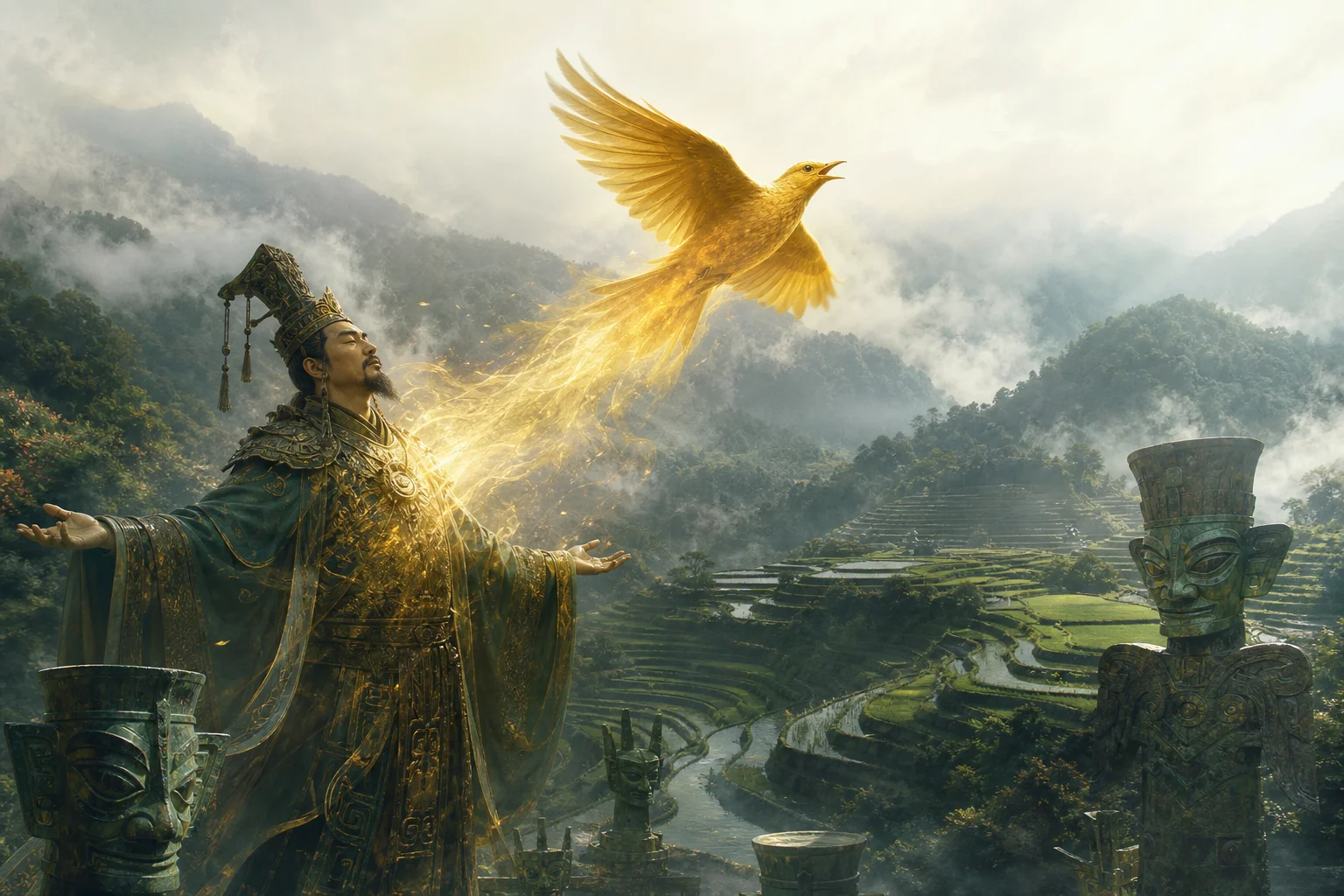
Du Yu (杜宇, Dù Yǔ) is also called Emperor Wang (望帝, Wàng Dì, “Emperor Who Looks Down / Gazing Emperor”). Chronicle tradition portrays him as a civilizing king who brought agriculture to ancient Shu — teaching people when to plow and harvest, establishing seasonal order in a land surrounded by mountains.
Origin myths vary wildly (and that variance matters):
- Some say he descended from heaven — a bird-spirit or immortal who chose to rule mortals
- Others say he was a transformed bird from the start, linking Shu kingship to avian symbolism early
- Later retellings tied to the game's broader lore describe him guiding the Bo people (僰人) to wield a divine gift — power over weather, longevity, or hidden forces
The through-line: Du Yu represents legitimate but fragile order. He gives Shu prosperity, yet the kingdom cannot keep the supernatural bargain clean. When tragedy comes, he does not die quietly — he becomes the cuckoo (杜鹃, dùjuān), crying each spring over fields he once protected. Poets call this “the cuckoo weeps blood” (子规啼血) — grief so intense it stains the bird's beak.
If you played through misty ruins hearing bird calls, you are meant to feel that literary echo. Du Yu is Shu's mourning soundtrack.
Bie Ling: the king from the river
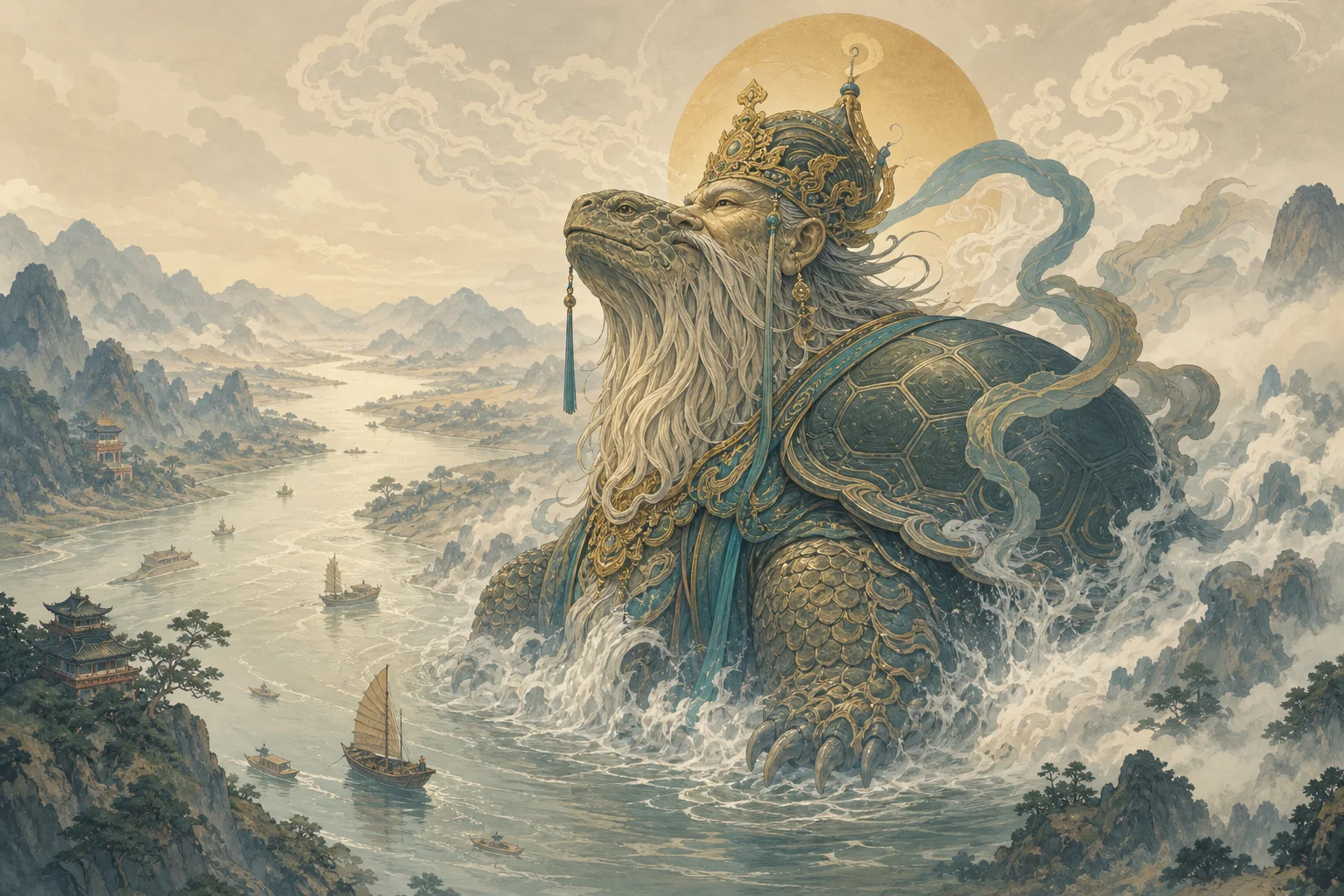
Bie Ling (鳖灵, Biē Líng) enters Shu myth as an outsider. The name contains bie (鳖) — soft-shelled turtle — and stories often show him emerging from the Yangtze gorges or being carried by river currents into Shu territory.
Chronicle plot beats (simplified across versions):
- Bie Ling arrives in Shu — sometimes as exile, spirit, or miracle survivor of drowning
- Du Yu recognizes talent and appoints him minister — or Bie Ling marries into royal line
- When flood, famine, or divine backlash strikes, factions blame the old order
- Bie Ling seizes throne; Du Yu abdicates or is overthrown
- Du Yu wanders, then transforms into the cuckoo — eternal commentator on the kingdom he lost
In game-adjacent community summaries, Bie Ling leads a rebel faction that abuses the same divine power Du Yu taught — cannibalizing kin, pursuing corrupt immortality, or refusing to renounce forbidden arts. That dramatization makes him a proto-villain for Feathering's body horror: the king who would not stop taking.
Historically on paper, Bie Ling is simply another remembered ruler in Shu's king list — not necessarily evil incarnate. Treat the game's Bie Ling echoes as selected moral reading, not the only classical interpretation.
The divine tool: chisel in myth, chisels in gameplay
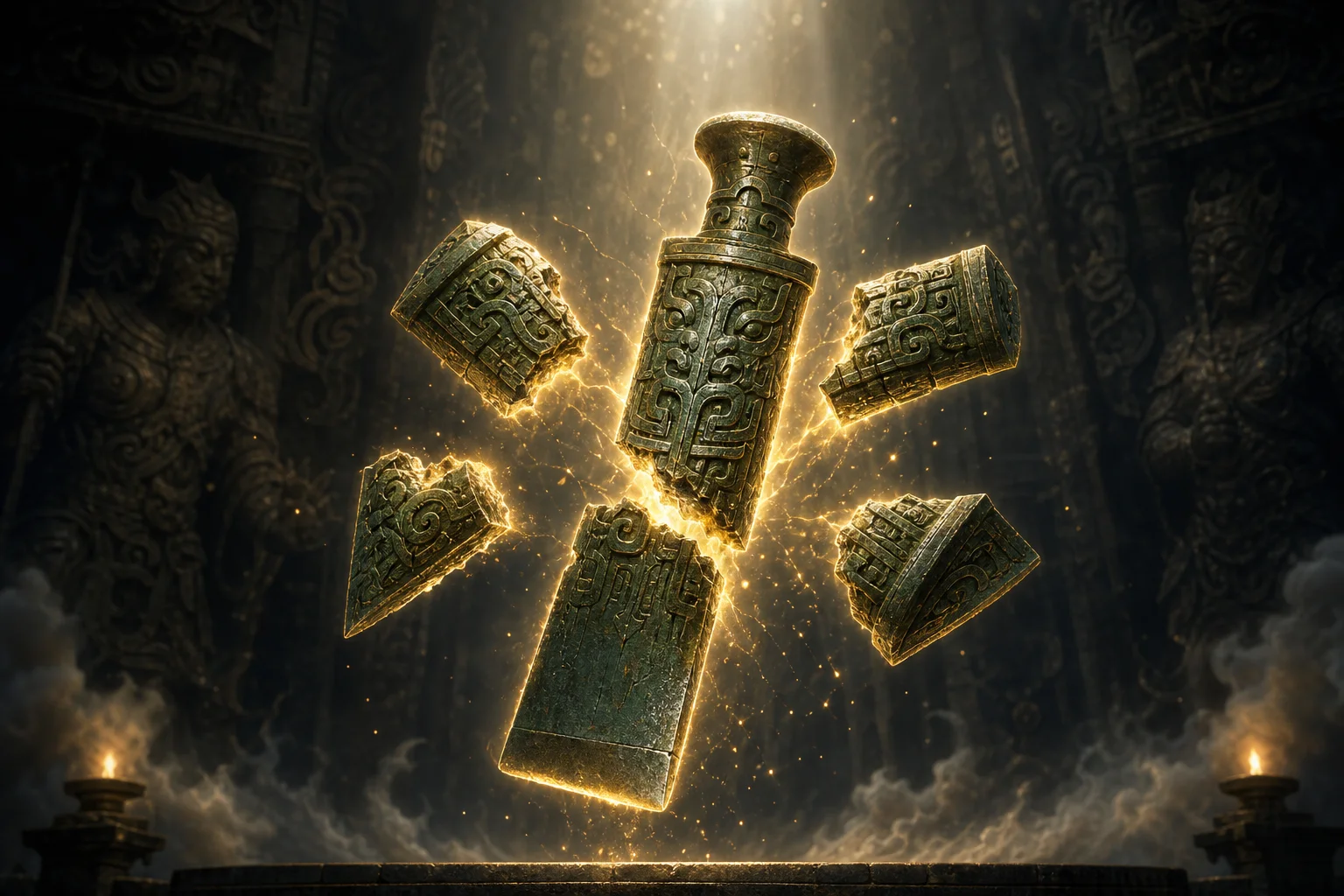
Classical chronicles do not always name a “chisel” in the Du Yu / Bie Ling arc — the záo zi motif is where Leenzee merges multiple traditions:
- ritual bronze tools and sacred implements from archaeological imagination
- the idea of a single object anchoring immortality for a people
- soulslike design need for collectible quest objects scattered across maps
Official and community-facing summaries align on a mythic sequence:
- Du Yu (or heaven) grants the Bo a miraculous instrument — the chisel — to channel divine force
- Overuse or rebellion corrupts the people; Bie Ling's faction pushes power past safe limits
- When order is restored, the chisel shatters into five fragments and immortality leaves the land
- Survivors become ordinary mortals; Shu continues as a human kingdom beneath the birds and bronzes
No ending spoilers: Who owns each fragment today, whether resurrection truly works, and how Wuchang's sister ties in — those are main-quest reveals for dedicated spoiler articles. Here we only establish that the chisel is the story's mythic USB drive — storage for power everyone in 1647 still fights over.
Other Shu kings (quick roster)
The Huayang Guo Zhi lists a longer genealogy — names like Can Cong (蚕丛, silkworm associations) appear in silk and agriculture myths. You do not need flashcards for every king to play WUCHANG, but two patterns repeat:
- Civilizing founders — teach farming, sericulture, or ritual
- Tragic successors — lose heaven's favor, leave bird or beast transformations as explanation for natural phenomena
Sanxingdui's bronze birds and Jinsha's sun-bird gold make more sense when read against this roster: archaeology gives faces; chronicles give why birds keep judging Shu.
Chronicle vs. game: a honest map
| Element | In chronicles / poetry | In WUCHANG |
|---|---|---|
| Du Yu | Agricultural king; becomes cuckoo; symbol of grief | Ancient authority whose failure still haunts Shu; bird audio motif |
| Bie Ling | River-born successor king; political turnover | Often framed as corrupt rebel using forbidden power |
| Bo people | Ancient Shu population in regional histories | Recipients of divine teaching; link to prehuman civilization layer |
| Chisel | Not always explicit in classical Du Yu texts | Central artifact; five fragments; resurrection rumors in 1647 |
| Immortality | Moral lesson — power withdrawn when abused | Inverted into Feathering plague and Red Mercury economy |
Why this myth layer sits under a late Ming game
The developers could have set another generic zombie apocalypse in Sichuan. Instead they anchored the horror in Shu's oldest guilt: a kingdom that once touched godhood and broke the tool that kept it safe. Late Ming warlords in 1647 scramble for chisel shards for the same reason tomb raiders scramble for gold — they believe the past still controls the future.
Wuchang's personal story (see Wuchang: Pirate Warrior, Amnesia & the Name) runs parallel: she lost a sister, lost memory, lost bodily integrity to Feathering — three kinds of impermanence echoing Du Yu's lost throne.
While you explore: what to notice
- Cuckoo calls near ruins → Du Yu grief motif, not ambient filler
- Turtle or river imagery → possible Bie Ling faction coding
- Five collectible macguffins → direct lift from shattered chisel myth structure
- Bo / ancient tribe names → deep-time civilization beneath Ming corpses
For archaeological visuals without re-reading the primer, bookmark Ancient Shu & the Feather People Legend. For the human warlords scratching at the same shards, continue to the next article on Zhang Xianzhong and 1647 factions.
Next in this series: Warlords & Factions — Zhang Xianzhong, Southern Ming remnants, and why everyone converges on Shu.