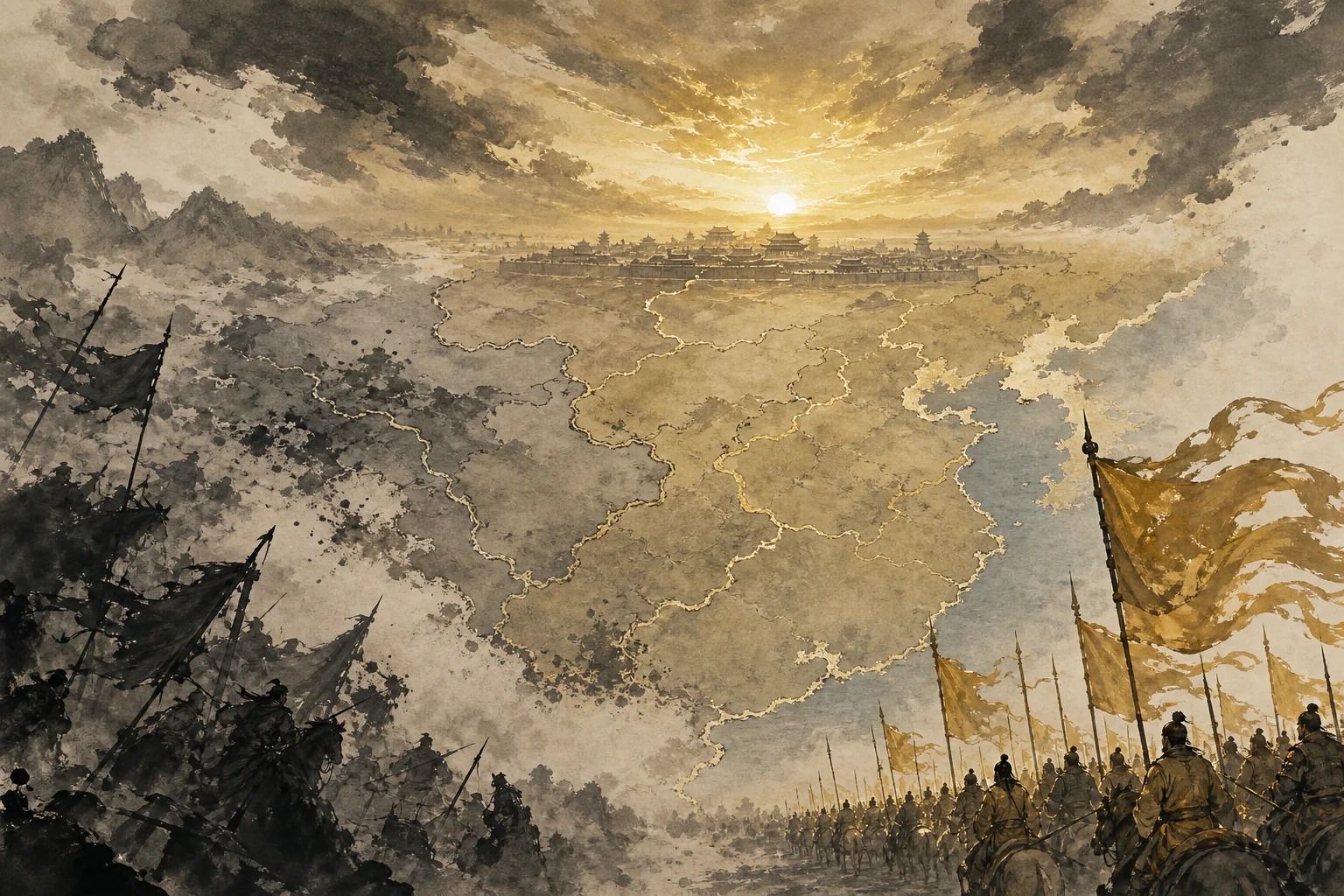
Where Winds Meet lives in the fracture — the Five Dynasties and Ten Kingdoms (~907–960) — but its English title points at what comes next: winds converging before a new order. In history, that convergence is the Song dynasty (宋朝, Sòng cháo), founded in 960 when general Zhao Kuangyin (赵匡胤) seized power and spent the next two decades knitting the map back together. This article closes Module B with the reunification arc: how the chaos ends (mostly), what stays broken (Yan Yun), and why the game's horizon matters even when your wanderer never sits on a throne.
The ending everyone feels coming
Fifty-three years is short for a dynasty but long for the people inside it. Between Tang's fall and Song's rise, northern regimes swapped every decade, southern kingdoms fought trade wars and border skirmishes, and the Yan Yun north stayed lost. By the 950s, exhaustion itself became a political force — elites wanted stability more than another charismatic warlord.
Problem
Constant coups, fragmented tax systems, frontier crises — see our timeline primer
Answer (960+)
A new dynasty that prioritizes central control and gradual conquest over instant universal empire
Game echo
Factions and wanderers in a world that sense reunification coming — even if the calendar never prints “Year 1 of Song” on screen
960: Zhao Kuangyin and the Chen Bridge story
The founding myth every Chinese student hears is the Chen Bridge mutiny (陈桥兵变, Chénqiáo Bīngbiàn) of 960. Zhao Kuangyin, a Later Zhou general commanding troops near Chen Bridge post, is proclaimed emperor by his soldiers — yellow imperial robes appear (in legend, almost by accident), and the Later Zhou child emperor is eased aside. Historians debate details; the cultural memory is clear: the man who reunifies China did not arrive as a distant philosopher-king but as a soldier the army chose.
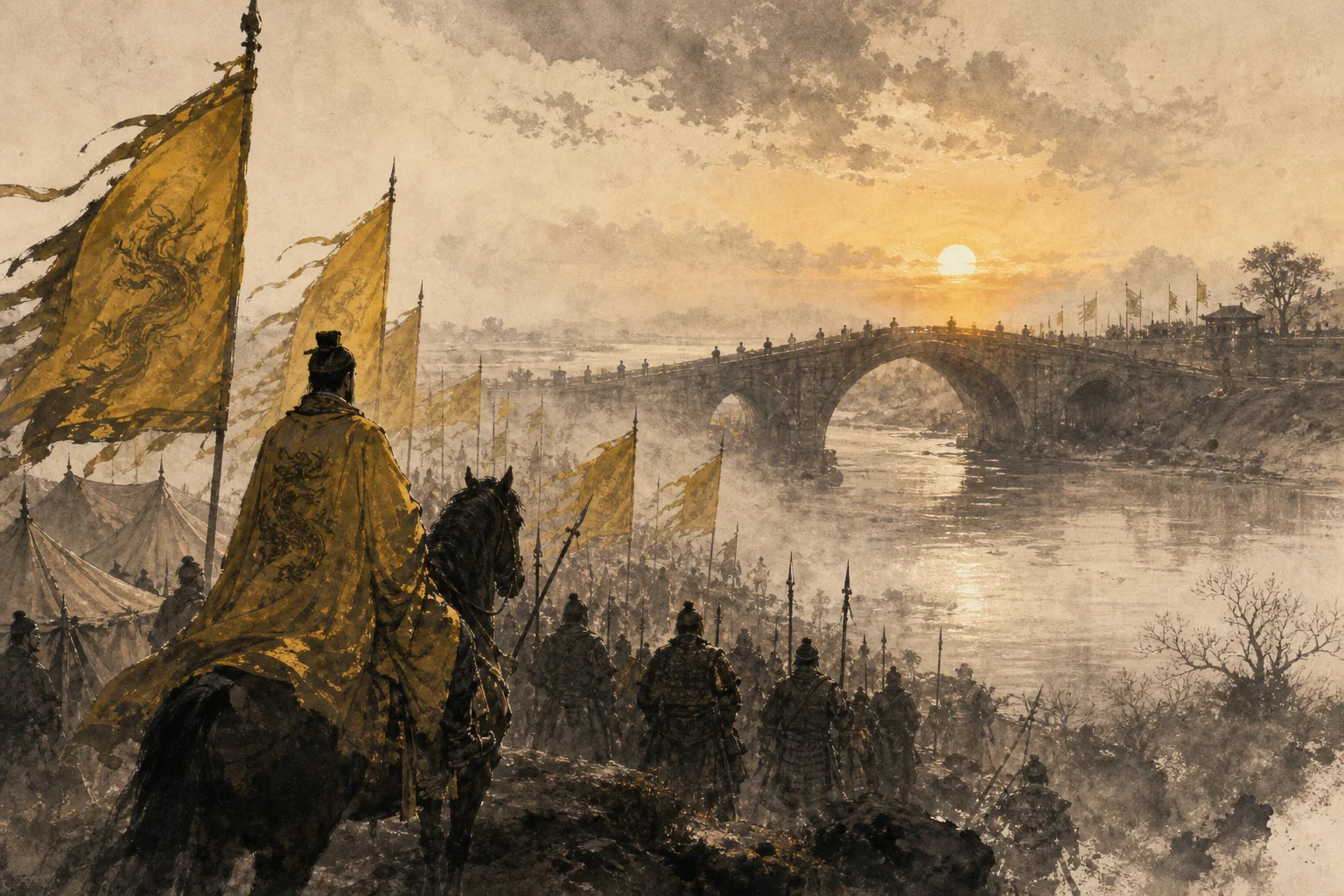
Zhao took the temple name Taizu (太祖) and the throne name Emperor Taizu of Song. His first capital continued the Kaifeng tradition — the city you explore in-game is the same geographic star about to enter its most famous chapter as Bianjing (汴京). Read our Kaifeng article for the urban layer.
Reunification by steps, not one sword stroke
Song did not conquer everything in 960. Taizu and his successors picked off rival states over years:
| Phase | What happened | Why it matters |
|---|---|---|
| 960s | Song secures the north-central core; reduces military governors' independence | Ends the Five Dynasties roulette — no more annual dynasty swaps in the north |
| 970s | Campaigns against southern kingdoms (Former Shu, Southern Han, etc.) | Southern wealth and rice economies fold into one tax system |
| 978 | Southern Tang falls — among the last major southern states | Cultural elites of the south enter Song orbit; poetry and painting networks unify |
| 979+ | Northern Han (北汉) defeated under Taizu's brother Zhao Guangyi (Emperor Taizong 太宗) | Closes most of the “Ten Kingdoms” board — except what Liao still holds |
The method mattered: Song court preferred diplomacy, bribery, and limited wars over endless total slaughter — a reaction to the very chaos the game dramatizes. For a youxia in the jianghu, reunification can mean fewer private armies — or new kinds of outlaw when central law finally reaches your valley.
What reunification did not fix: Yan Yun
The Song achievement was real — most of Han China under one bureaucracy again — but the map had a missing tooth. The Sixteen Prefectures remained under Liao control, ceded back in 936. Song armies tried; they failed to recover Yan Yun in the eleventh century's famous campaigns. That unfinished business haunted politics for centuries — and it is why the game's Chinese title keeps saying Yanyun.
Deep dive: Yan Yun & the Sixteen Prefectures. Reunification is therefore bittersweet in cultural memory: unity returned, wound remained.
Where Winds Meet metaphor: English title Where Winds Meet — many winds (factions, philosophies, wanderers) colliding before convergence. Song is the historical convergence; Yan Yun is the storm that never fully clears.
Song as cultural payoff — why the game teases it
Everstone compresses visual history so Kaifeng can feel Song-bustling while the calendar still says Five Dynasties. That is because players worldwide recognize the payoff:
- Economic revolution — paper money experiments, canal trade, urban craft specialization
- Art and literature — the Northern Song golden age that produced scrolls like Qingming
- Civil governance ideal — scholar-official exams expanded (later Song), less raw warlord rule
- Jianghu fiction backdrop — many wuxia novels are set in Song-ish worlds even when they cite earlier dynasties
Your game is not simulating 978 AD turn-by-turn. It is letting you wander in the emotional prequel — the storm before the winds align.
Module B recap — four lenses on one map
B1
Yan Yun
The northern wound reunification cannot heal in one lifetime.
B2
Kaifeng
The capital that will become Song Bianjing — already rich, already cracked.
B3
Qinghe & Hexi
Legend and poetry outside the canal machine — where the map breathes.
B4
Song reunification
The horizon line — order returns, scars stay.
Where to go next on this hub
- Jianghu & youxia — how social worlds change when empires stabilize
- History vs fiction living doc — boundaries as patches add regions
- Glossary — Song, Taizu, Five Dynasties
Further reading (English)
- Britannica: Song dynasty, Zhao Kuangyin
- The Cambridge History of China, Vol. 5 — Song founding and early reunification wars
- Compare with our reading list for wuxia novels set in post-unification worlds
Dragon Forge Culture is editorial — not affiliated with NetEase or Everstone Studio. Dates follow standard Song-period historiography.