

Between Archon quests and adeptus legends, Liyue keeps running on ordinary trades: a bowl of noodles at Wanmin Restaurant, a prescription from Bubu Pharmacy, a funeral notice posted near the harbor stairs. This article looks at the daily-life layer — how food, medicine, and mortality services make the harbor feel like a place people live in, and what those details echo in real Chinese city culture.
No spoilers
Describes locations and trades visible from early exploration. For Hu Tao's funeral customs in depth, see our opera, exorcism & funeral article.
Why daily life matters in a fantasy nation
Genshin could have made Liyue only jade pavilions and god battles. Instead, HoYoverse fills the harbor with specialist trades — the same way real Chinese cities historically mixed temples, markets, medicine halls, and ritual professionals on one street. When you notice Wanmin's wok smoke beside Wangsheng's plum-blossom ads, you are seeing a design choice: myth stays grounded because someone still has to cook dinner and fill a prescription.
Food
Wanmin Restaurant — regional cuisine as neighborhood identity
Medicine
Bubu Pharmacy — herbal doctors and TCM trade logic
Mortality
Wangsheng Funeral Parlor — death rites as a public service
Wanmin Restaurant and harbor cuisine
Wanmin Restaurant (万民堂, Wànmín Táng) — "Hall of Ten Thousand People" — sits on Feiyun Slope, the harbor's everyday market layer. Chef Xiangling (香菱) experiments with Liyue ingredients and Mondstadt imports, turning the restaurant into a symbol of how trade ports absorb foreign goods while keeping local flavor.
Chinese food culture is intensely regional. A harbor city in real history would serve Cantonese seafood, Jiangnan sweetness, Sichuan heat, and northern wheat noodles — not one generic "Chinese menu." Wanmin captures that variety in game form:
- Black-back perch stew and other fish dishes — coastal Liyue's river-and-sea bounty
- Jueyun chili chicken — mountain spice tied to adeptus-named ingredients
- Imported flour and cheese — Mondstadt trade items remixed into Liyue recipes (game fiction, but historically ports did exactly this)
- Adventurer commissions — bulletin-board requests that treat cooking as skilled labor, not background decoration

Xiangling's father Chef Mao (卯师傅) represents the older generation of craft cooks — apprenticeship, family recipe, and reputation. That parent–child kitchen dynamic mirrors real restaurant lineages in Chinese food cities.
Baizhu, Bubu Pharmacy, and traditional medicine
Up the slope from the woks sits Bubu Pharmacy (不卜庐, Bùbǔ Lú) — a name suggesting divination or foreknowledge, run by the herbal doctor Baizhu (白术). His personal name is literally atractylodes, a herb used in classical formulas — the same pattern as Liyue characters named after stars, stones, or auspicious beasts.
Baizhu embodies traditional Chinese medicine (中医) as a living trade, not a museum exhibit:
- Herbal formulas — dried roots, leaves, and minerals compounded for balance, not single-symptom pills
- Diagnosis by observation — pulse, tongue, complexion; the game simplifies this into character charm and quest hooks
- Preventive care — tonics for fatigue, seasonal teas, dietary advice tied to harbor humidity and traveler strain
- Ethics of healing — Baizhu's gentle manner and reluctance to profit from suffering echo real physician ideals in Chinese medical texts
His companion Changsheng (长生) — a white snake who speaks — adds folklore flavor. Snakes appear in Chinese medicine mythology (e.g., snake wine in folk practice) and in immortal tales; the pairing reads as "doctor with a familiar," not documentary TCM.
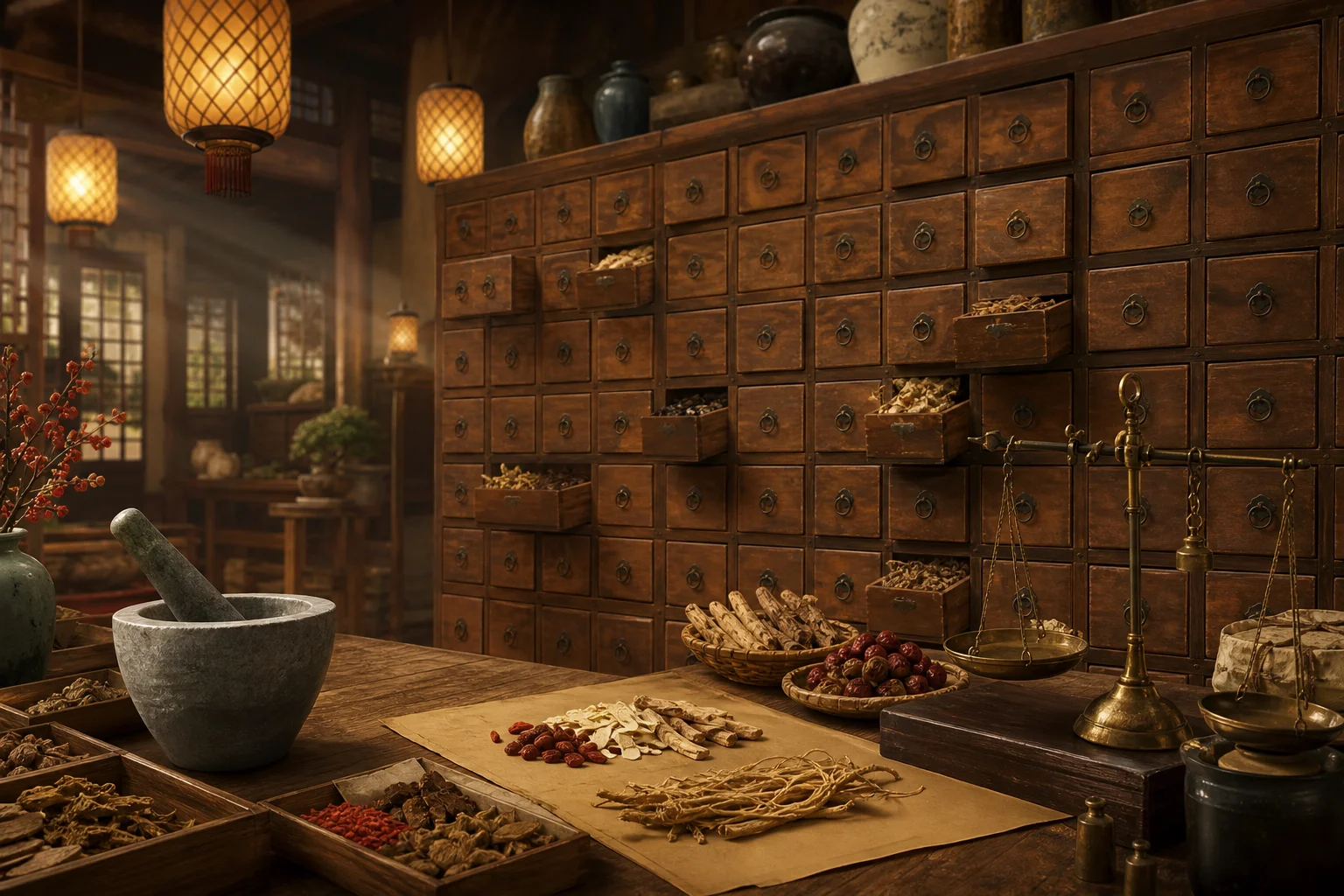
Baizhu also links Liyue Harbor to Chenyu Vale through herb lore — Fujin's adeptus past and southern tea hills supply the materia medica that pharmacies like Bubu refine for city patients. See Chenyu Vale, Tea Culture & Southern China for that countryside connection.
Wangsheng in the neighborhood
Wangsheng Funeral Parlor (往生堂) shares the harbor with restaurants and clinics — not exiled to a distant graveyard. In real Chinese communities, funeral directors, incense sellers, and paper-offering shops often sat on ordinary commercial streets; death was a managed transition, not a taboo zone hidden from sight.
Director Hu Tao (胡桃) markets with playful slogans; consultant Zhongli (钟离) knows every antique and contract clause. We cover funeral rites, processions, and exorcism contrasts in Yun Jin, Hu Tao & Chongyun: Opera, Exorcism & Funeral Customs. Here, the point is simpler: Wangsheng is infrastructure — like Bubu for the sick and Wanmin for the hungry.
When Rex Lapis's Rite of Descension disrupts the harbor, Wangsheng is among the institutions that keep public order. You do not need the full story outcome to notice that Liyue treats funerals with the same bureaucratic seriousness as trade contracts.
Other textures of harbor life
Daily Liyue is more than three shops. Notice these recurring layers while you explore:
| In-game element | Cultural echo |
|---|---|
| Adventurers' Guild board | Public job postings — the harbor runs on commissioned labor like real market towns |
| Millelith guards | Standing army / city watch — Liyue security as visible street presence |
| Northland Bank & shops | Foreign capital and imported goods in a treaty-port economy |
| Tea houses and street vendors | Social third spaces — gossip, rest, light commerce between major quests |
| Contracts for everything | Written agreements for trade, adeptus pacts, and even Zhongli's lunch debts — exaggeration of Chinese emphasis on documented obligation |
| Qiqi at Bubu | Zombie child apprenticed to herb gathering — folklore about restless dead given a gentle, domestic twist |
Players who enjoy "jianghu" — the rivers-and-lakes world of martial arts novels — may recognize Feiyun Slope as Liyue's 市井 (shìjǐng), the bustling street-level society where heroes eat before they fight. Our Bustling World culture hub explores that literary tradition in another game; Liyue borrows the mood without copying one novel.
Food, medicine, and funeral: one street logic
| Trade | Question it answers | Real-world parallel |
|---|---|---|
| Wanmin (food) | How do we sustain the living today? | Family restaurants, regional cuisine, harbor imports |
| Bubu (medicine) | How do we restore balance when the body fails? | TCM clinics, herbal halls, physician ethics |
| Wangsheng (funeral) | How do we send the dead onward and comfort survivors? | Funeral directors, offerings, community rites |
All three are care trades — specialists the community hires because everyday families cannot handle every crisis alone. Liyue's Geo theme of contracts even extends here: implied agreements between doctor and patient, chef and regular, parlor and bereaved family.
What the game freely invents
- Recipe names tied to adeptus geography — Jueyun chili is flavor fiction with real spice-culture logic
- Talking snake assistant — Changsheng is character charm, not clinical practice
- Qiqi's zombie apprenticeship — folklore motif played for gentle comedy
- Hu Tao's marketing songs — anime exaggeration of funeral-director professionalism
For the general line between documented tradition and Teyvat fiction, see How Genshin Blends Myth, History & Fantasy.
Quick term reference
| English | Chinese | Meaning hint |
|---|---|---|
| Wanmin Restaurant | 万民堂 | Hall of ten thousand people |
| Bubu Pharmacy | 不卜庐 | Pharmacy of divination / foreknowledge |
| Baizhu | 白术 | Herbal doctor; atractylodes plant |
| Changsheng | 长生 | Long life — snake companion's name |
| Wangsheng Funeral Parlor | 往生堂 | Hall of passage to the next life |
| Feiyun Slope | 飞云坡 | Cloud-flying slope — harbor market layer |
| TCM | 中医 | Traditional Chinese medicine |
| Shijing / market street | 市井 | Street-level urban life; jianghu backdrop |
That completes the everyday layer of Places, Festivals & Liyue Lore for Phase 2. Deeper Archon War history waits in The Archon War in Liyue: Myth Meets Fantasy (major spoilers), or browse the full Liyue glossary while you play.