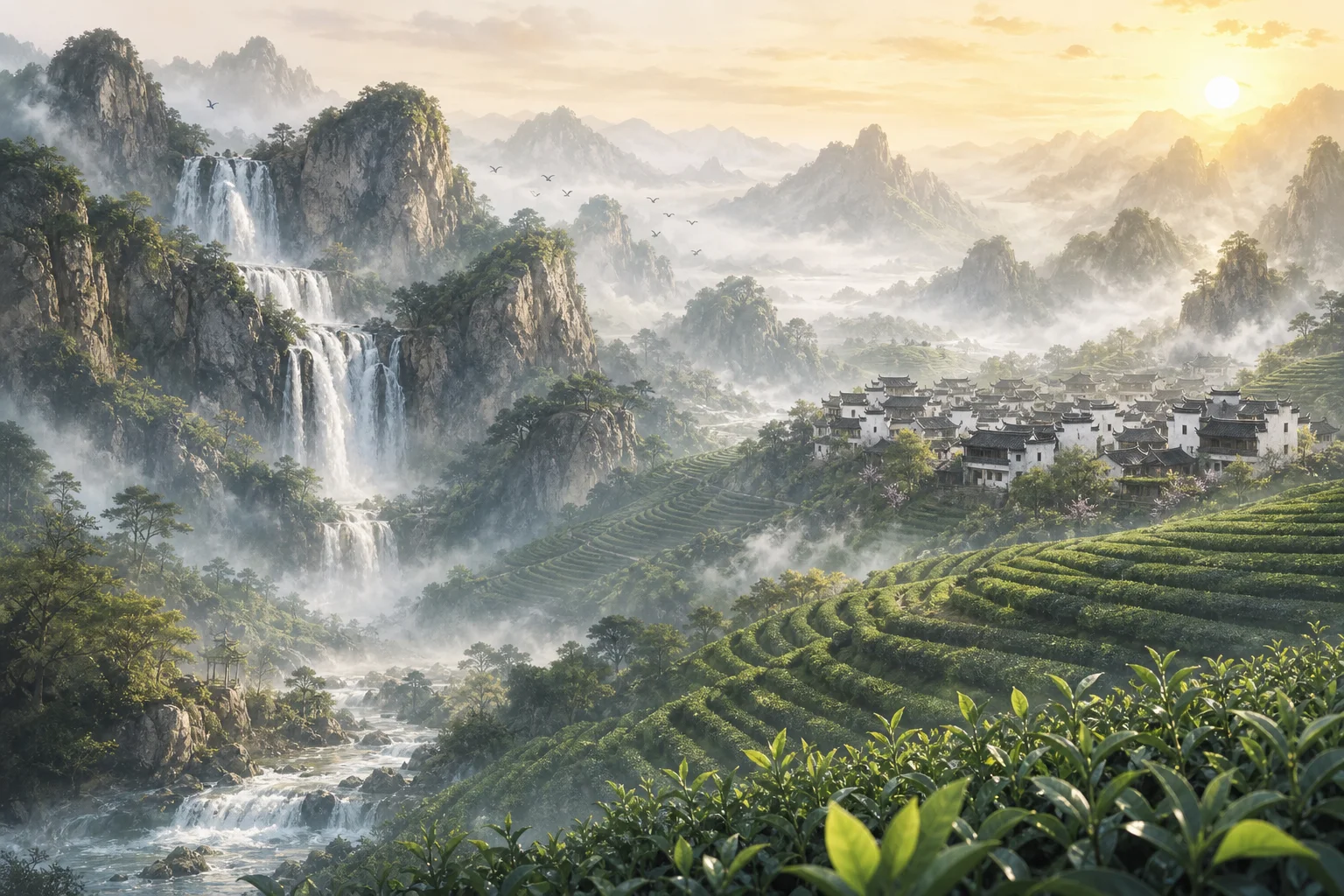
When Version 4.4 opened Chenyu Vale, Liyue gained a second cultural register. Where the harbor stacks merchant guilds and jade pavilions, the vale offers tea fields, canal-side villages, and white-walled houses with black-tiled eaves — the countryside side of Chinese tradition that many players recognize from travel photos of Anhui or Jiangnan. This article explains what Chenyu Vale echoes in real culture, how tea and jade shape its stories, and where game lore takes over.
Living document
Chenyu Vale is a live-service expansion. New quests, characters, and festivals may add detail. We update this page when major additions clearly draw on new cultural material.
Light spoilers
Mentions Fujin and the tea-tree origin, Xianyun's connection to Cloud Retainer, and regional quest themes. No full Archon Quest or character story walkthroughs.
What is Chenyu Vale?
Chenyu Vale (沉玉谷, Chényù Gǔ) — literally "Sunken Jade Valley" — is a subregion northwest of Liyue Harbor, added in Version 4.4. HoYoverse describes it as mist-shrouded hills, waterfalls, flourishing villages, and adeptus legends — a deliberate shift from the vertical merchant city toward rural southern China aesthetics.
If Liyue Harbor cites Tang–Song maritime trade, Chenyu Vale cites the tea hills and canal towns south of the Yangtze — especially the rolling terraces and Hui-style architecture associated with Anhui and broader Jiangnan (江南) culture.
In-game role
Liyue's tea heartland; adeptus-touched origin story for Teyvat tea
Key settlements
Qiaoying Village (tea), Yilong Wharf (trade west toward Fontaine)
Real-world echo
Southern tea provinces, Hui villages, jade folk ritual, shanshui landscape
Qiaoying Village: tea terraces and Hui-style houses
Qiaoying Village (翘英庄, Qiàoyīng Zhuāng) is Chenyu's tea center. In lore, adeptus-taught cultivation methods made the village famous; in visual design, it reads as a hillside water town — streams wrapping low buildings, ponds of hibiscus, and tea fragrance carried on the wind.
The architecture differs sharply from Liyue Harbor's stacked guild halls. Qiaoying uses Hui-style (徽派) cues familiar from Anhui:
- White walls, black tiles — high-contrast village palette against green hills
- Horse-head walls (马头墙) — stepped gable tops that rise like a row of silhouettes along a lane
- Build-to-terrain layout — houses follow streams and slopes instead of a flat grid
- Tea fields on the back hills — terrace agriculture visible from the village, the way real tea counties market themselves
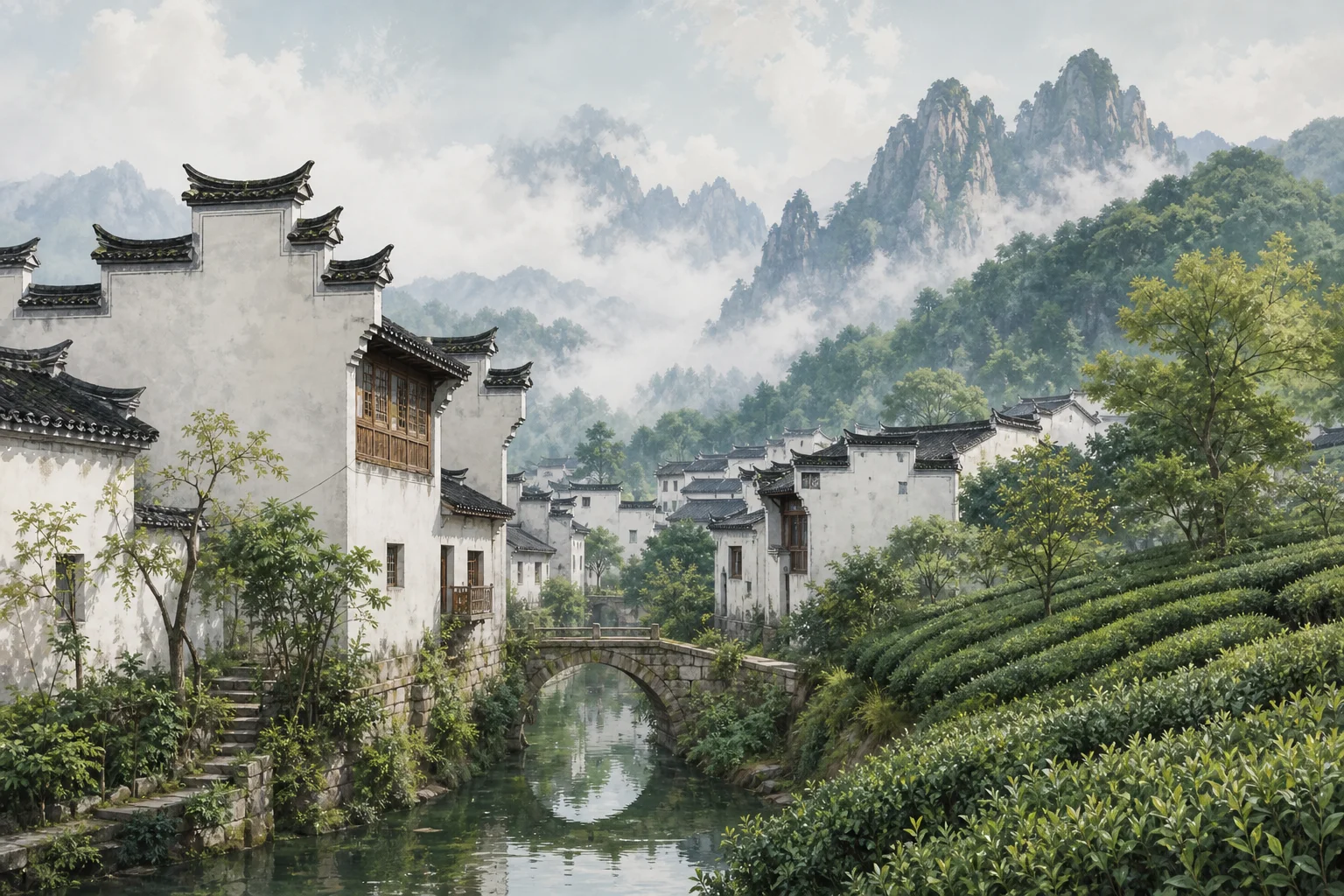
Real-world commentators often compare Qiaoying to villages around Huangshan (黄山) in Anhui — both for landscape mood and because Anhui is one of China's historic tea provinces (Keemun, Huangshan Maofeng, and others). Genshin compresses several southern regions into one vale; the point is aesthetic recognition, not a labeled map of Anhui.
Tea culture: from Fujin's tree to harbor cups
Chenyu Vale is where Teyvat's tea culture is anchored. World lore credits the adeptus Fujin (药君, Herblord) with planting the first tea tree, teaching early settlers ritual and cultivation after they fled the catastrophe that opened the Chasm. A jade ornament tied to the sapling — and later grafting across the river — becomes the mythic origin of a tea strain that supposedly grows best only in Chenyu, "because it remembers the promise between two friends."
That story layers three real Chinese ideas:
| Real tradition | How Chenyu uses it |
|---|---|
| Named origin myths — famous teas tied to a monk, emperor, or legend | Fujin's sapling and the jade-tied promise |
| Terroir (风土) — tea flavor tied to one valley's soil and climate | Tea "only grows well in Chenyu Vale" |
| Tea as social glue — hospitality, trade, poetry, medicine | Harbor merchants drink Qiaoying leaves; Zhongli buys tea in the city |
| Imperial tribute tea — prized leaves sent upward as tax or gift | Liyue wealth flows through tea alongside jade and porcelain |
In daily Chinese life, tea is never just a beverage. It marks greeting guests, closing business talk, meditating before exams, and pairing with mooncakes at Mid-Autumn. Liyue already showed tea at festivals; Chenyu shows the agriculture and craft behind the cup.
Jade, rivers, and southern prestige goods
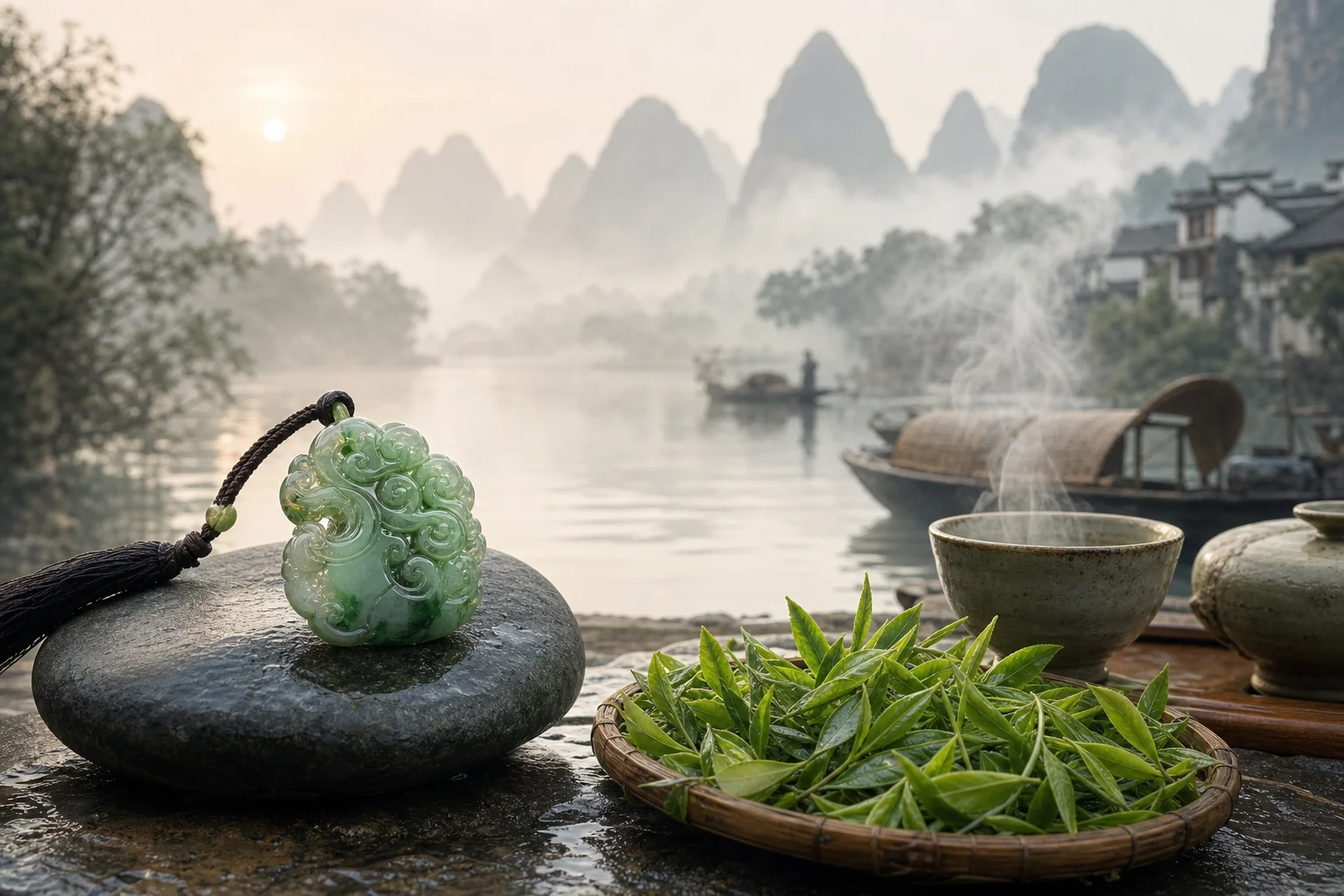
The vale's name joins jade (玉) and sunken valley imagery. Players cast jade ornaments into rivers as part of local custom — a fiction that still echoes how Chinese culture treats jade as ritual object, not mere jewelry. From Neolithic Liangzhu culture to modern gift-giving, jade carries blessings, status, and memory.
Southern and southwestern China — especially Yunnan and Guizhou in real geography — are also associated with jade processing and mountain trade routes. Chenyu blends that prestige-good logic with tea, the way historical Liyue trade lists ran silk, tea, porcelain, and salt together.
Yilong Wharf: tea country meets the world
West of the tea villages lies Yilong Wharf (遗珑埠) — a trading nexus connecting Liyue to Fontaine. Its water-powered elevator is fantasy engineering, but the function is historical: interior tea and jade counties still needed river ports to reach coastal merchants and foreign buyers.
Chenyu thus completes a geographic story inside Liyue:
- Harbor — global contracts and Qixing politics
- Vale — agricultural production and adeptus-origin myth
- Wharf — export corridor toward other nations
Adepti, carp, and mountain folklore
Chenyu is still Liyue, so immortals remain part of the landscape. Besides Fujin, the region connects to Xianyun (闲云) — Cloud Retainer's human guise — and mountain domains like Chiwang Terrace. The vale's exploration gimmicks (transforming into a carp to reach cliffside paths, mist-shrouded peaks tinted like shanshui painting) extend the sacred mountain + water grammar from Jueyun Karst into tea country.
The boss Solitary Suanni (狻猊) draws on a classical lion-like beast from Chinese myth — fitting for a region that also celebrates lion-dance culture through characters like Gaming (嘉明), a youth from the area who practices martial arts and festival lion performance. Lion dance (舞狮) is a live southern Chinese folk art tied to New Year and community pride — another way Chenyu signals "south of the harbor," not generic fantasy village.
Harbor Liyue vs. Chenyu Vale
| Liyue Harbor | Chenyu Vale | |
|---|---|---|
| Landscape | Vertical port, open bay | Terraced hills, waterfalls, river mist |
| Architecture | Merchant guild stacks, jade terraces | Hui-style white walls, canal-side lanes |
| Economy | Mora, contracts, diplomacy | Tea cultivation, jade ritual, export wharf |
| Cultural tone | Tang–Song maritime city | Jiangnan / Anhui countryside |
| Real echo | Quanzhou, Guangzhou, canal ports | Tea counties, Huangshan scenery, southern folk arts |
What is documented tradition vs. game fiction?
- Documented — Tea terroir, Hui architecture types, lion dance, jade ritual prestige, southern shanshui aesthetics
- Mythic motif — Adeptus planting sacred trees, beast bosses from classical bestiaries, carp-as-spirit shortcuts
- Game fiction — Fujin's exact backstory beats, Fontaine elevator logistics, Xianyun's wardrobe, Vision mechanics
For the general blending philosophy, see How Genshin Blends Myth, History & Fantasy.
Exploration tips for culture-minded travelers
- Compare rooflines — Notice horse-head walls in Qiaoying vs. harbor eaves; HoYoverse uses architecture to signal region
- Follow the tea quest chain — World quests explain why the harbor cares about leaves from this valley
- Visit Yilong at different times of day — Mist and water lighting mimic Jiangnan travel photography
- Pair with Lantern Rite — Spring festival content often debuts alongside Chenyu; see Lantern Rite, Moonchase & Liyue Festivals
- Watch for Baizhu links — Medicine and herb lore connect Chenyu's adeptus past to Liyue's living healers (more in our upcoming daily-life article)
Quick place-name reference
| Place / term | Chinese | Meaning hint |
|---|---|---|
| Chenyu Vale | 沉玉谷 | Sunken Jade Valley |
| Qiaoying Village | 翘英庄 | Tea village; "raised excellence" mood |
| Yilong Wharf | 遗珑埠 | Legacy jade wharf |
| Fujin (Herblord) | 药君 | Herb / medicine lord adeptus |
| Hui-style architecture | 徽派建筑 | Anhui white-wall black-tile tradition |
| Jiangnan | 江南 | Region south of the Yangtze; canal-town culture |
| Lion dance | 舞狮 | Festival performance art; Gaming's cultural anchor |
Continue with everyday Liyue trades in Wangsheng, Baizhu & Daily Life in Liyue, or revisit the harbor–mountain overview in Liyue Harbor & Chinese Landscapes.