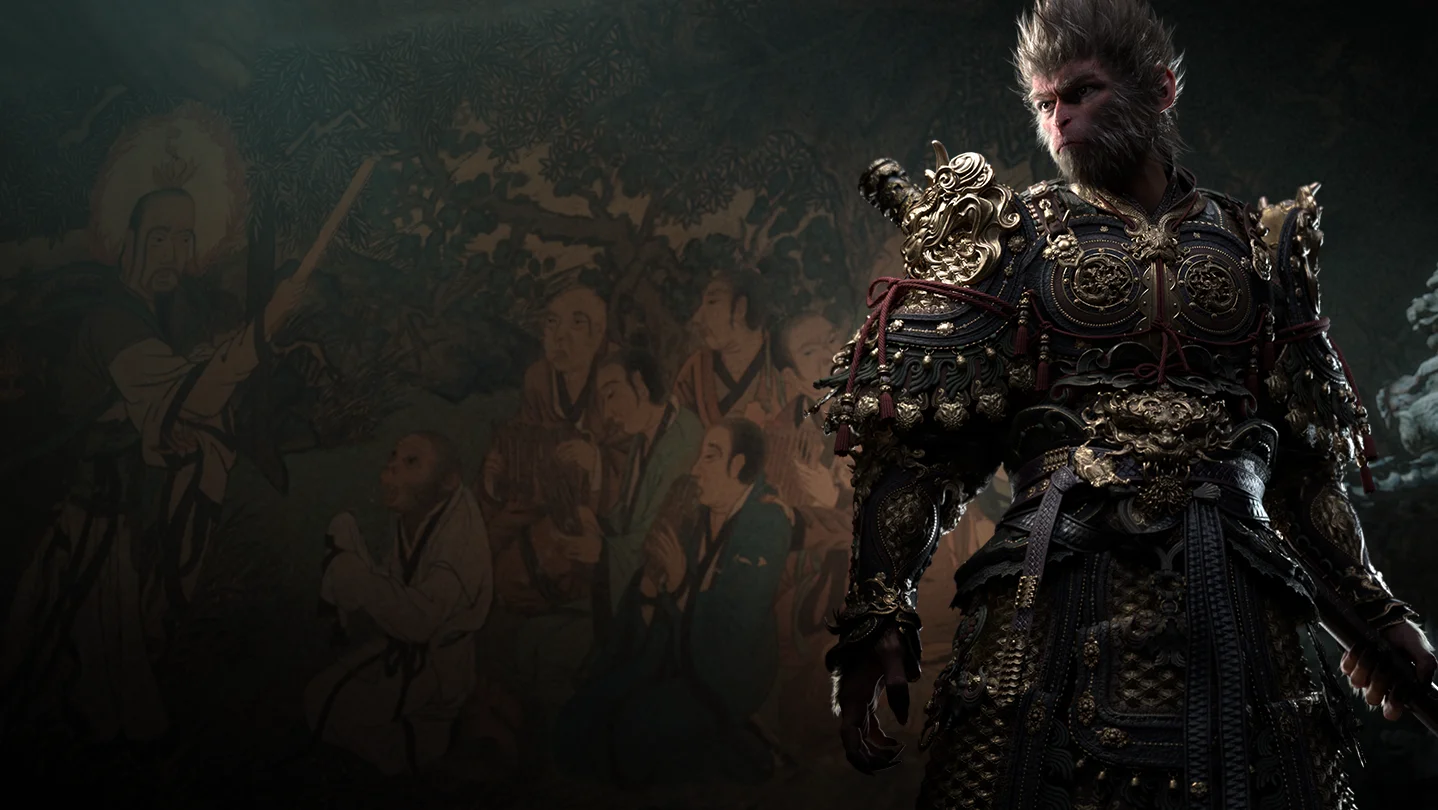
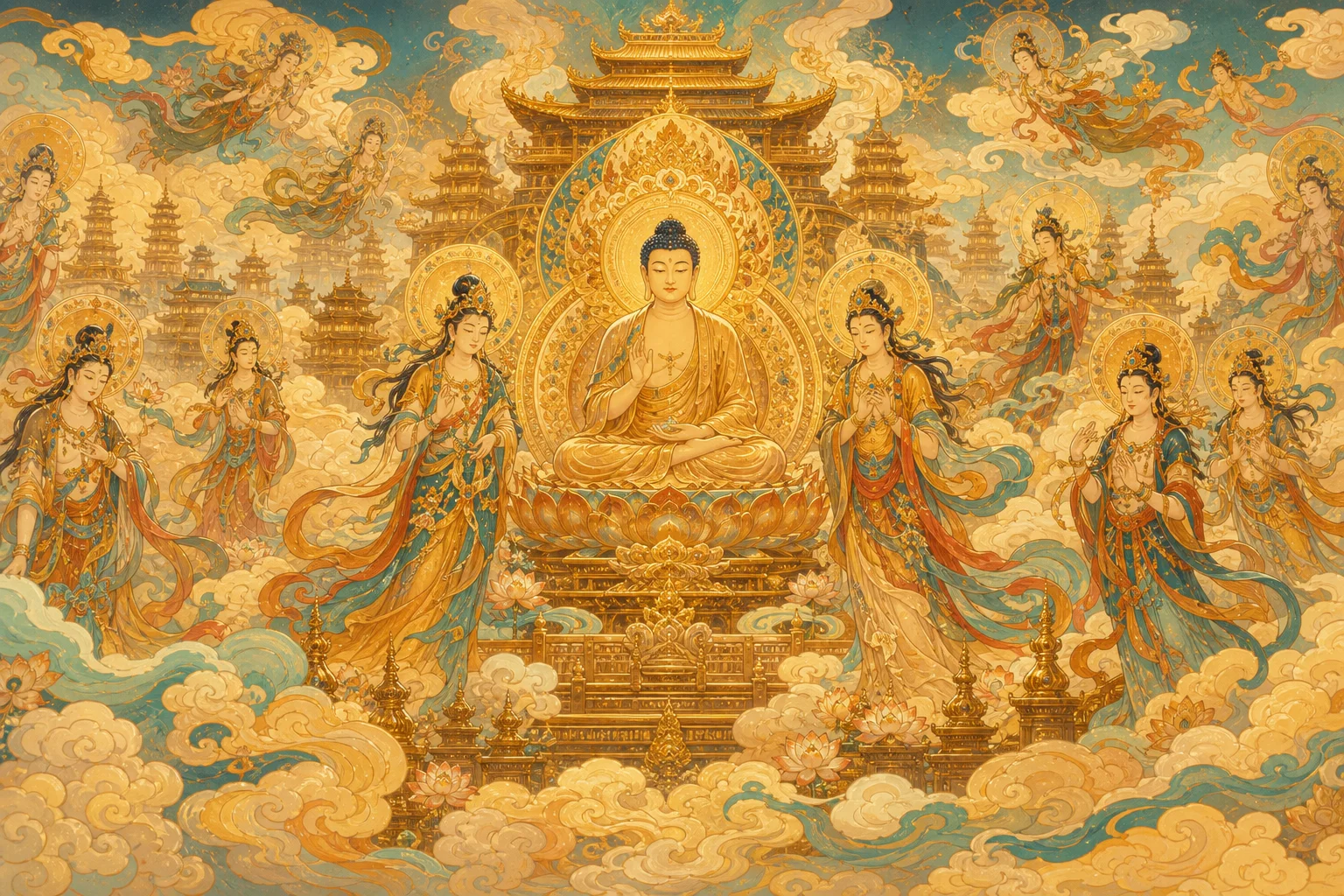
The Heavenly Court runs on Taoist bureaucracy; the Western Heaven (西天) runs on Buddhist enlightenment. If you know Tang Sanzang and his disciples, this article completes the picture: who sits above the pilgrimage, what separates a Buddha from a bodhisattva, and why those powers keep testing Wukong instead of simply crushing every demon for him.
Three ranks of enlightenment
Journey to the West uses Buddhist titles loosely — the novel is fiction, not a sutra — but the hierarchy is consistent enough to follow. Think of three tiers:
Buddha (佛)
Fully enlightened; transcended the cycle of rebirth. The highest authority in the Buddhist cosmos of the story.
Bodhisattva (菩萨)
Enlightened beings who delay final Buddhahood to help others. Active guides, recruiters, and testers on the pilgrimage.
Arhat / Lohan (罗汉)
Disciples who achieved personal liberation. Often appear as guardians, messengers, or comic relief in the novel.
In practice the novel blurs the lines for drama. A character called “Buddha” might still negotiate, scold, or scheme. What matters for reading Black Myth is simpler: who outranks whom, and who has the authority to assign trials.
Tathagata — the Buddha who stops Wukong
Tathagata (如来, Rúlái) — often called simply the Buddha or Shakyamuni (释迦牟尼) in translations — is the supreme Buddhist figure in the novel. He ends Havoc in Heaven with a famous wager: Wukong bets he can leap out of the Buddha's palm; he cannot. Five Elements Mountain and the golden headband follow from that defeat.
At the pilgrimage's end, Tathagata receives the party in the Western Heaven and assigns each member a fruits of enlightenment (正果) — Buddhist titles that mark their redemption. Wukong becomes Victorious Fighting Buddha (斗战胜佛, Dòu Zhànshèng Fó). That closing ceremony is the novel's clearest statement about who ultimately judges the Monkey King.
Why this matters in Black Myth
- → Wukong's rebellion ends at Buddha's palm — any “cosmic limit” or sealing imagery likely echoes this moment.
- → The title Douzhansheng Fo signals post-pilgrimage Wukong, not the untamed Monkey King of Flower-Fruit Mountain.
- → When gods and buddhas argue over Wukong's fate, they are continuing a story beat the novel already established.
Guanyin — the pilgrimage's architect
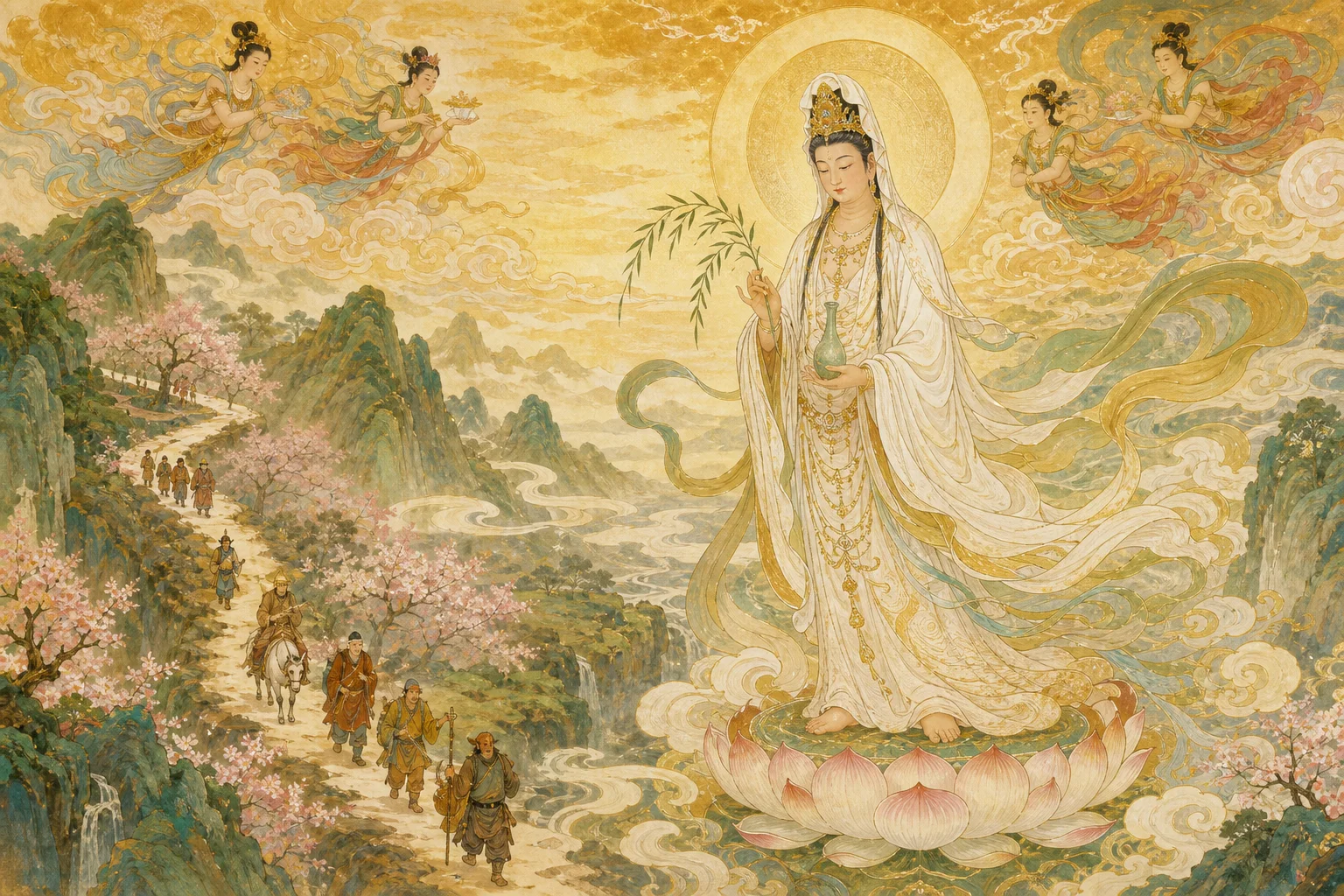
If Tathagata is the final judge, Guanyin (观音, Guānyīn) is the day-to-day manager. She receives the scripture mission from the Buddha, finds Tang Sanzang, recruits each disciple under conditional parole, and coordinates the 81 tribulations (八十一难) the party must survive.
Guanyin is a bodhisattva of compassion, but compassion in this story does not mean softness. She lets demons test the pilgrims because the trials themselves are the point — suffering, loyalty, and restraint are measured on the road, not in a single final exam. When Wukong wants to smash every obstacle, Guanyin often wants him to learn patience.
For a deeper look at how she assembles the party, see Tang Sanzang & the Pilgrimage Party. For the wider Buddhist cosmos, see Heaven, Hell, and the Buddhist Cosmos.
Other bodhisattvas you will meet
Guanyin is the most active, but other bodhisattvas appear as region bosses, testers, or symbolic hosts. Recognizing them helps when a chapter title sounds like a temple name rather than a demon's lair.
Wisdom
Manjusri 文殊
Bodhisattva of wisdom, often linked to Wenshu Monastery settings and trials that punish arrogance. Several novel episodes involve his mount or disciples testing the pilgrims' judgment.
Practice
Samantabhadra 普贤
Bodhisattva of great conduct and vows. Appears in episodes tied to oaths, repentance, and proving sincerity through action rather than cleverness.
Future Buddha
Maitreya 弥勒
The “Laughing Buddha” of popular art — future enlightened one. In the novel, Maitreya-related episodes often involve disguised tests and comic traps that look harmless until the pilgrims walk into them.
Underworld mercy
Ksitigarbha / Dizang 地藏
Vows to save all beings in hell realms. More prominent in folk religion than in the main pilgrimage plot, but useful context when the story dips into Diyu (地狱) and judgment themes.
Western Heaven — who lives where
The Western Heaven is not one palace but a Buddhist paradise bureaucracy — thrones, tiers, messengers, and scripture archives. The novel names many figures briefly; these are the ones worth anchoring in memory.
| Figure | Chinese | Role in the story |
|---|---|---|
| Tathagata / Buddha | 如来 / 佛祖 | Supreme authority; stops Havoc in Heaven; grants scripture and enlightenment titles at the end |
| Guanyin | 观音 | Assigns the quest, recruits disciples, manages tribulations |
| Ananda & Kasyapa | 阿难 / 迦叶 | Buddha's disciples who hand over scriptures — and famously demand a “fee” in the novel |
| Four Heavenly Kings | 四大天王 | Guardians at cosmic gates; bridge Buddhist and folk martial imagery |
| Amitabha | 阿弥陀佛 | Lord of the Western Pure Land in broader Buddhism; referenced as ultimate salvation destination |
Enlightened titles and “fruits of merit”
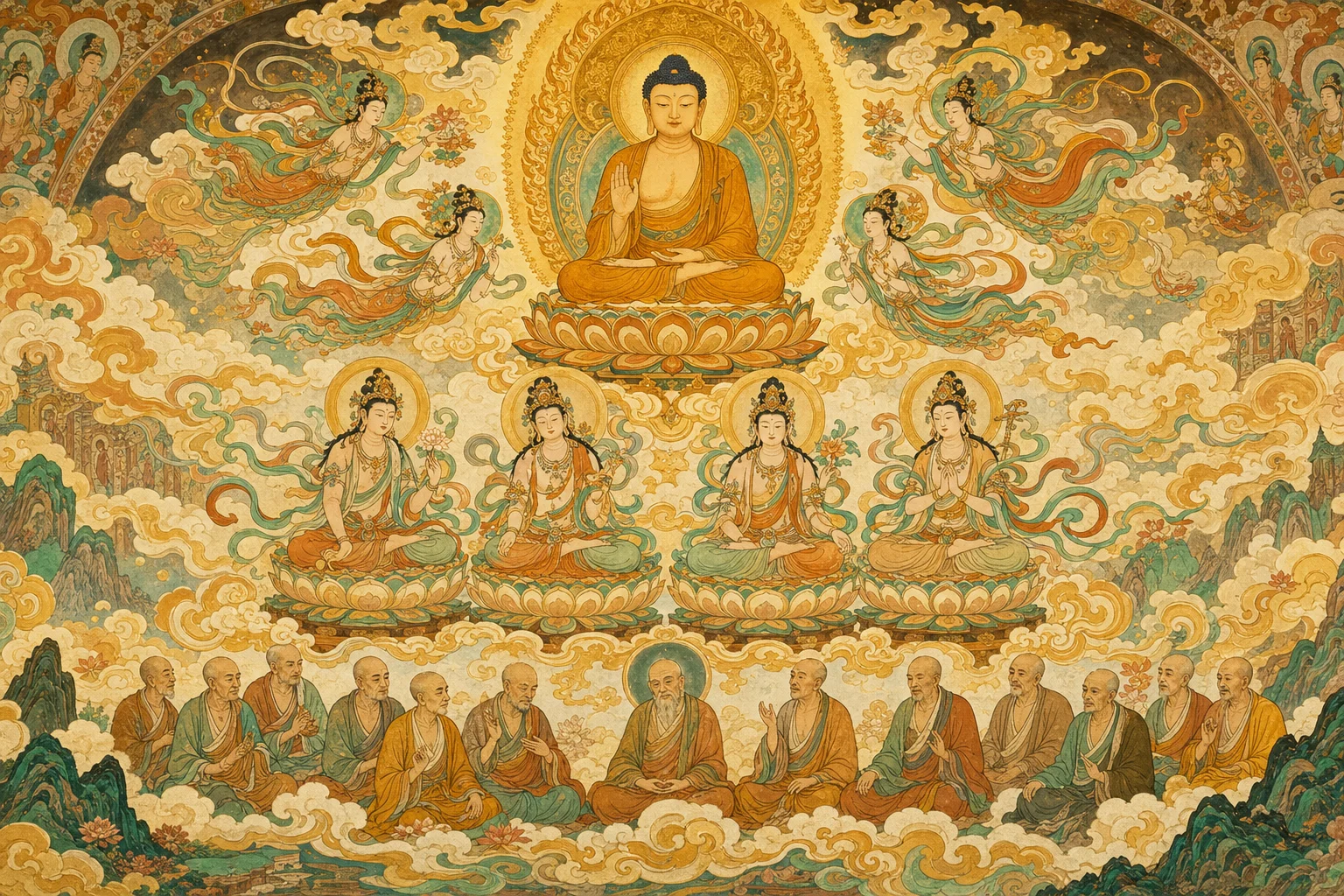
Buddhist characters in the novel often carry multiple names: a worldly name, a dharma name, and eventually a fruit of enlightenment (正果) granted after trials. These titles sound like military ranks to new readers, but they mark spiritual status.
| Character | Enlightenment title | What it signals |
|---|---|---|
| Sun Wukong | 斗战胜佛 (Victorious Fighting Buddha) | Redeemed rebel — power now bound to Buddhist order |
| Zhu Bajie | 净坛使者 (Altar Cleanser) | Partial redemption; appetite turned into ritual duty |
| Sha Wujing | 金身罗汉 (Golden Body Arhat) | Steady service rewarded with arhat status |
| White Dragon Horse | 八部天龙 (Eightfold Dragon) | Dragon prince restored after silent penance |
Notice the pattern: none of the disciples become idle gods. Each title matches the flaw they carried into the journey. Wukong keeps fighting — but now as a Buddha, not a bandit king.
Why buddhas test instead of rescue
A common question from players: if Guanyin is so powerful, why not destroy every yaoguai and escort the monk in an afternoon? The novel's answer is Buddhist pedagogy. Scripture alone is not enough; the pilgrims must be transformed by the road. Tribulations are curriculum. Demons are often unwitting exam proctors — sometimes literally sent or permitted by higher powers.
That logic explains why enlightened beings appear in disguise, why they withhold help until the last moment, and why Wukong repeatedly learns that raw strength without restraint creates new disasters. Black Myth inherits this tension even when it is not retelling the pilgrimage chapter by chapter: cosmic powers watch, judge, and occasionally bet on outcomes.
In Black Myth
Black Myth: Wukong draws on the Monkey King's full legend — including the phase when buddhas and bodhisattvas already shaped his fate. Expect visual echoes of lotus imagery, golden halos, scripture motifs, and sealed powers that recall Five Elements Mountain or the Tightening Spell era.
The game may not name every bodhisattva from the novel, but the logic of enlightened oversight persists: Wukong is never purely free. Someone higher on the Buddhist ladder has always been watching — assigning limits, offering redemption, or waiting to see whether he breaks again.
While you play
- → A sealed power or palm-shaped prison usually points to Tathagata's wager, not random magic.
- → Compassionate guide figures — especially feminine bodhisattva imagery — often echo Guanyin.
- → Look up unfamiliar Buddhist titles in our glossary.
Further reading
- Heaven, Hell, and the Buddhist Cosmos — how Taoist heaven and Buddhist enlightenment share one story world.
- Sun Wukong: From Stone to Monkey King — the Havoc in Heaven arc that brings Buddha into Wukong's life.
- Anthony C. Yu, Journey to the West, vol. 4 — the scripture handover and enlightenment titles at journey's end.