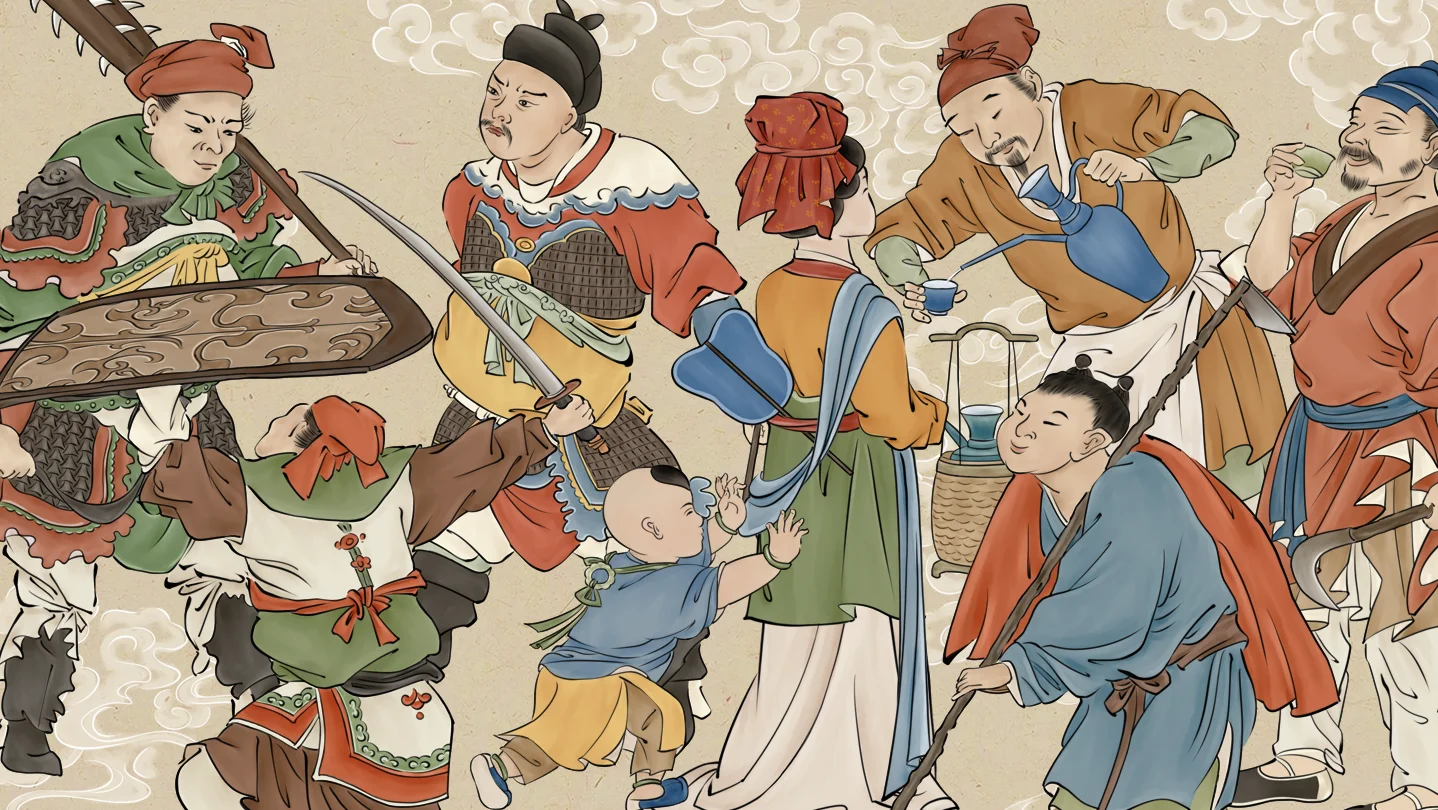
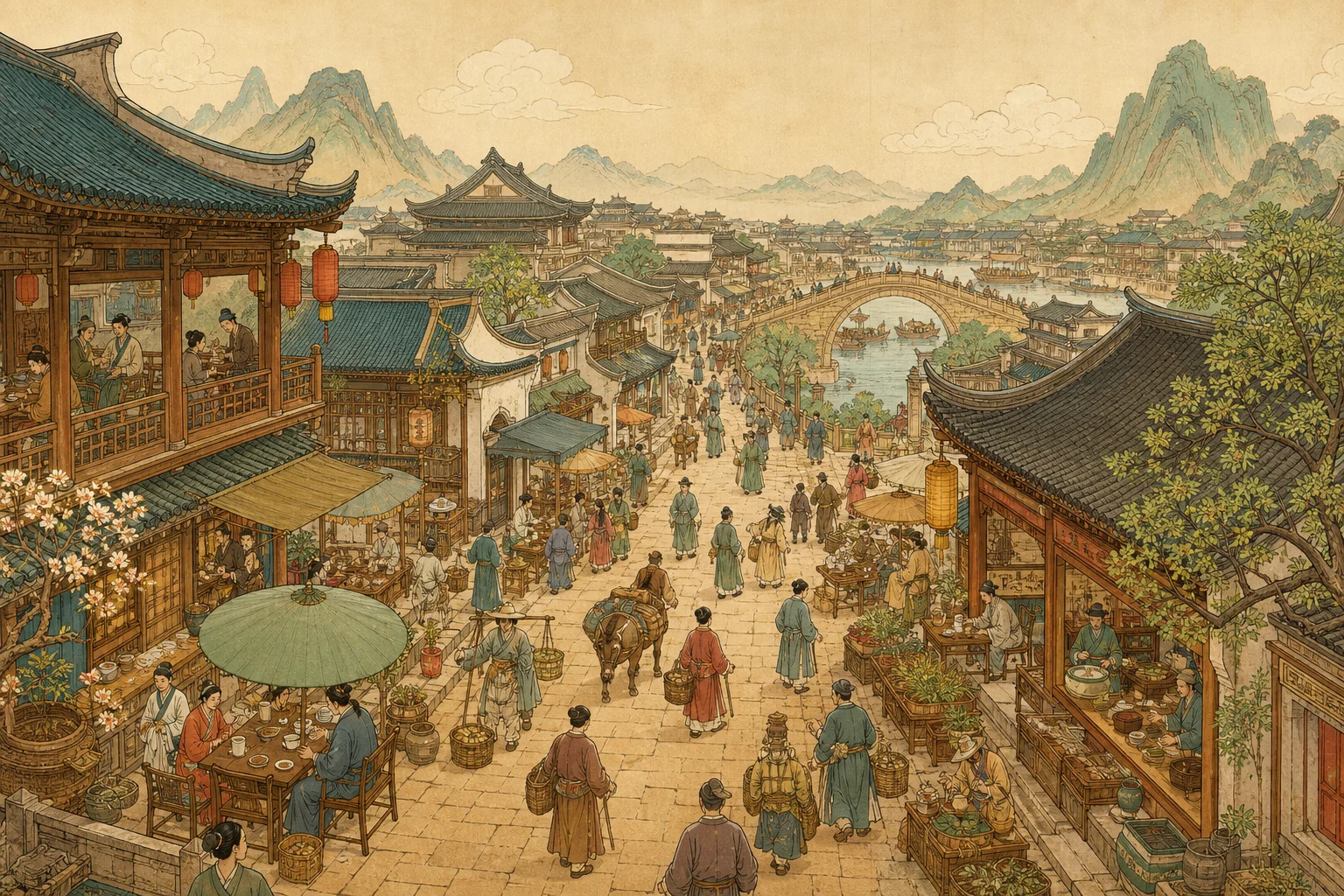
Most "Chinese fantasy" games pick ink wash: black mountains, mist, splashed water. The Bustling World went a different direction — gongbi (工笔画, gōngbǐ, "meticulous brush"), the tradition of fine lines, flat color fills, and obsessive detail that made Song genre paintings like Along the River During the Qingming Festival (清明上河图, Qīngmíng Shànghé Tú) famous. The result is a 3D world rendered with hand-painted textures — more than 5,000 completed at last count — in a stylized three-dimensional (三渲二, sān xuàn èr) pipeline. This seven-minute primer explains why that choice matters culturally — and why Western players keep calling the streets "living scroll paintings."
The art direction in one paragraph
Producer Liu Xujian has said the team tested oil-painting and ink-wash looks before settling on gongbi because daily life — shops, roofs, carts, cloth — needs readable edges, not atmospheric blur. Gongbi prioritizes 形似 ( likeness through form ) over the expressive abstraction of xieyi (写意, xiěyì, "writing the idea") ink painting. Every asset passes through human painters referencing Song–Tang sources; the engine adds depth, lighting, and cloth physics, but the surface stays illustrative. Interviews compare walking the market to stepping into a bustling section of the Qingming scroll — hawkers, lion dancers, wine cups — with snow that keeps wheel ruts and seasons that change street detail.
Style
Gongbi line + mineral color sensibility; not ink-wash landscape fantasy
Pipeline
3D models with hand-painted textures; full cloth simulation on traditional dress
Scale
5,000+ painted textures; ~2,000 build parts; ~1,000 furniture & props
Gongbi vs. ink wash — why it matters
In Chinese painting history, two poles dominate teaching:
| Tradition | Priority | Typical subject | Game analogy |
|---|---|---|---|
| Gongbi 工笔 | Fine outline, careful color, detail you can count | Figures, architecture, flowers, court life | The Bustling World — streets you can read like a scroll |
| Xieyi 写意 | Brush energy, suggestion, empty space | Mountains, mist, philosophical landscape | Many wuxia titles — heroic mood over shop signs |
A teahouse signboard, bracket set, or woman's fubing (幞头, official hat) loses identity when everything dissolves into ink fog. FireWo Games needed players to recognize occupations from dress and architecture from joinery — the same reason Song artists painted cities instead of only peaks. Gongbi also differentiates the project visually: domestic audiences note the clean paving and bright facades; overseas press compares it to animated classical art rather than dark realism.
Hand-painted 3D: what "三渲二" means here
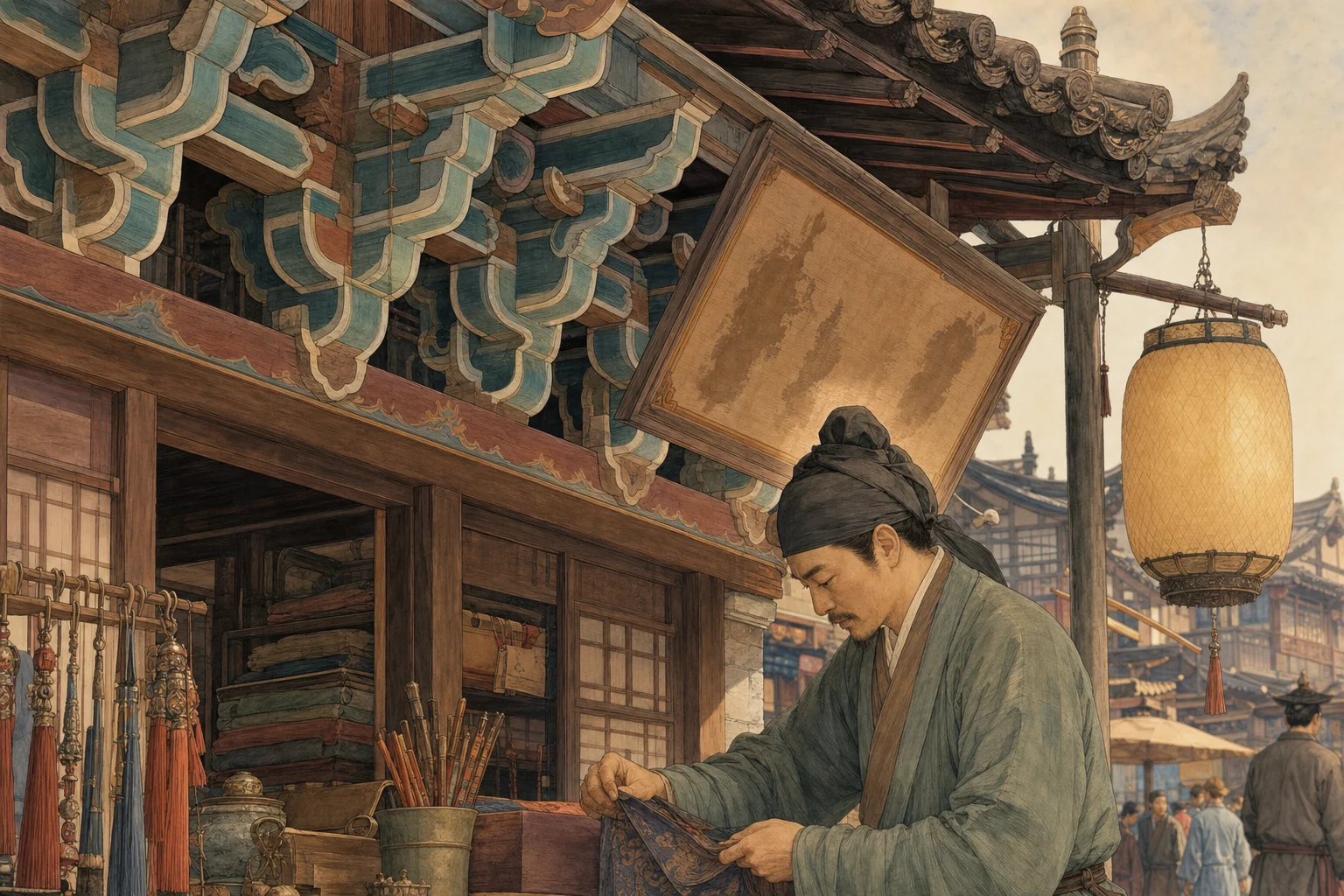
Sanxuan'er (三渲二) literally "three rendered as two" — 3D geometry shaded to look 2D/illustrative. The team models buildings and characters in three dimensions so the camera can walk freely, but painters draw albedo textures by hand instead of photogrammetry scans. That hybrid explains trailer moments that feel both game and album leaf:
- Consistent stylization — no mixed PBR realism breaking the scroll illusion
- Art-directed weather — snow retains cart tracks; rain darkens ink-toned roofs without turning mud photoreal
- Cloth physics on painted fabric — sleeves and belts move physically while keeping woven patterns hand-drawn
- Minimal HUD — dialogue options float near heads; interaction prompts appear only when close, preserving composition
Liu Xujian has described the team as strong in technical art and engine work; the gongbi look is a deliberate constraint that scales — every new prop must pass the same brush standard.
留白 — negative space and "too clean" streets
Viewers sometimes ask why cobblestones look unnaturally tidy. The producers answer with another painting concept: liubai (留白, liúbái, " leaving white " ) — deliberate empty areas that let the eye rest. In scroll composition, unpainted ground is not failure; it separates crowds from chaos. The game borrows that: readable ground planes, restrained clutter, emphasis on figures and storefronts. It is stylization grounded in classical composition, not ignorance of muddy roads — though mud exists in farm scenes and battlefields when the mood demands it.
Culture, not photoreal: If you expect gritty historical reconstruction, compare props to Song manuals and paintings (see our primer on Song–Tang sources). If a surface looks "too perfect," ask whether it reads like gongbi album art — that is often intentional.
The spirit of Along the River During the Qingming Festival
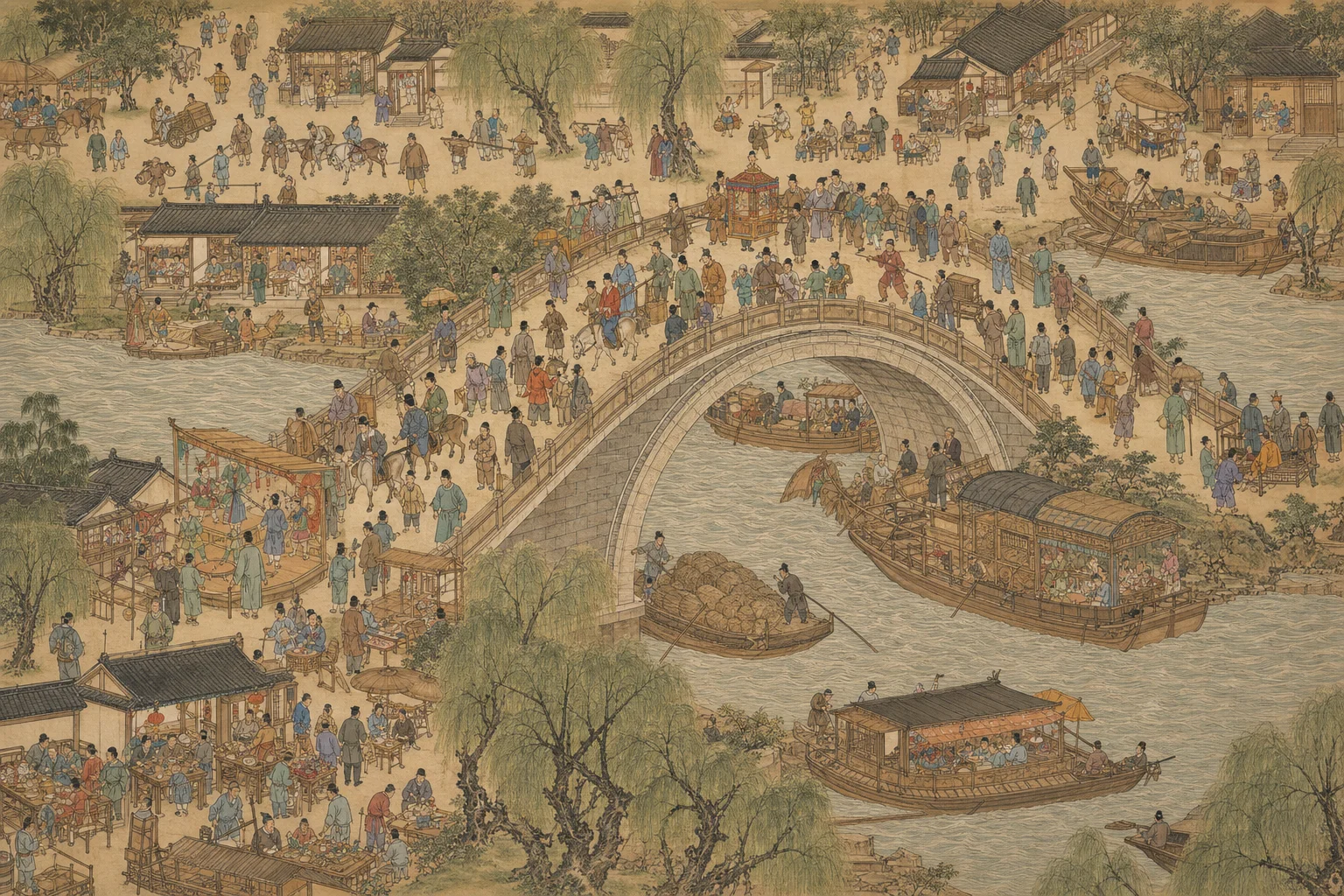
The Qingming scroll (attributed to Zhang Zeduan, 张择端, Song dynasty) is China's most famous genre painting: a long horizontal view of Bianjing (汴京) life — bridges, boats, restaurants, cargo, beggars, officials, children. It is not a map; it is a social panorama. The Bustling World cites it as emotional target: the shout "Have a look, have a look!" (瞧一瞧,看一看), lion dances, wine halls, scholars at leisure.
What the game takes from the scroll:
- Urban rhythm — commerce as spectacle, not just loot containers
- Class mix — laborers, merchants, and literati share one frame
- Moving camera as unrolling paper — the open world mimics scrolling through episodes of daily life
What it does not claim: reproducing Kaifeng in 1127, or using the scroll as a level blueprint. Remember the three layers from our first primer — artistic source, not pinned history.
How this serves both "beacon fire" and "cooking smoke"
The same art pipeline paints quiet villages and burned battlements. Cooking smoke scenes lean into warm market palettes and farm greens; beacon fire scenes drain saturation, add smoke layers, and break walls — but bracket sets and costumes stay gongbi-clear so you always know where you are culturally. Later trailers introduced mythic interiors ( suspended sculptures, underworld gates ) with richer gold and lacquer while keeping line discipline — fantasy amplifies color, not sloppy photoreal.
What to compare when judging screenshots
- Against ink-wash wuxia: Is detail sacrificed for mist? Here, detail is the point.
- Against photoreal historical sims: Is texture scanned mud or painted pattern? FireWo chose paint.
- Against the Qingming scroll: Do you sense crowd logic and trade noise — or only generic "Asian village" assets?
- Against the team's own trailers: Second-year footage added seasons and myth sites; line quality should stay consistent as scope grows.
Awards such as Best Art at ChinaJoy INDIE GAME 2024 reflect domestic recognition of this bet — that classical genre painting could carry a sandbox, not only menu backgrounds.
Next in this series: a living document on where history ends and game fiction begins — what we know from trailers versus what painters and texts actually document.
Next in this series: How The Bustling World uses history — confirmed features, dramatization, and what to update when new footage drops.