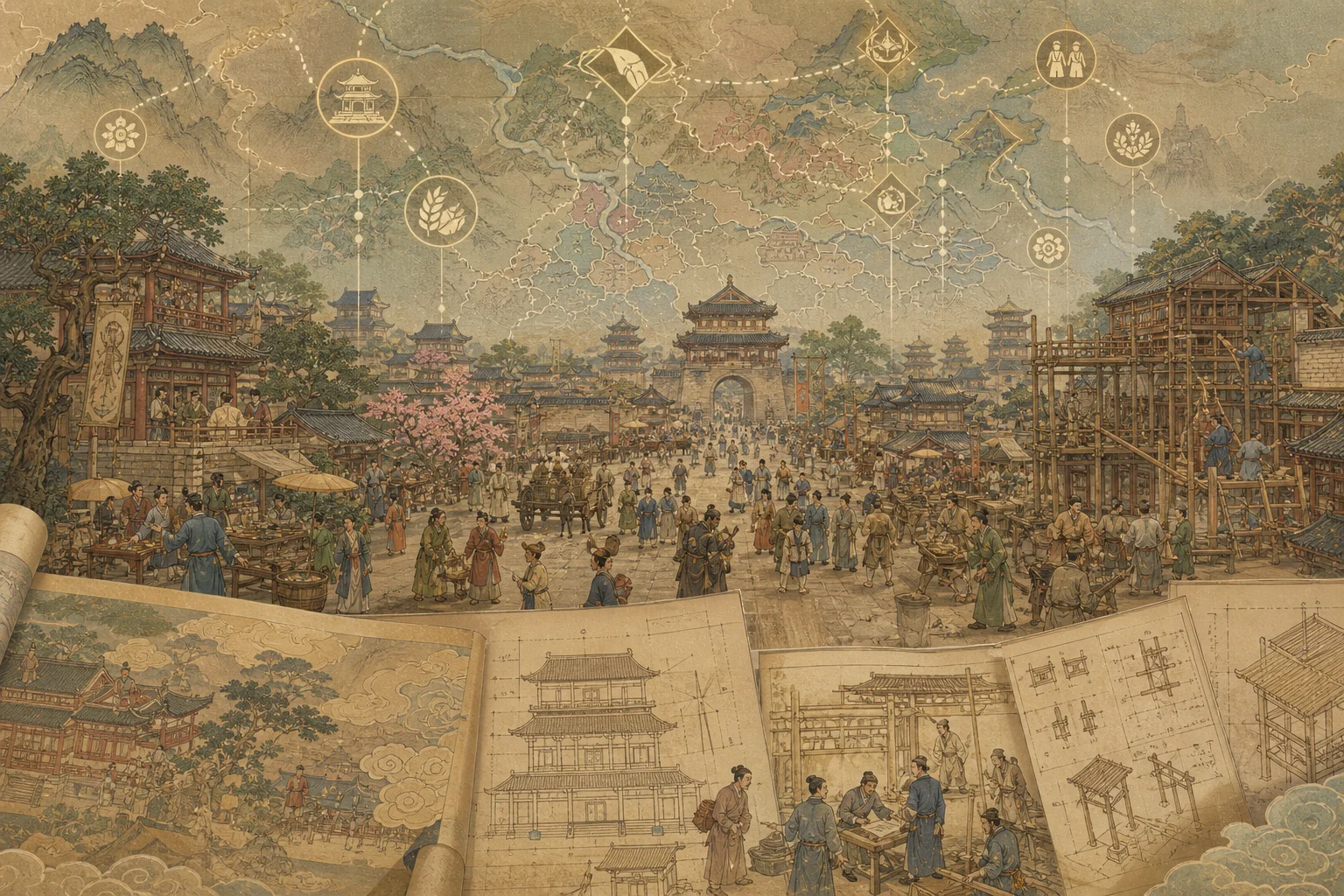
Living document. Unlike Blood Message, which dramatizes one documented year (848 AD), The Bustling World has no pinned historical calendar and no mandatory main quest. It still claims serious research — Song–Tang paintings, building manuals, costume records — while asking you to invent a life in a realm that never existed on a map. This page separates what FireWo Games has officially confirmed from what comes from historical practice, artistic & textual sources, and pure game fiction. Last scoped: first and second gameplay trailers, Steam store text, and interviews through 2025. Dragon Forge is editorial — not affiliated with FireWo Games or Lightning Games.
Status at a glance
Developer / publisher
FireWo Games (火娃娃) · Lightning Games (G-bits) · Chengdu-based team
Genre
Open-world sandbox RPG — survival, crafting, sim, jianghu combat, city-building, strategy
Release
Premium PC (Steam); date TBA — development targeted for completion in 2026
| Item | Confirmed? | Notes |
|---|---|---|
| Fictional setting | Yes | Ancient China without a named real dynasty or start year |
| Material culture research | Yes | Song–Tang paintings & texts; field study; ~2,000 build parts; ~1,000 props; 5,000+ hand-painted textures |
| War atmosphere | Yes (tone) | Background conflict / rebel suppression mood — not a locked historical war campaign |
| No forced main storyline | Yes | Sandbox paths: civilian life, jianghu, state-building |
| Living NPC simulation | Yes | Families, migration, grudges, dynamic cities |
| Mythic / fantasy sites | Partial (PV2) | Xiaoxitian-style temples, underworld imagery shown — scope in final game TBD |
| Playable historical figure | No | Player is a sandbox actor, not a named person from records |
| Linear narrative campaign | No | Not a story-led single-player like Blood Message |
| Soulslike structure | No | Combat exists; loop is life-sim + open world, not boss-gate progression |
Three layers (not one "retelling")
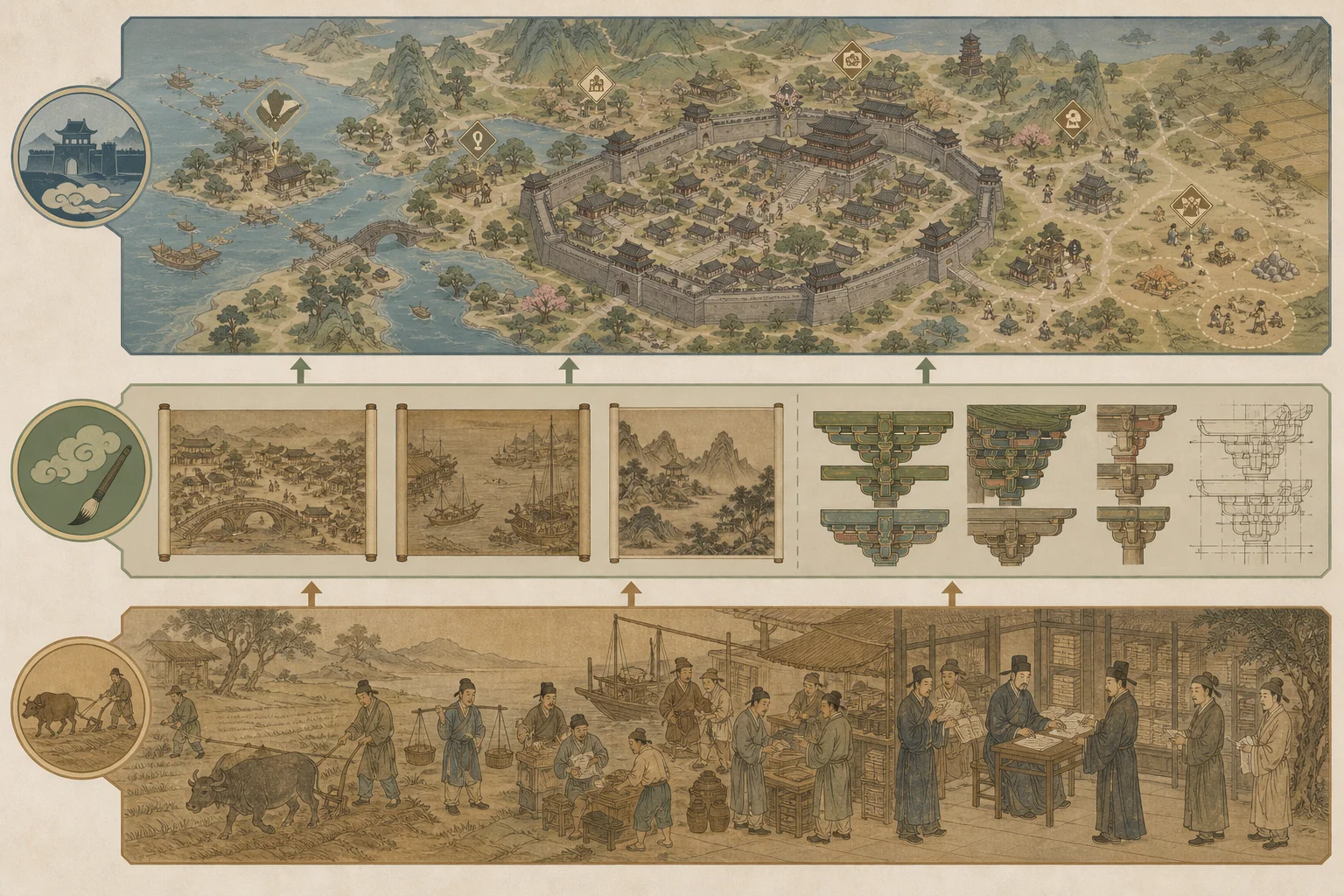
Use this filter whenever a trailer beat looks "historical":
| Layer | Question to ask | Example in game materials |
|---|---|---|
| Historical practice | Did societies like this really work this way? | Four occupations; teahouses as social hubs; corvée pressure in wartime; escort agencies |
| Artistic & textual source | Does this object appear in a painting or manual? | Qingming scroll shop types; Yingzao Fashi brackets; Tang–Song costume forms in art |
| Game fiction | Is this invented for play? | Unnamed dynasty; policy cards; player-founded states; hook-lock traversal; myth dungeons |
A pawnshop interior might match Song visual sources (source), function like real pawn lending (practice), and sit in a city name the writers invented (fiction). All three can be true at once.
What official materials treat as "real"
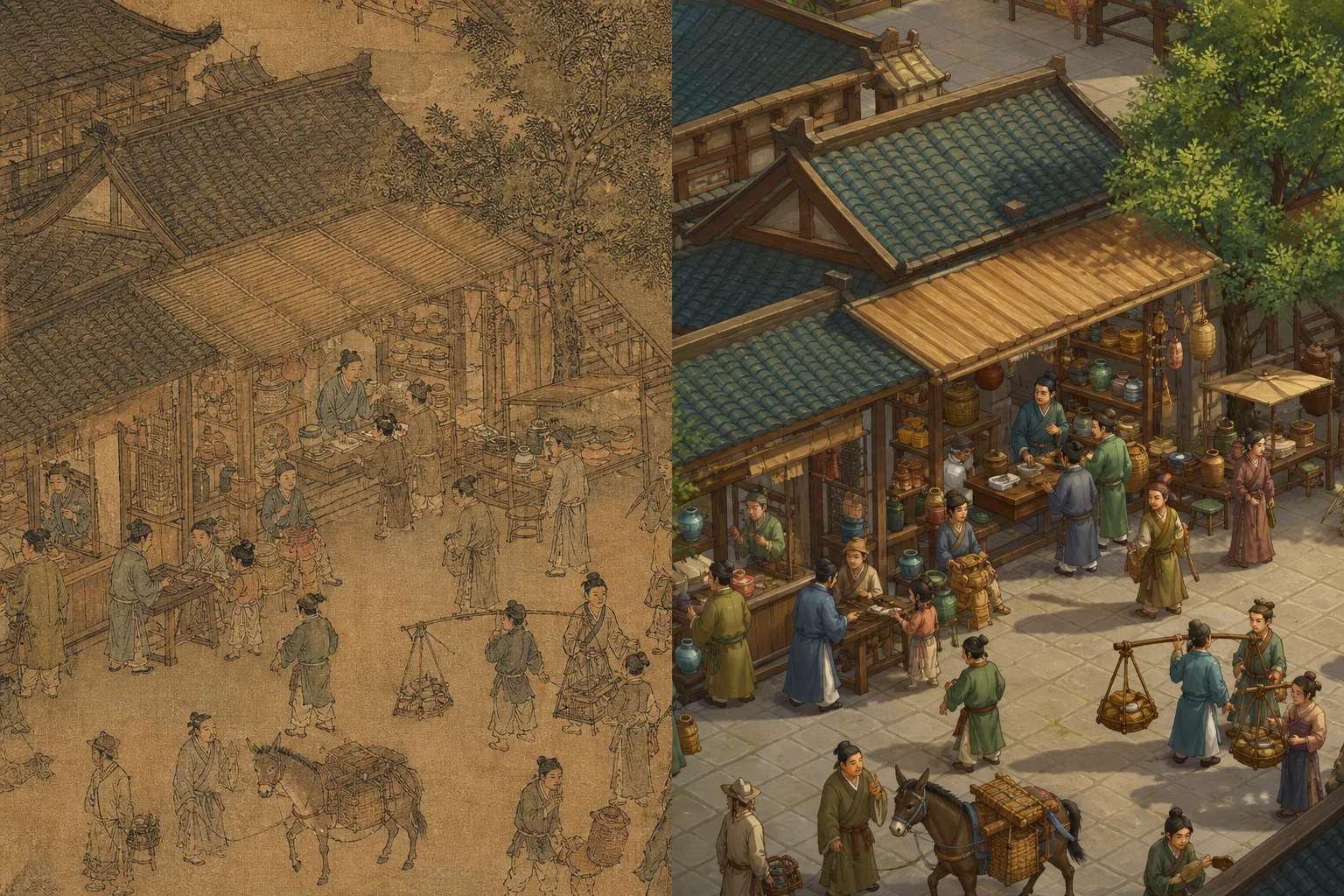
Interviews and Steam copy repeatedly emphasize restoration from art and books, not re-enactment of a dynasty:
- Architecture and props drawn from Tang–Song paintings and classical records
- Gongbi-inspired hand-painted 3D; cloth physics on historically referenced dress
- 60+ plants and 30+ livestock species with period flavor
- Market, farm, and workshop loops modeled on pre-modern livelihood patterns
- NPC behavior echoing family, migration, and revenge logic familiar from traditional society
When producers compare streets to Along the River During the Qingming Festival or cite only what is national can become global (只有民族的才是世界的), they mean cultural texture — not "this is Kaifeng in 1127."
What the game clearly fictionalizes
Without insider access to unreleased design docs, these are safe classifications from public materials:
- Geography and polities — cities, borders, and factions you create or encounter are sandbox constructs
- Player biography — you are not role-playing a documented official or rebel leader
- Policy cards and diplomacy minigames — strategic abstractions for fun, not Qing-era memorial transcripts
- Combat set-pieces — hook locks, multi-mode attacks, and wanted-poster loops are game verbs
- Myth layers — underworld gates and ornate temple interiors are atmospheric fiction unless later confirmed as core lore
- Timeline — war "like An Lushan times" is mood, not a datable scenario
Our rule: We label historical practice, artistic & textual source, and game dramatization separately. When a new trailer shows a named place or dated event, we update the table above — and spin off spoiler articles only if a fixed plot appears.
Common fan assumptions (and corrections)
| Assumption | Likely? | Correction |
|---|---|---|
| "It's set in the Song dynasty" | Unconfirmed | Song–Tang are source periods for art and objects, not a declared setting year |
| "The main story is suppressing rebels" | Partial tone | Rebellion/war exists as backdrop; no forced main quest stated |
| "It's Chinese Assassin's Creed / GTA" | Shorthand only | Western press tags; actual mix is sim + sandbox + strategy + jianghu |
| "Every building is archaeologically exact" | Overstated | Research-driven stylization; gongbi clarity sometimes overrides mud and decay |
| "Myth scenes mean full fantasy RPG" | TBD | PV2 showed myth sites; proportion vs grounded life unknown until release |
How this differs from other Culture hubs
- Blood Message — history-first; one event; fictional characters in real gaps
- WUCHANG — pinned 1647 + archaeology + horror fiction on a linear ARPG
- Black Myth: Wukong — one novel; bosses map to chapters
- The Bustling World — material culture first; your story is the variable; history is texture and reference, not homework
What we will update here
When FireWo or Lightning releases new material, we revise this page and our future Quick Reference:
- Named cities, factions, or historical figures appearing in-game
- Whether a main storyline exists in the shipping build
- Confirmed biomes, myth zones, and era-specific props
- Closed-test features vs marketing trailers
- Release date, platforms, pricing, and localization
Primary sources: firewogames.com, Steam store page, and official Bilibili / Weibo channels.
Next in this series: Books, scrolls, and documentaries for players who want to go deeper — our reading and viewing list for The Bustling World.