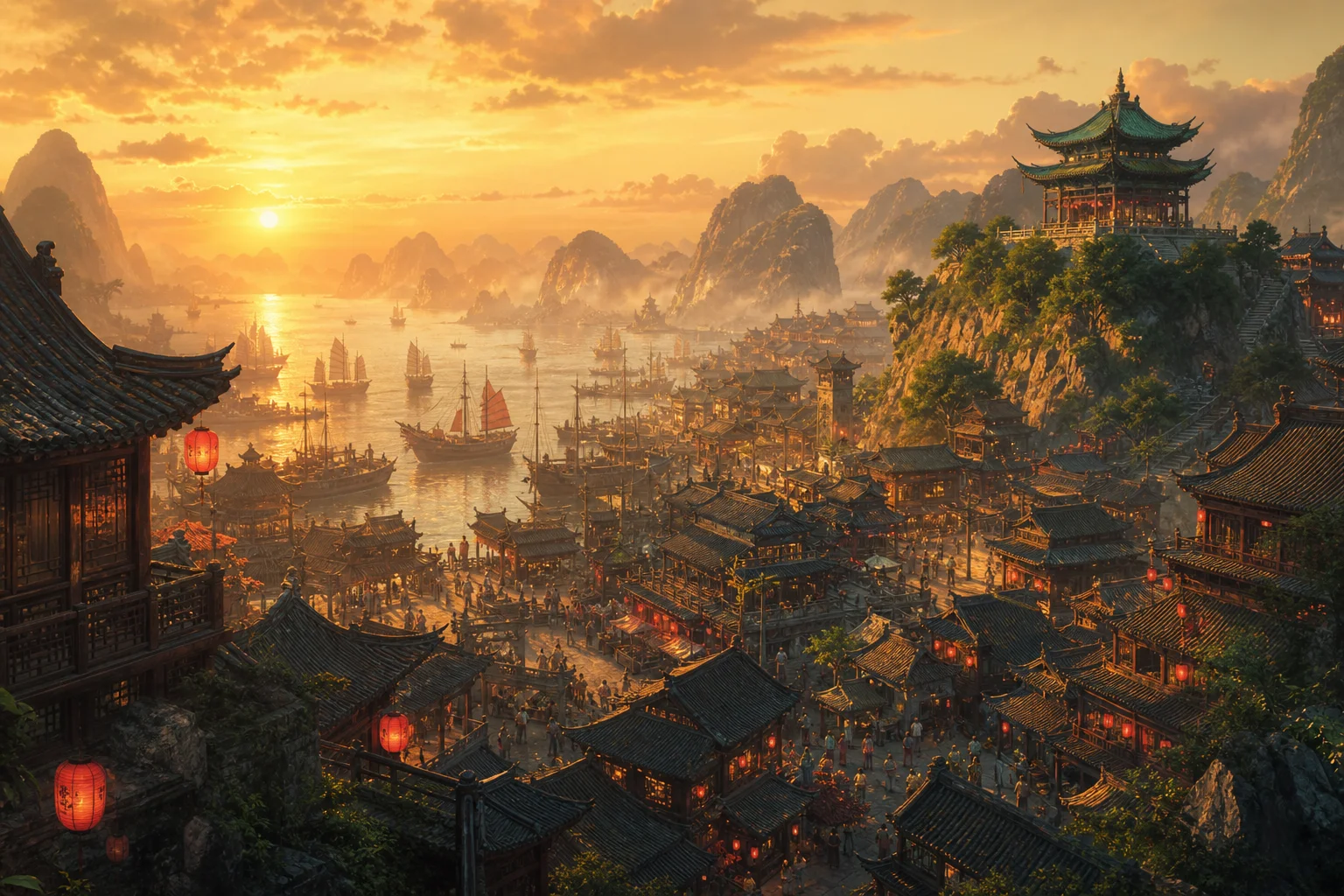
The first time you climb the stairs from the docks, Liyue feels unmistakably Chinese — not because the game labels a province, but because the roofs, lanterns, merchant guilds, and mist-wrapped cliffs cite real aesthetic traditions. This article maps Liyue Harbor and the landscapes around it to the architecture, geography, and painting culture they echo — so every stroll from Wangsheng Funeral Parlor to Jueyun Karst carries a little more context.
Liyue Harbor: a vertical merchant city
Liyue Harbor (璃月港, Líyuè Gǎng) is Teyvat's busiest eastern port. HoYoverse designed it as a layered harbor: docks and warehouses at the waterline, shops and restaurants on middle terraces, and the Yujing Terrace (玉京台) — seat of the Liyue Qixing — at the top. That vertical layout mirrors how real Chinese port cities grew: wealth and ritual climbing uphill while labor stayed near the tide.
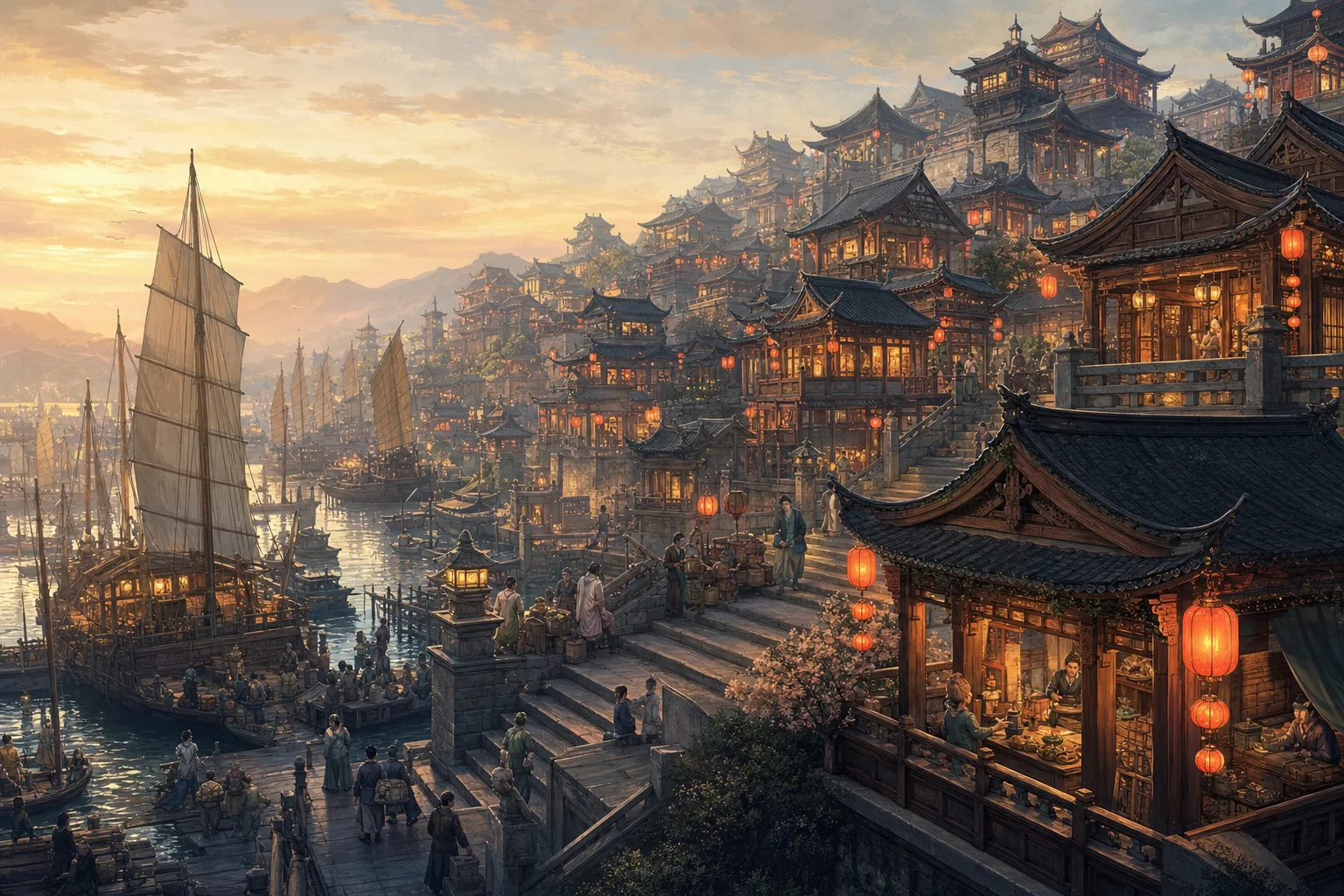
The harbor's look blends Tang–Song merchant culture with fantasy scale. You will see:
- Stacked eaves and upturned corners — classic Chinese timber architecture, exaggerated for game readability
- Red lanterns and guild banners — festival lighting made permanent; merchants advertise like opera troupes
- Stone bridges and canal stairs — water-city logic familiar from Jiangnan (江南) canal towns, scaled up for adventure
- Jade and gold accents — visual shorthand for Liyue's Geo wealth and the Mora economy
Harbor role
Trade hub, contracts, diplomacy with other nations
Real-world echo
Maritime China — Quanzhou, Guangzhou, canal cities, Silk Road ports
Game fiction
Rex Lapis's contract nation; Fatui embassy; floating Jade Chamber
Districts you keep revisiting
Liyue Harbor is not one uniform "Chinatown set." Each district carries a cultural job:
Governance
Yujing Terrace 玉京台
The Qixing meet here — a jade platform above the city. "Yujing" suggests a jade capital; the terrace is Liyue's visible seat of mortal power.
Ritual commerce
Wangsheng Funeral Parlor 往生堂
Hu Tao's parlor sits in the living city, not a remote cemetery — matching Chinese funeral culture where death rites are a public trade, not hidden shame.
Everyday life
Feiyun Slope & Wanmin 飞云坡 · 万民堂
Restaurants, bulletin boards, and side quests — the harbor's "market street" layer where Liyue feels like a city people actually live in.
Foreign presence
Northland Bank & embassy quarter
Snezhnaya's Fatui outpost reminds you Liyue is a node in a world network — like historical ports where Persian, Arab, and Southeast Asian traders shared docks with Chinese merchants.
Above the harbor floats the Jade Chamber (群玉阁) — Ningguang's sky pavilion. It is pure fantasy architecture, but its message is historical: Liyue wealth can literally reshape the skyline, the way merchant patrons funded pagodas, guild halls, and gardens in real port cities.
Beyond the docks: villages, passes, and inns
Liyue's open world extends the harbor logic into countryside zones — each citing a different Chinese landscape type:
| In-game place | Chinese name | Cultural echo |
|---|---|---|
| Qingce Village | 轻策庄 | Agricultural village below terraced hills — rice-and-bamboo country life |
| Mingyun Village | 明蕴镇 | Mining town; echoes real resource towns in mountain provinces |
| Wangshu Inn | 望舒客栈 | Mountain-pass inn — where travelers, merchants, and Xiao's vigil meet the Dihua Marsh road |
| Jueyun Karst | 绝云间 | Adeptus domain — peaks too steep for ordinary settlement, perfect for immortal hermitage fiction |
| Guili Plains | 归离原 | Ruined plain — battlefield archaeology layered into landscape storytelling |
| The Chasm | 层岩巨渊 | Deep mine frontier — industrial China underground, plus dragon-lore in later story |
Wangshu Inn (望舒客栈) deserves special mention. "Wangshu" (望舒) is a classical poetic name for the moon's charioteer — moonlight over a road inn is exactly the mood Chinese travel poetry loves. The inn sits where lowland marsh meets mountain pass, the kind of junction where real history placed post stations, toll gates, and temple hostels.
Shanshui: the landscape painting behind the cliffs
Liyue's most famous visual debt is shanshui (山水) — "mountain-water" — the core subject of classical Chinese landscape painting. For centuries, artists did not paint scenery for tourism postcards. They painted cosmology: mountains as bones of the earth, mist as breath, rivers as veins. Genshin's art direction imports that grammar directly into 3D space.
Real locations often cited by players and artists when discussing Liyue:
- Zhangjiajie (张家界) — pillar peaks in Hunan; the floating sandstone columns echo Jueyun Karst and Mt. Tianheng vibes
- Guilin & Yangshuo (桂林 · 阳朔) — karst hills over the Li River; the classic "Chinese landscape painting in real life" shot
- Huangshan (黄山) — sea of clouds and gnarled pines; adeptus hermitage mood
- Yellow River & North China plains — wide horizons at Guili Plains and Liyue's northern edges
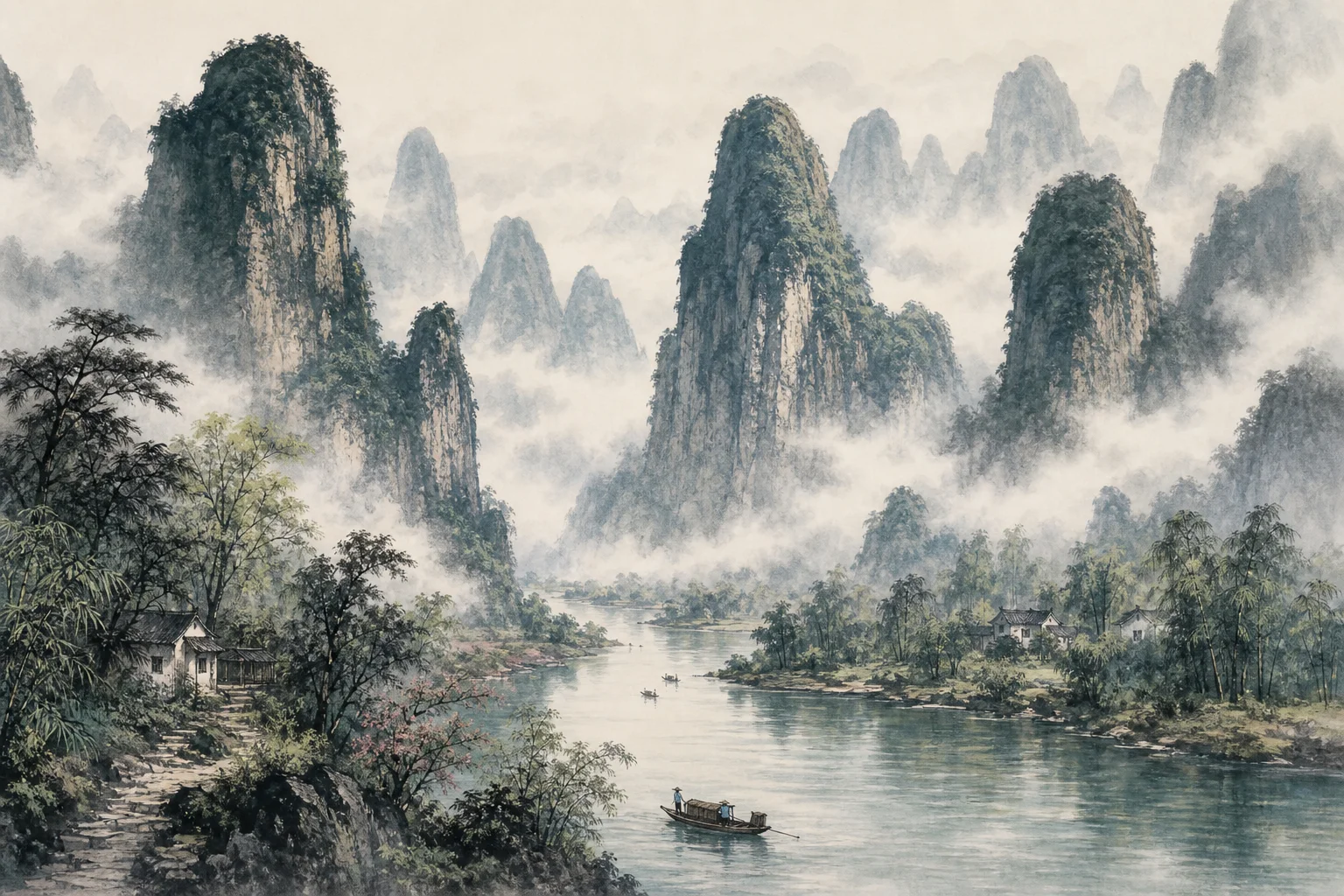
HoYoverse does not paste Guilin next to Zhangjiajie on a labeled map. Liyue compresses China's geographic diversity into one nation — the same design move as blending Tang commerce with immortal mountains. For a deeper look at that blending philosophy, see How Genshin Blends Myth, History & Fantasy.
Harbor vs. mountain: two Liyues, one culture
Liyue's design splits cleanly into two moods that real Chinese culture also holds together:
| Harbor Liyue | Mountain Liyue | |
|---|---|---|
| Theme | Contracts, Mora, guild politics | Adeptus, hermitage, yaksha vigil |
| Architecture | Shops, terraces, opera stage | Temples, inns, cliff paths |
| Real echo | Maritime trade cities | Daoist/Buddhist sacred mountains |
| Characters | Ningguang, Keqing, Ganyu at work | Xiao, Cloud Retainer, Shenhe |
Chinese history rarely separated "merchant coast" from "immortal mountain" — pilgrims traveled from port cities to sacred peaks, and poetry linked both. Liyue makes that journey a ten-minute glider ride, but the cultural pairing is old.
Exploration tips for culture-minded travelers
- Climb at dusk — Lantern light against blue hour mimics Song-dynasty night-market paintings
- Stand on Qingce Terrace — Compare rice fields below with karst walls above; it is shanshui in gameplay form
- Visit Wangshu Inn at night — The inn lamp over marsh fog is a travel-poem composition
- Read bulletin boards — Local notices ground fantasy names in everyday harbor speech
- Pair with festivals — Lantern Rite transforms the harbor; see Lantern Rite, Moonchase & Liyue Festivals
No spoilers
This article describes places and aesthetics visible from early exploration. Story revelations about Guili Plains, the Chasm, or Chenyu Vale are saved for later articles in this series.
Quick place-name reference
| Place | Chinese | Meaning hint |
|---|---|---|
| Liyue | 璃月 | Glazed / glass moon — poetic harbor image |
| Liyue Harbor | 璃月港 | The port itself |
| Yujing Terrace | 玉京台 | Jade capital terrace |
| Jade Chamber | 群玉阁 | Pavilion of gathered jade |
| Wangshu Inn | 望舒客栈 | Inn of moonlight / moon charioteer |
| Jueyun Karst | 绝云间 | Among clouds cut off from the world |
| Shanshui | 山水 | Mountain-water landscape aesthetic |
Continue with southern tea country in Chenyu Vale, Tea Culture & Southern China, or return to the primer Liyue in 10 Minutes if you want the nation overview first.