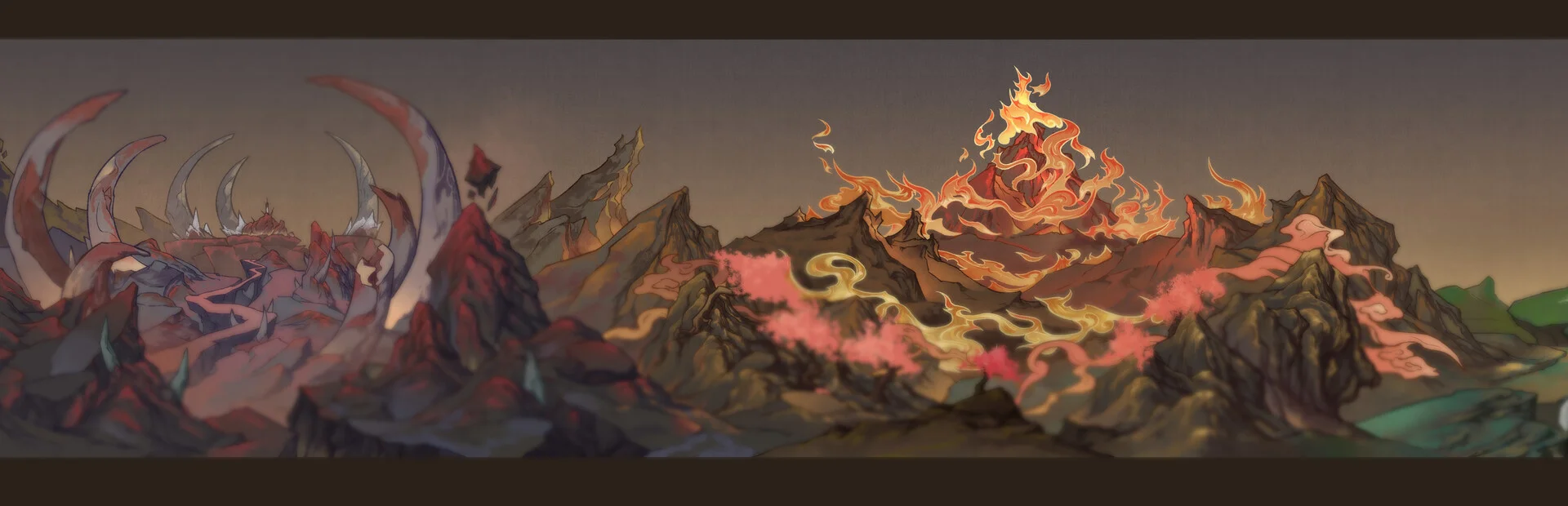
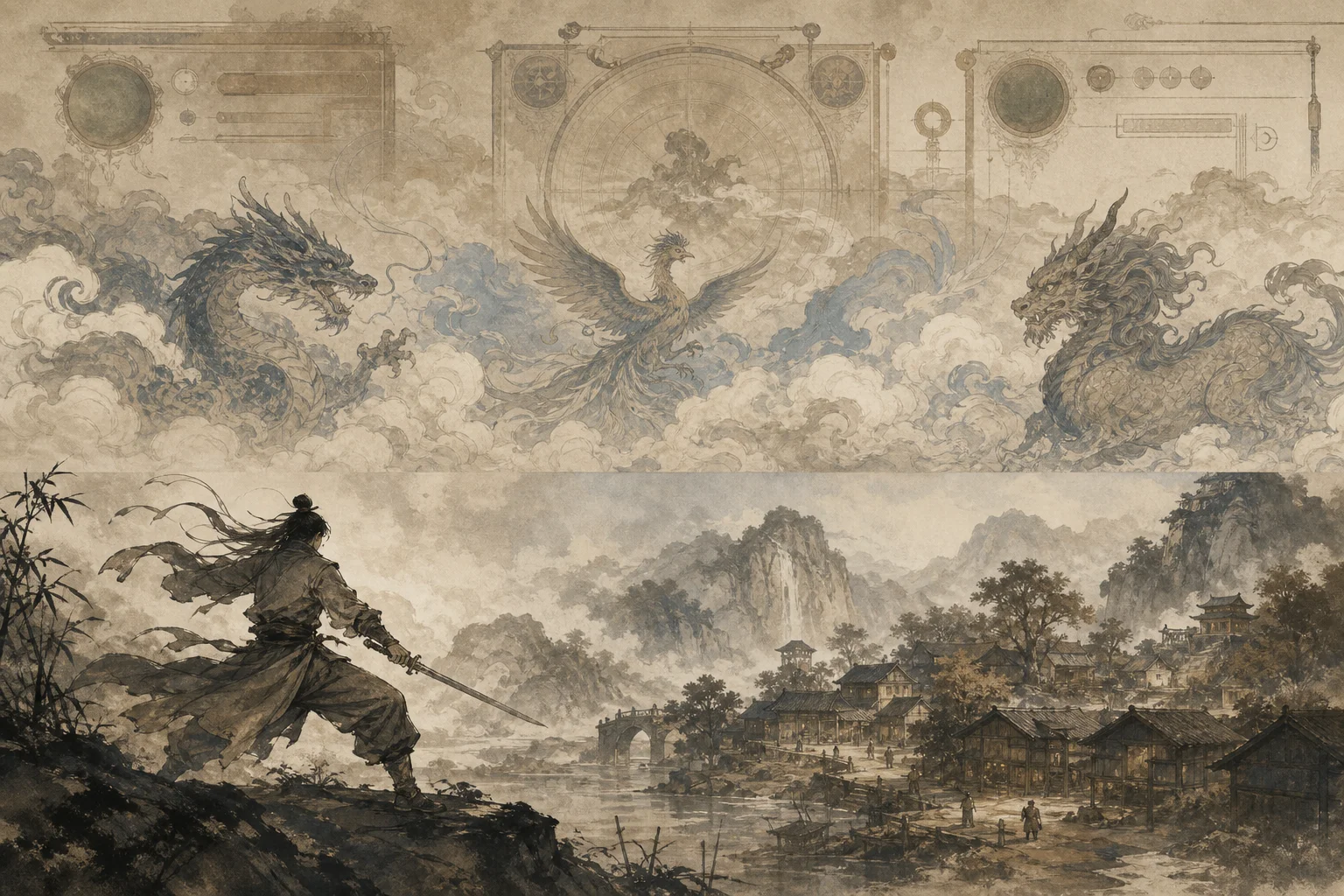
Living document. Unlike Black Myth: Wukong, which adapts one famous novel, The Scroll of Taiwu has no single source text and no pinned historical year. It still claims deep roots — Chinese mythology, martial-arts fiction, generational clan sagas — while asking you to write an emergent chronicle in a reshuffled jianghu. This page separates what ConchShip Games has officially confirmed from what comes from genre tradition, myth & folk sources, and pure Taiwu fiction. It also records what changed when v1.0 Beyond the Dome (天幕心帷) shipped in June 2026. Last scoped: v1.0 launch materials, Steam store text, and official English site through June 2026. Dragon Forge is editorial — not affiliated with ConchShip Games.
Status at a glance
Developer / publisher
ConchShip Games (螺舟工作室) · Hangzhou-based · Steam (PC)
v1.0 release
Beyond the Dome (天幕心帷) · June 17, 2026 · ground-up overhaul of Early Access
Genre
Open-world sandbox RPG · wuxia + myth · generational Roguelike conflict · sim & craft layers
| Item | Confirmed? | Notes |
|---|---|---|
| Cultural roots (wuxia + mythology) | Yes | Official pitch — not a retelling of one novel or dynasty |
| Taiwu clan heir across generations | Yes | Core identity; v1.0 adds custom characters & inheritable traits |
| Fifteen martial sects | Yes | Game-original schools; some arcs rewritten in v1.0 (e.g. Emei, Jieqing per store copy) |
| Procedural maps & NPCs | Yes | Each run's geography and cast differ; clan-level conflict persists |
| Hereditary enemy | Yes (framework) | Long-arc vendetta — details in spoiler-tagged articles, not here |
| Open sandbox + story pressure | Yes | Village life, sect politics, and vendetta can coexist; not a pure life sim |
| Baixiao Manual (百晓册) | Yes (v1.0) | In-game encyclopedia — setting detail lives here first |
| Demonic cultivation path (邪道) | Yes (v1.0) | Forbidden route converting enemy essence — cultural frame in our sects series |
| Official English localization | Yes (v1.0) | Large-scale translation shipped with complete edition |
| EA saves compatible with v1.0 | No | Core systems changed; Steam keeps EA Classic branch + character transfer tool |
| Playable figure from history or a novel | No | You play Taiwu heirs in fiction — not Tang Sanzang or a documented person |
| Linear retelling of Journey to the West | No | Myth stack is broader; names usually trace to Taiwu lore, not chapter maps |
Three layers (not one "adaptation")
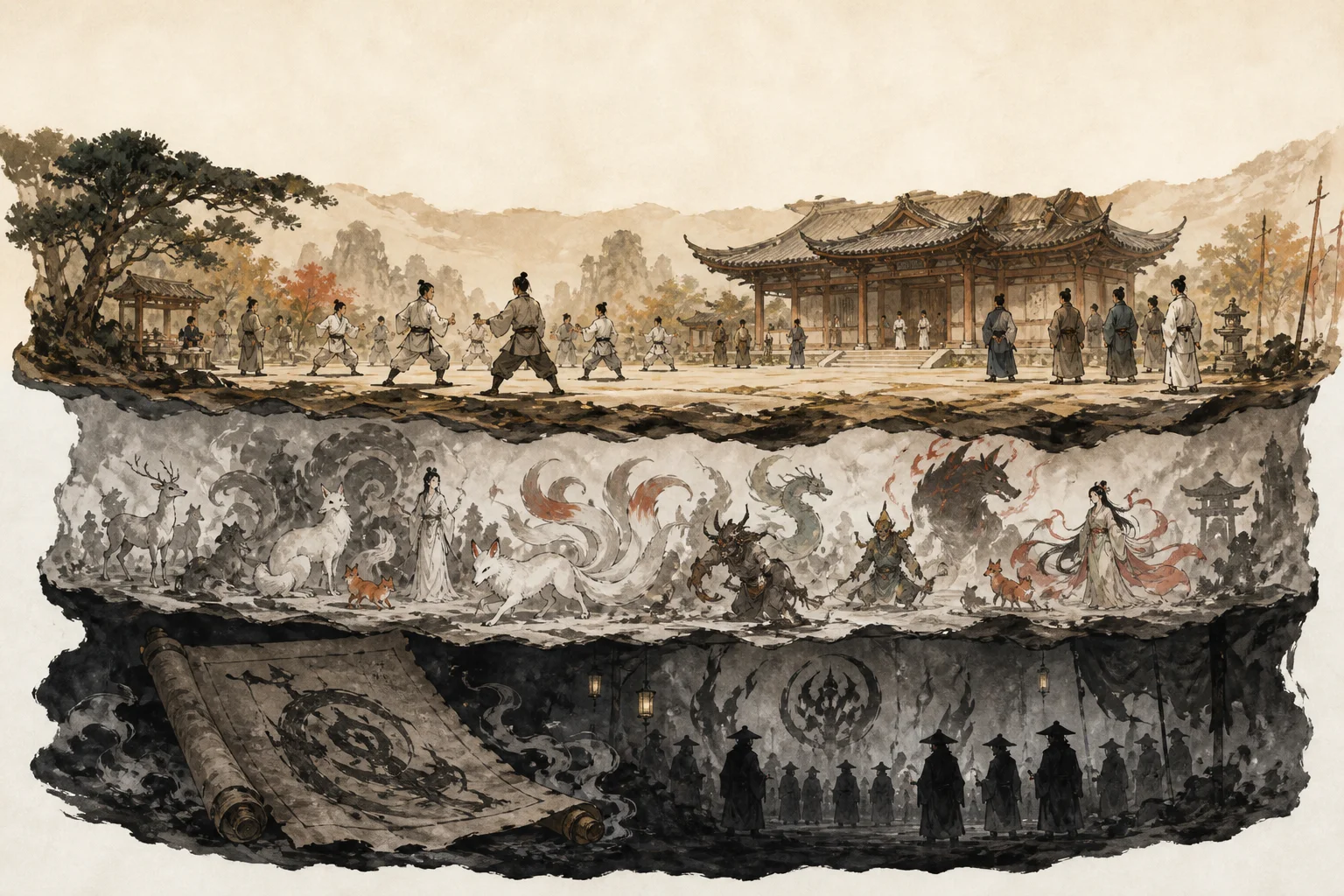
Use this filter whenever a name or scene feels “classical”:
| Layer | Question to ask | Example in Taiwu materials |
|---|---|---|
| Genre tradition | Is this how wuxia stories usually behave? | Sect rivalry; forbidden manuals; face and vendetta; generational succession |
| Myth & folk source | Does this echo a text, bestiary, or belief pattern? | Shan Hai Jing strangeness; zhiguai fox tests; yaoguai logic; talisman culture |
| Taiwu fiction | Is this invented for this game's clan saga? | The Taiwu name; specific sects & regions; procedural NPC bios; v1.0 endgame myth names |
A technique might sound like classical poetry (genre), use meridian language from cultivation lore (source), and belong only to a Jieqing disciple in your save (fiction). All three can be true at once. See our myth & strange-tales primer for the source layer in depth.
What official materials treat as "traditional"
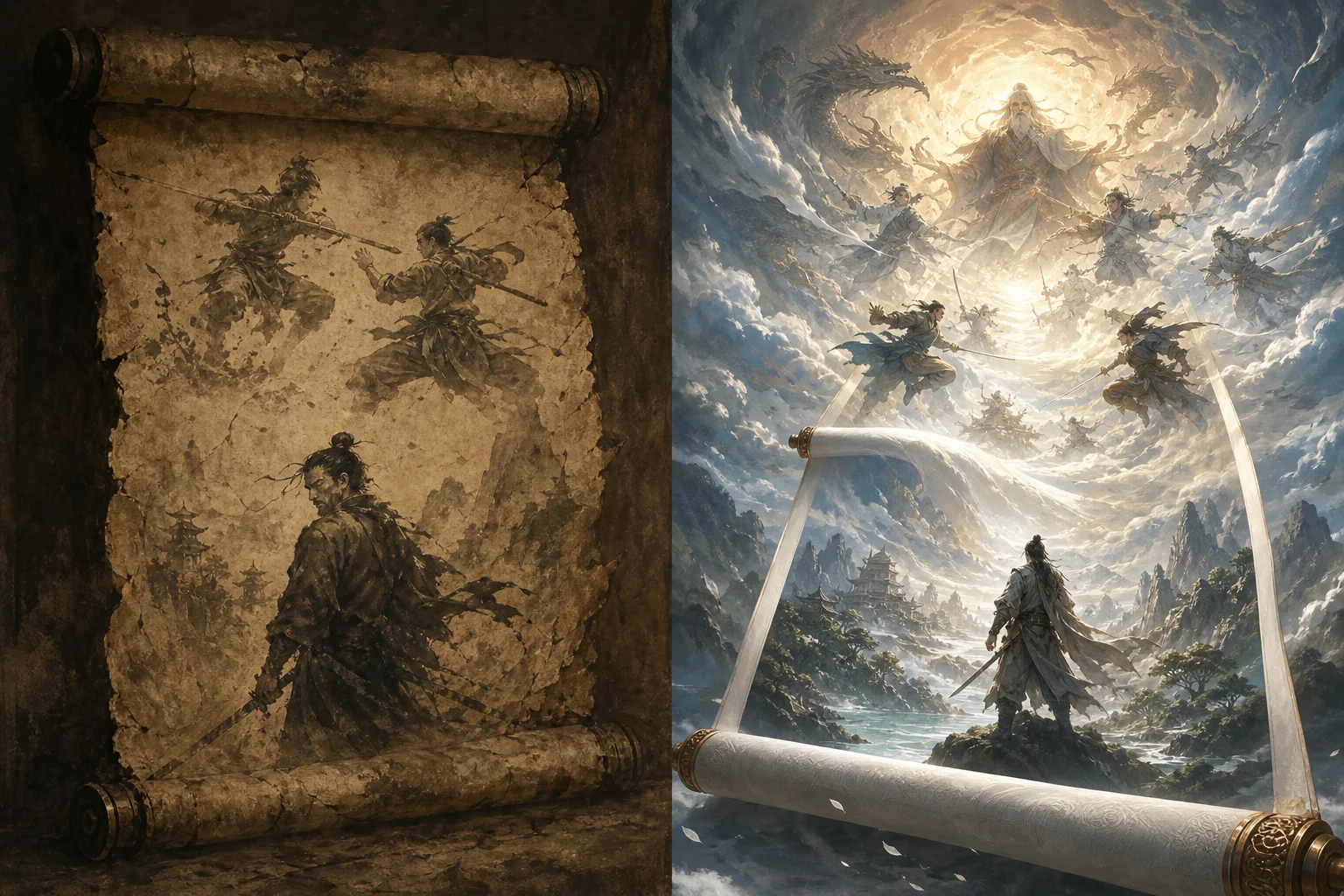
Steam and ConchShip's English site emphasize roots in martial fiction and Chinese myth, not homework in one dynasty:
- Jianghu social logic — alliances, blood feuds, sect study, wandering knights-errant
- Mythic and strange-tale atmosphere — esoteric cultivation, uncanny beings, darker v1.0 paths
- Generational storytelling — heirs inherit consequences, manuals, and grudges
- Material daily life — villages, craft, seasons, folk pastimes such as cricket fighting
- Martial body culture — turn-based combat with specific body-part strikes
- In-game reference — the Baixiao Manual as the primary lore authority for proper nouns
When marketing mentions thousands of techniques or fifteen sects, it signals genre depth — the way a wuxia reader expects manuals, schools, and rivalries — not a claim that every move exists in a historical manual.
What the game clearly fictionalizes
Without insider design documents, these are safe public-material classifications:
- The Taiwu bloodline and hereditary enemy — clan saga fiction driving long-arc stakes
- Named sects, regions, and NPCs — game-original cast in a procedural sandbox
- Map seeds and encounter tables — systems for replay, not geographic simulation of China
- Roguelike generational conflict — structured replay layered on top of wuxia inheritance tropes
- v1.0 mythic endgame figures — setting fiction (see spoiler articles for plot use)
- Difficulty tiers, UI, and onboarding — modern game craft, not cultural restoration
Our rule: We label genre tradition, myth & folk source, and Taiwu fiction separately. When patches rename sects, revise arcs, or add creatures, we update the tables above — and spin off spoiler articles when endgame lore needs plot context.
v1.0 Beyond the Dome vs Early Access Classic
Taiwu's long Early Access (2018–2026) makes version context essential for returning players and curious newcomers.
| Topic | EA Classic (legacy branch) | v1.0 Beyond the Dome |
|---|---|---|
| Status on Steam | Preserved TEST branch — The Scroll of Taiwu EA Classic | Default complete edition — ground-up system rebuild |
| Saves | Old saves remain playable on EA branch | Not compatible with EA saves; character transfer tool for engraved heirs |
| Localization | Primarily Chinese player base history | Official English (and existing Chinese) at scale |
| Presentation | Earlier UI and narrative delivery | Full UI reset; dynamic CG for key beats; difficulty tiers & guided onboarding |
| Content scope | Years of EA iteration | Rewritten sect arcs; new endgame challenges; demonic cultivation; expanded encyclopedia |
| Cultural frame | Wuxia sandbox + generations | Same frame — systems and canon delivery changed, not the basic pitch |
Culture hub note: Articles here describe the v1.0 framing unless marked otherwise. EA veterans comparing memories should expect renamed flows, revised stories, and a different onboarding curve — not a mere graphics patch.
Common fan assumptions (and corrections)
| Assumption | Likely? | Correction |
|---|---|---|
| “It adapts a Jin Yong novel” | No | Uses wuxia genre grammar; sect names and plot are Taiwu-original |
| “Every creature is from Shan Hai Jing” | Overstated | Bestiary mood often echoes classical strange catalogs; many entries are game fiction |
| “Sandbox means no main conflict” | Partial | Hereditary enemy arc exists; sandbox chooses how each heir engages it |
| “EA lore equals v1.0 canon” | Often false | Sect stories and systems were rewritten — check Baixiao Manual in v1.0 |
| “Demonic cultivation = edgy reskin” | Undersells it | Rooted taboo-power trope; see future orthodox vs demonic article |
| “English names are fan translations” | Outdated post-v1.0 | Prefer official English from store and in-game text when available |
How this differs from other Culture hubs
- Black Myth: Wukong — one novel; bosses map to chapters
- Blood Message — one historical year; fictional messengers in real gaps
- WUCHANG — pinned 1647 history + archaeology on a linear ARPG
- The Bustling World — material culture first; no pinned date; no fixed hero
- The Scroll of Taiwu — genre + myth first; procedural jianghu; clan chronicle you write across heirs
What we will update here
When ConchShip ships patches, DLC, or new store copy, we revise this page and our future Quick Reference:
- Sect name changes, arc rewrites, and new regions
- Baixiao Manual scope and English terminology shifts
- Confirmed endgame myth lore (cross-link to spoiler articles)
- Platform, price, and branch policy (EA Classic availability)
- Community-verified vs marketing-only features
Primary sources: ConchShip official site (EN), Steam store page, and in-game Baixiao Manual entries after v1.0.
Next in this series: Books, films, and online resources for players who want to go deeper — our reading and viewing list for The Scroll of Taiwu.