

After Rex Lapis, the most powerful names in Liyue belong to mortals: the Liyue Qixing (璃月七星), a council of merchant-officials who run the harbor's contracts, tariffs, and daily politics. Their title is not random fantasy — it points at the Big Dipper (北斗, Běidǒu), one of the most important star groups in Chinese astronomy and folklore. This article explains the seven star names, how they map to characters you meet, and why a trading nation chose the sky as its org chart.
What is the Liyue Qixing?
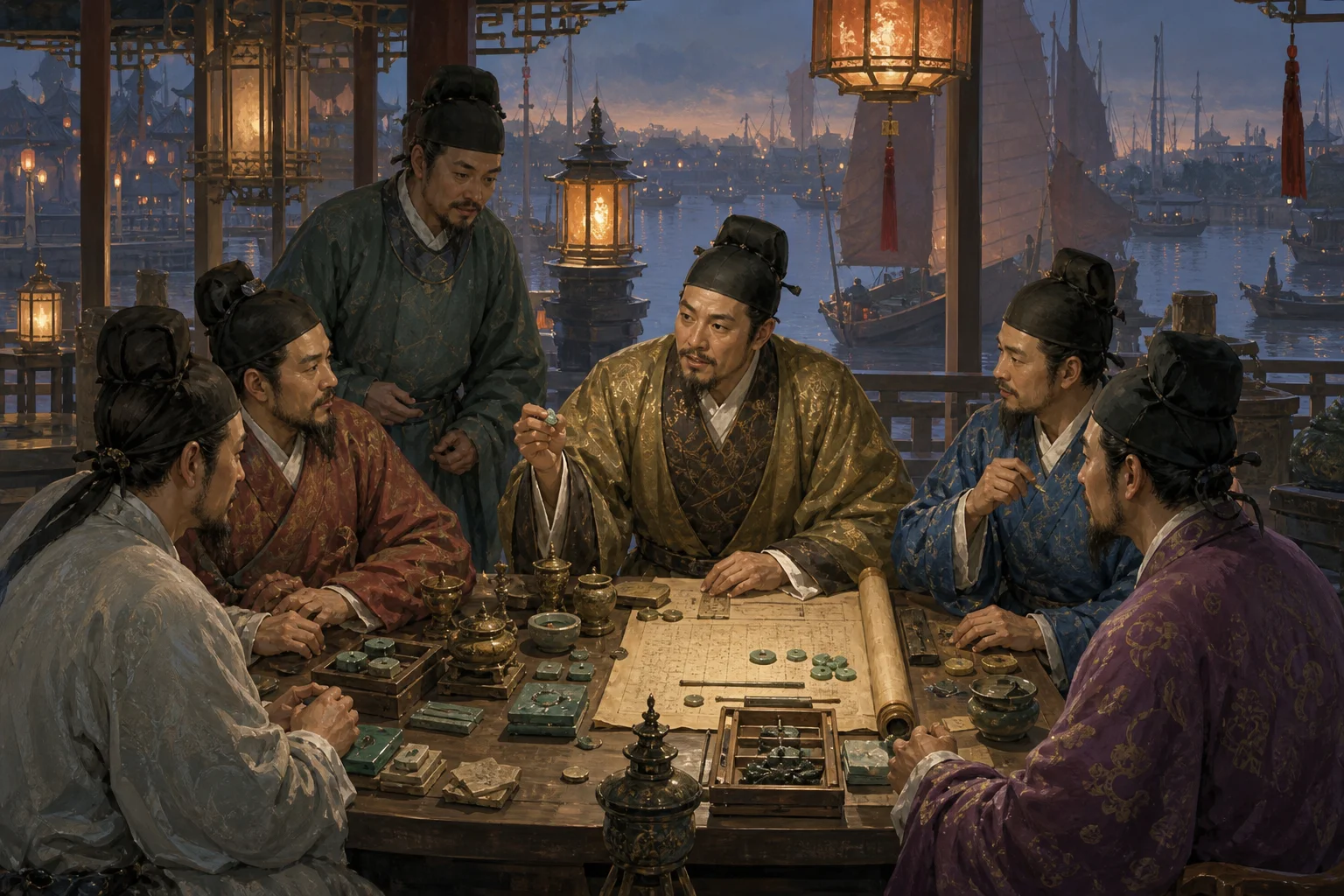
In-game, the Qixing are Liyue's human government — less a hereditary dynasty than a merchant republic with star titles. They negotiate with the Fatui, fund the Millelith, set harbor policy, and argue about how much mortal law should replace divine guidance now that Rex Lapis has stepped back from direct rule.
Culturally, the name rhymes with real Chinese habits of borrowing the cosmos for earthly order: emperors called themselves "Son of Heaven," calendars followed lunar stations, and star names marked rank the way modern ministries mark departments. Liyue compresses that into one visible institution — the Seven Stars who oversee the world's richest port.
Chinese
璃月七星 — "Liyue's Seven Stars"
Model
Merchant council + celestial bureaucracy
Real-world echo
Big Dipper lore, navigation, Tang–Song commerce
The Big Dipper in Chinese tradition
The Big Dipper (北斗七星) is a bowl-and-handle asterism in the northern sky. Chinese astronomy treats its seven bright stars as a single system tied to:
- Navigation — finding north when traveling by land or sea
- Timekeeping — the handle's rotation marks seasons in classical star lore
- Authority — the Dipper "turns" heaven's command; emperors and temples invoked it
- Myth — Daoist texts link the stars to deities, chariots, and the governance of fate
Each star has an old proper name. Together they form the template behind Liyue's ministerial titles:
| Star name | Chinese | Pinyin | Common association |
|---|---|---|---|
| Dubhe / Alpha UMa | 天枢 | Tiānshū | First star — "celestial pivot" |
| Merak | 天璇 | Tiánxuán | Second star — "jade ring" of heaven |
| Phecda | 天玑 | Tiānjī | Third star — celestial balance |
| Megrez | 天权 | Tiānquán | Fourth star — "celestial power / authority" |
| Alioth | 玉衡 | Yùhéng | Fifth star — "jade measuring rod"; justice and standards |
| Mizar | 开阳 | Kāiyáng | Sixth star — opening the yang principle |
| Alkaid | 瑶光 | Yáoguāng | Seventh star — luminous jade light |
You do not need to memorize every star to play Liyue — but when a character's title is Yuheng (玉衡), the game is quietly saying: this person carries the measuring rod of heaven, the official who sets standards and plans.
Characters and star titles
HoYoverse has not named all seven sitting members in public story — but several playable and major NPCs wear Dipper titles on their sleeves:
Tianquan · 天权
Ningguang 凝光
Liyue's wealthiest magnate and builder of the floating Jade Chamber (群玉阁). "Tianquan" suggests celestial authority — power exercised through jade, intelligence networks, and Mora.
Yuheng · 玉衡
Keqing 刻晴
The planner who wants Liyue to stand on human effort, not divine habit. Yuheng is the measuring rod — standards, schedules, infrastructure, reform.
Constellation name
Beidou 北斗
Not a Qixing ministerial title, but the entire Dipper itself — perfect for a captain who navigates by stars and runs the Crux fleet outside polite harbor politics.
Ganyu (甘雨) often appears beside the Qixing as Rex Lapis's longstanding secretary — half-adeptus bureaucrat rather than a star-titled merchant prince. She shows how Liyue's government mixes immortal contracts with mortal administration. For the Archon's layer, see Morax, Zhongli & the God of Contracts.
Trade, contracts, and why merchants govern
Tang and Song China prized maritime and overland trade. Port cities grew rich on silk, tea, porcelain, and salt — managed through guilds, licenses, and written agreements. Liyue pushes that history into fantasy: the nation that invented Mora treats commerce as sacred, so its rulers look like CEO-statesmen as much as classical officials.
The Qixing debate you hear in story — whether Liyue still needs a god — is also a debate about who owns the contract when the contract-giver walks away. That is distinctly Liyue, and distinctly tied to a culture that respected both heaven's mandate and a fair deal on paper.

Beidou vs. the Qixing
Players sometimes conflate Beidou with the council because her name is the constellation itself. Useful distinction:
- The Qixing are a formal governing body with star minister titles and harbor policy power.
- Beidou leads the Crux — semi-autonomous sailors who operate between law and frontier.
- Culturally, both belong to the same symbolic world: navigation, risk, and north-star confidence.
She is the folk hero of the open sea; they are the boardroom. Liyue needs both to stay rich and defensible.
What the Qixing are not
The Qixing are not a one-to-one copy of a specific Tang dynasty cabinet or a complete map of every Big Dipper deity in Daoist religion. HoYoverse uses the seven-star naming system to signal Chinese bureaucratic cosmology — not to teach an astronomy exam. Treat star tables as cultural context, not spoiler keys to hidden characters.
Key terms
| English | Chinese | Quick meaning |
|---|---|---|
| Liyue Qixing | 璃月七星 | Seven Stars — Liyue's governing merchant council |
| Big Dipper | 北斗 | Seven-star northern asterism; navigation and authority |
| Yuheng | 玉衡 | Keqing's star title — jade balance / measuring rod |
| Tianquan | 天权 | Ningguang's star title — celestial authority |
| Jade Chamber | 群玉阁 | Ningguang's floating pavilion — symbol of Qixing wealth |
Next in this series: Xiao & the Yaksha Tradition — the guardian who never joined the merchant debate but still holds Liyue's borders. Or review the Liyue glossary for star names and character lookups.