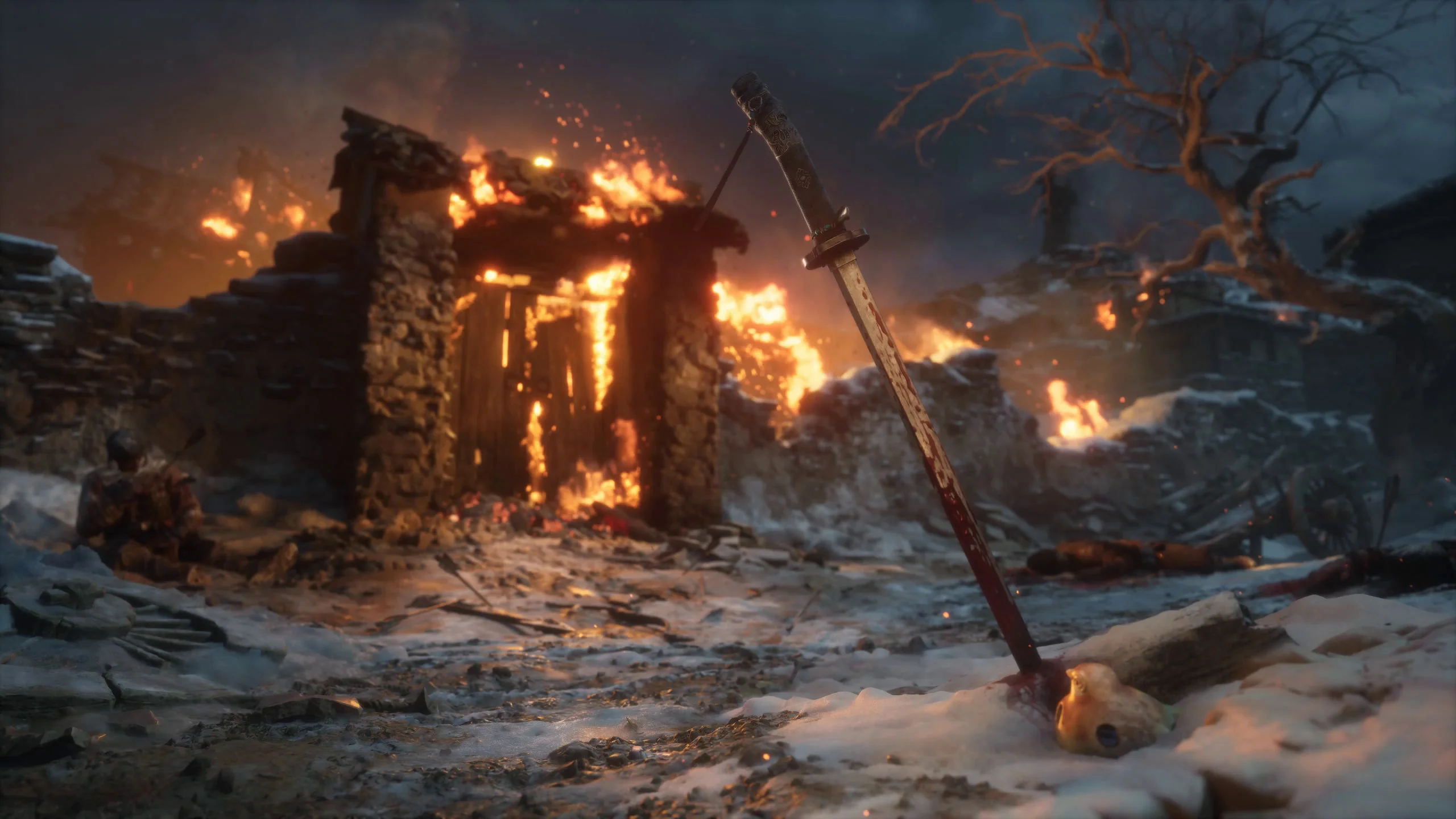
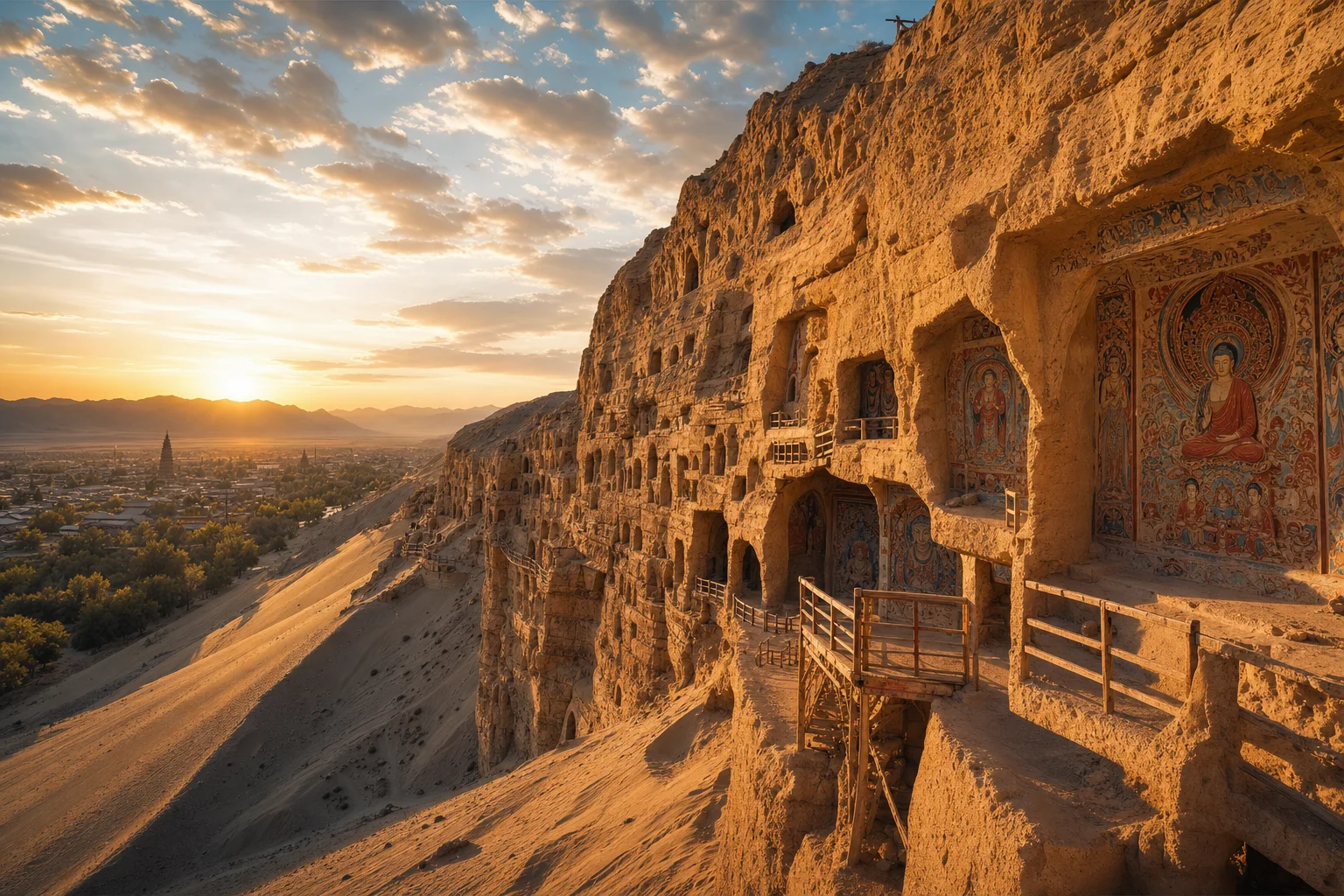
Dunhuang is not a generic desert backdrop. For a thousand years it was one of the richest cultural crossroads on earth — a city where Silk Road merchants, Buddhist monks, and Tang officials shared walls painted in lapis and gold. Blood Message draws heavily on this visual heritage. Here is why the game's look and feel are rooted in real places you can still visit today.
Dunhuang = Shazhou
In Tang administrative terms, Shazhou (沙州) was the prefecture; Dunhuang (敦煌) was its principal city. Players and historians use both names. When Zhang Yichao rebelled in 848, he seized Shazhou — meaning Dunhuang and its surrounding garrison farms. The city sat at the junction of routes south into Qinghai, west into the Tarim Basin, and east toward the Chinese heartland.
Mogao Caves
492 decorated caves; UNESCO World Heritage; murals span 4th–14th centuries
Dunhuang manuscripts
Tens of thousands of documents — Buddhism, contracts, poetry, daily life
Silk Road role
Gateway between Chang'an and Central Asia; multicultural by design
The Mogao Caves: art as archive
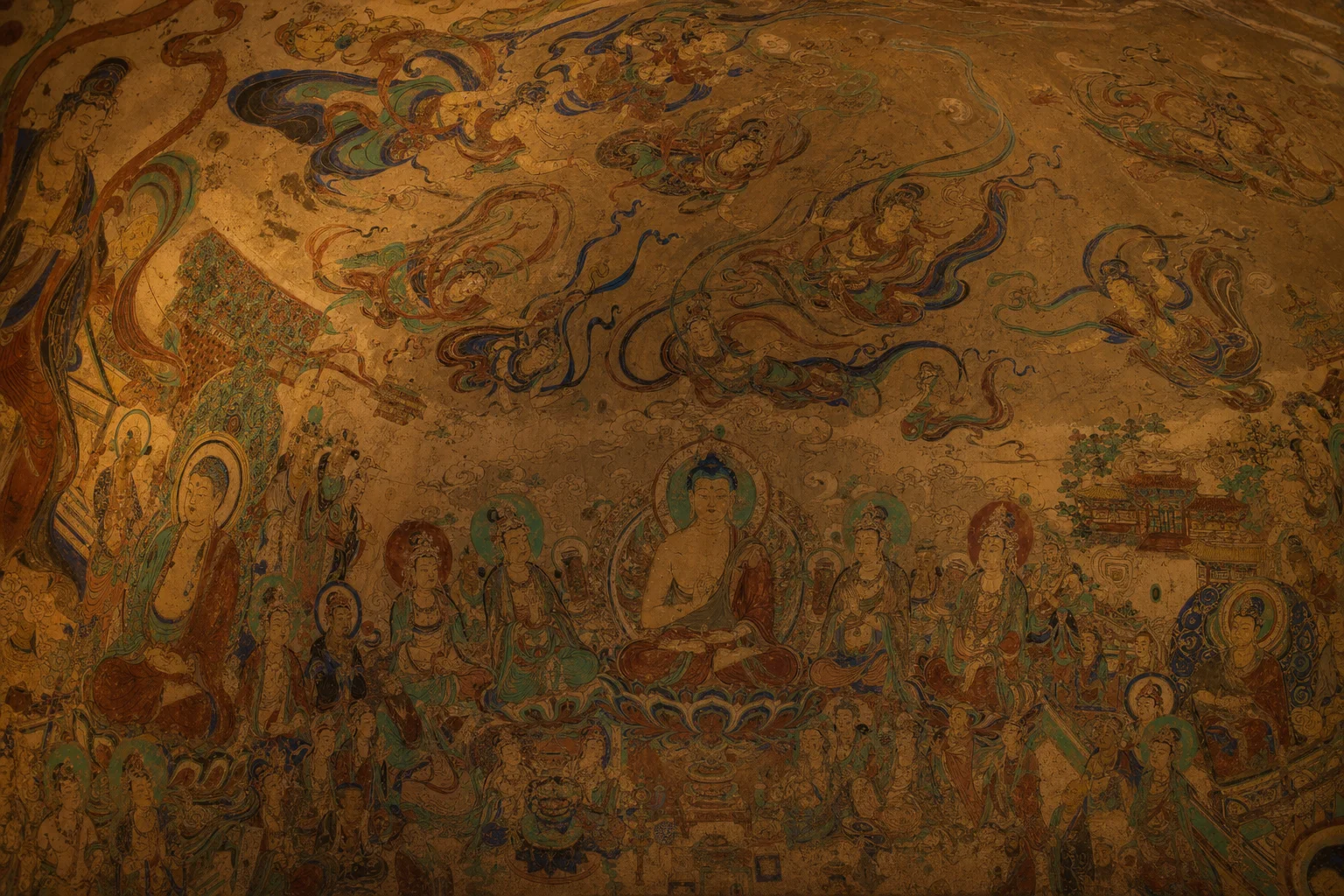
The Mogao Caves (莫高窟, Mògāo Kū) lie southeast of Dunhuang city — hundreds of Buddhist temple grottoes carved into a cliff face. Tang-era caves show bodhisattvas, flying apsaras, and donor portraits of local families who paid for merit. Critically for Blood Message's historical layer, Dunhuang preserves visual records of the Guiyi Army period, including the famous Zhang Yichao Leading His Army mural — a procession of cavalry and banners commemorating the very regime the game celebrates.
NetEase's marketing emphasizes Dunhuang aesthetics: mineral-pigment colors, flowing robes, gold leaf patterns, desert light on mud-brick walls. These are not fantasy motifs — they are documented styles from cave walls that survived because the climate is dry and the site was revered.
Multicultural Hexi
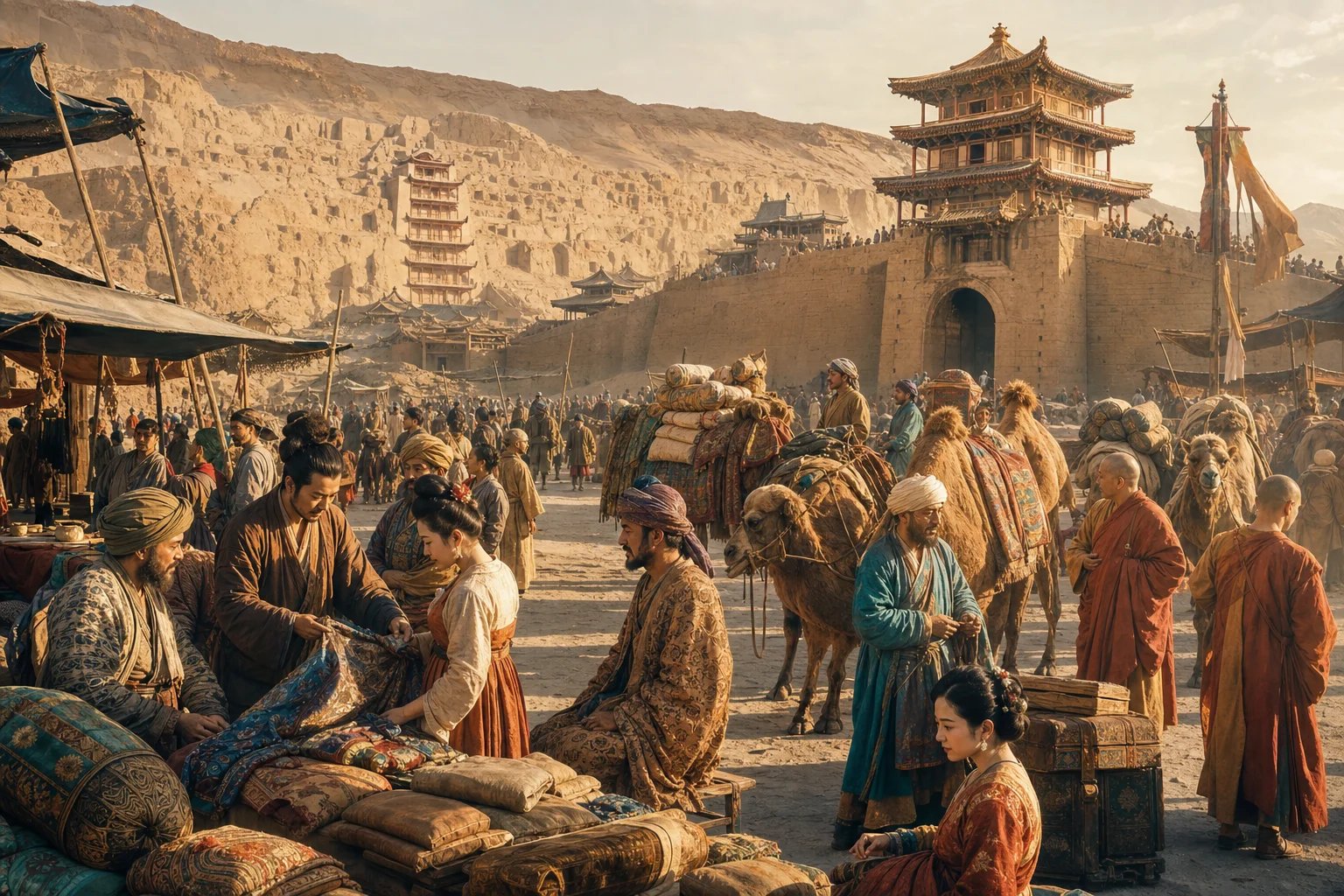
Dunhuang under Tang and Tibetan rule was never ethnically simple. Manuscripts appear in Chinese, Tibetan, Sanskrit, Sogdian, and Uyghur. Merchants from Samarkand worshipped beside Han farmers; Buddhist abbots negotiated with military governors. Blood Message's "ordinary heroes" — stonemasons, monks, farmers — reflect this social fabric: a city built by many hands, fighting to remain itself.
Why Buddhism matters here
Buddhism was the dominant public religion in Dunhuang. Monasteries owned land, ran schools, and provided the clergy who doubled as diplomats and, in 848, as messengers. Wuzhen's monastic courier team was historically plausible: monks traveled with fewer obstacles, carried writing skills, and commanded local respect. The game's spiritual tone — mural Buddhas watching over carnage — echoes how Dunhuang residents literally lived beside sacred art.
The Dunhuang Library Cave
In 1900, a sealed chamber (Cave 17) was discovered packed with manuscripts hidden circa 11th century — including documents from the Guiyi Army era. These papers let modern scholars reconstruct prices, loan contracts, military rosters, and even popular storytelling texts like the Zhang Yichao Bianwen (张议潮变文) — a narrative ballad celebrating the uprising. Blood Message sits in a long tradition of retelling this history; the game is the newest layer on a story Dunhuang never stopped telling.
Visit virtually: The Digital Dunhuang project offers high-resolution cave tours online — useful context before playing.
Silk Road material culture
Expect to see in game and in history:
- Silk and wool — trade goods that paid for temples
- Paper and ink — Dunhuang was a production center for Buddhist scrolls
- Weapons and armor — Tang-style lamellar mixed with frontier practicality
- Music and dance — reflected in cave paintings of ensembles and feasts
The Silk Road was not only a trade route but a technology highway: printing, astronomy, and artistic techniques flowed east and west through Dunhuang. When Blood Message shows a ruined yet beautiful city, it references a place that was genuinely once among the most cosmopolitan on the planet.
Next: How the game adapts history — confirmed facts, creative choices, and what we update when new trailers drop.