Zhong Kui (钟馗, Zhōng Kuí) is one of China's best-known ghost catchers — not a Western-style demon hunter, but a folk judge of the uncanny who punishes evil spirits and protects the living. This ten-minute primer covers who he is, how the legend grew, and why his image still hangs on doors today — no classical Chinese required.
Who is Zhong Kui?
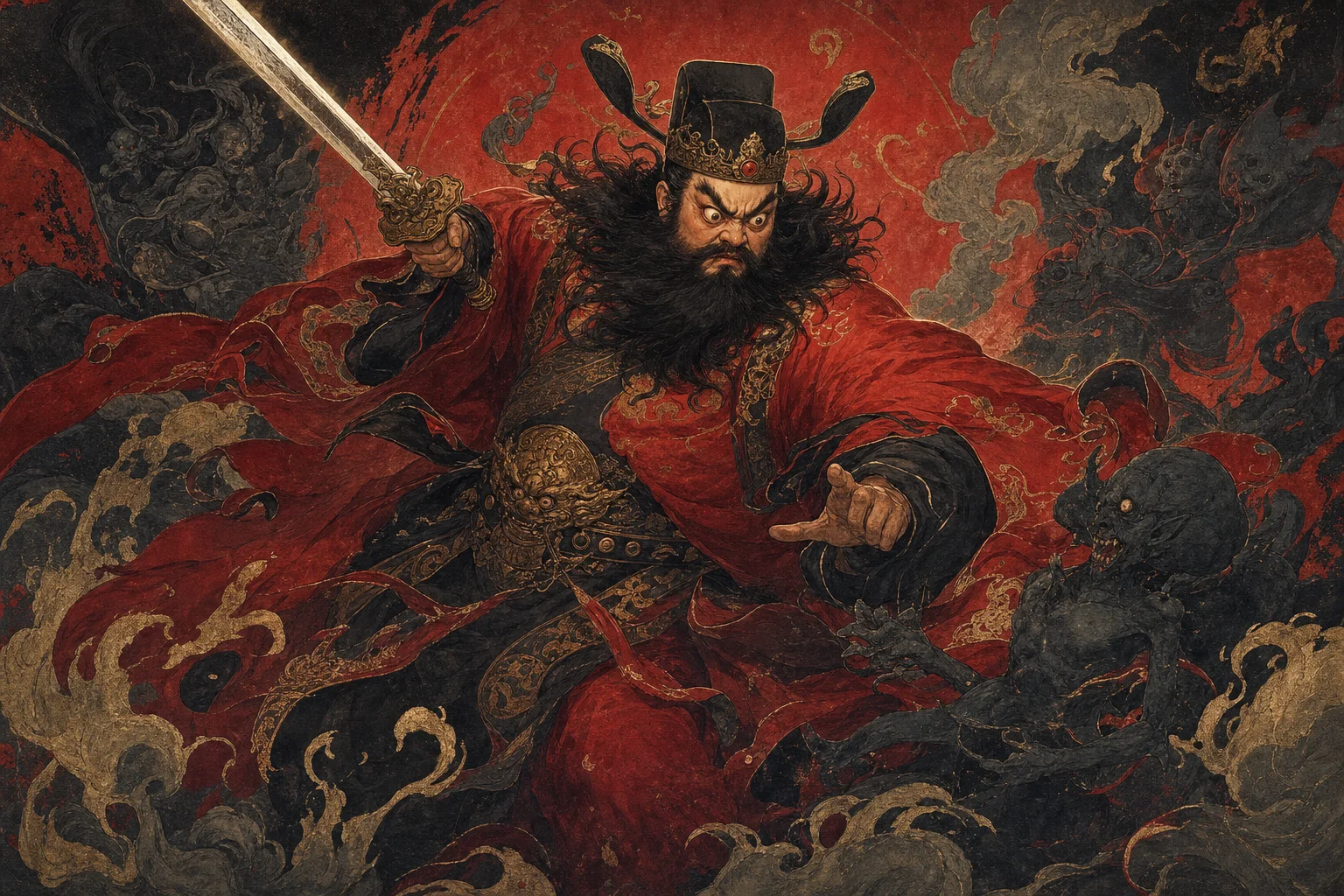
In Chinese folklore, Zhong Kui is the figure you call when ghosts become a problem. He is fierce, ugly, and absolutely not interested in negotiation. Armed with a sword — sometimes called the sword for slaying ghosts (斩鬼剑, zhǎn guǐ jiàn) — he hunts evil spirits, swallows demons, and restores order between the living world and whatever crawls out of the dark.
Unlike a Buddhist monk or a Taoist priest performing rites, Zhong Kui is remembered as a warrior-exorcist: direct, violent when necessary, and morally certain. He does not debate whether a ghost deserves mercy. If it harms people, it gets the sword.
Role
Demon queller, household protector, underworld enforcer
Tradition
Folk religion + zhiguai (志怪) strange tales — not a single novel
Core hook
A brilliant scholar rejected for his looks; death turns him into the ghost who hunts ghosts
The legend: how a failed scholar became a ghost king
There is no one official biography. Zhong Kui's story spread through folk tales, paintings, opera, and notebooks of strange events over roughly a thousand years. But the version most Chinese readers know goes like this:
The examination and the fall
During the Tang dynasty (618–907 CE), a scholar named Zhong Kui travels to the capital to take the imperial examination (科举, kējǔ) — the civil service test that could lift a talented man from obscurity into government office. He performs brilliantly. On paper, he should win.
He is rejected anyway. Different retellings blame different causes — corrupt officials, political favoritism, or simply his ugly appearance: wild beard, bulging eyes, dark complexion. A face that did not match what the court wanted to see. Humiliated and furious, Zhong Kui kills himself at the palace gate, striking his head against the steps until he dies.
The emperor's dream
Sometime later, the Tang emperor — usually identified as Emperor Xuanzong (唐玄宗) — falls gravely ill with fever. In a dream, he sees a small, sneaking ghost stealing treasures and harassing his beloved consort Yang Guifei. Then a much larger, uglier man appears, catches the small ghost, tears it open, and devours it.
When the emperor demands to know who he is, the figure answers: I am Zhong Kui of Zhongnan Mountain. I failed the imperial exam and died in disgrace — yet I swore to exterminate evil spirits on behalf of Your Majesty. The emperor wakes cured. Grateful, he orders a state burial for Zhong Kui and commissions portraits of the demon queller to protect the realm.
Why the ugly face matters
- → Zhong Kui is not a handsome hero. His power lives in his terrifying presence — the kind of face that frightens ghosts before the sword swings.
- → The legend critiques a society that judges talent by appearance, then elevates the outcast into a protector everyone needs.
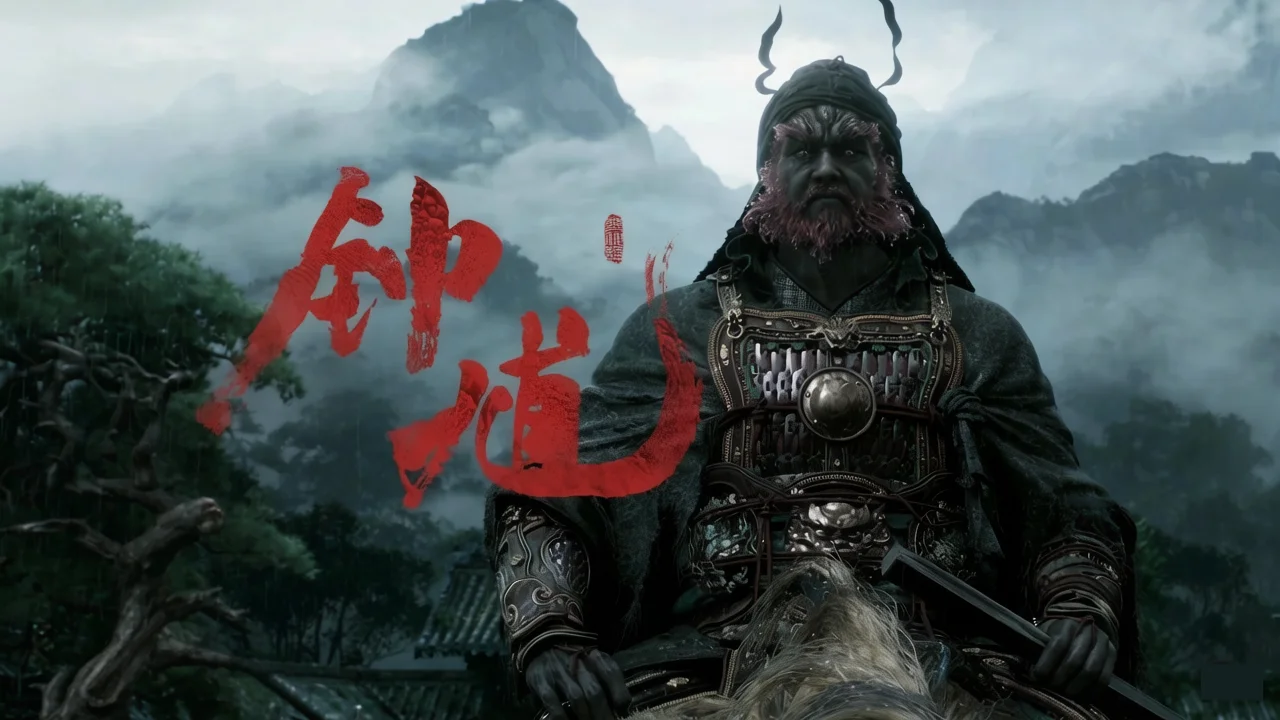
- → Black Myth's teaser leans into this: a coiled black beard, heavy armor, and an aura that says do not mistake me for a bureaucrat.
Other origin threads
Folklore rarely settles on one version. You may also encounter these threads — all part of the same cultural figure, not contradictions to panic over:
Variant A
The underworld appointment 冥府封官
After death, the king of the underworld recognizes Zhong Kui's talent and names him a ghost official — sometimes “king of ghosts” (鬼王), sometimes chief demon queller. Justice arrives from below, not from the court above.
Variant B
The Daoist exorcist 终南道士
Some sources place Zhong Kui on Zhongnan Mountain (终南山) as a trained exorcist before any examination story. Here he is less wronged scholar, more professional spirit-fighter from the start.
Variant C
The painter's patron 吴道子
Legend credits the great Tang artist Wu Daozi (吴道子) with the first iconic portrait — so vivid that one painting supposedly came alive. Art and myth reinforce each other.
Variant D
The sister's wedding 钟馗嫁妹
A separate beloved tale — Zhong Kui Marries Off His Sister — shows his human side: a dutiful brother arranging his sister's marriage even after death. More on this in later articles on famous episodes.
What Zhong Kui is — and what he is not
Western players often reach for easy comparisons: Van Helsing, the Doom Slayer, Constantine. Useful as a mood reference, but the Chinese figure sits in a different cosmology.
| Zhong Kui is | Zhong Kui is not |
|---|---|
| A folk exorcist and protector of households | The Buddhist King of Hell (that is Yanluo Wang / 阎罗王) |
| A symbol of justice against corrupt powers and evil spirits | A courtroom judge who weighs souls (that is the panguan / 判官) |
| A cultural icon in painting, opera, and festival custom | A single character from one fixed novel with a chapter-by-chapter plot |
| Sometimes shown commanding lesser ghosts who serve him | A generic “monster” — he is on the side of order, even when he looks terrifying |
Think of him as a border guard between normal life and the uncanny: the person you put on your door so trouble walks somewhere else.
Iconography: how to recognize him
Once you learn the visual shorthand, Zhong Kui is unmistakable in Chinese art — and increasingly in Black Myth marketing.
Face
Fierce & ugly 豹头环眼
Wide glaring eyes, leonine features, dark or flushed skin. The face is a weapon — meant to scare spirits, not win polite company.
Beard
Wild black whiskers 虬髯
A bursting, coiled beard signals uncontainable force. The game's teaser emphasizes this texture — less groomed official, more living thunderstorm.
Weapon
Ghost-slaying sword 斩鬼剑
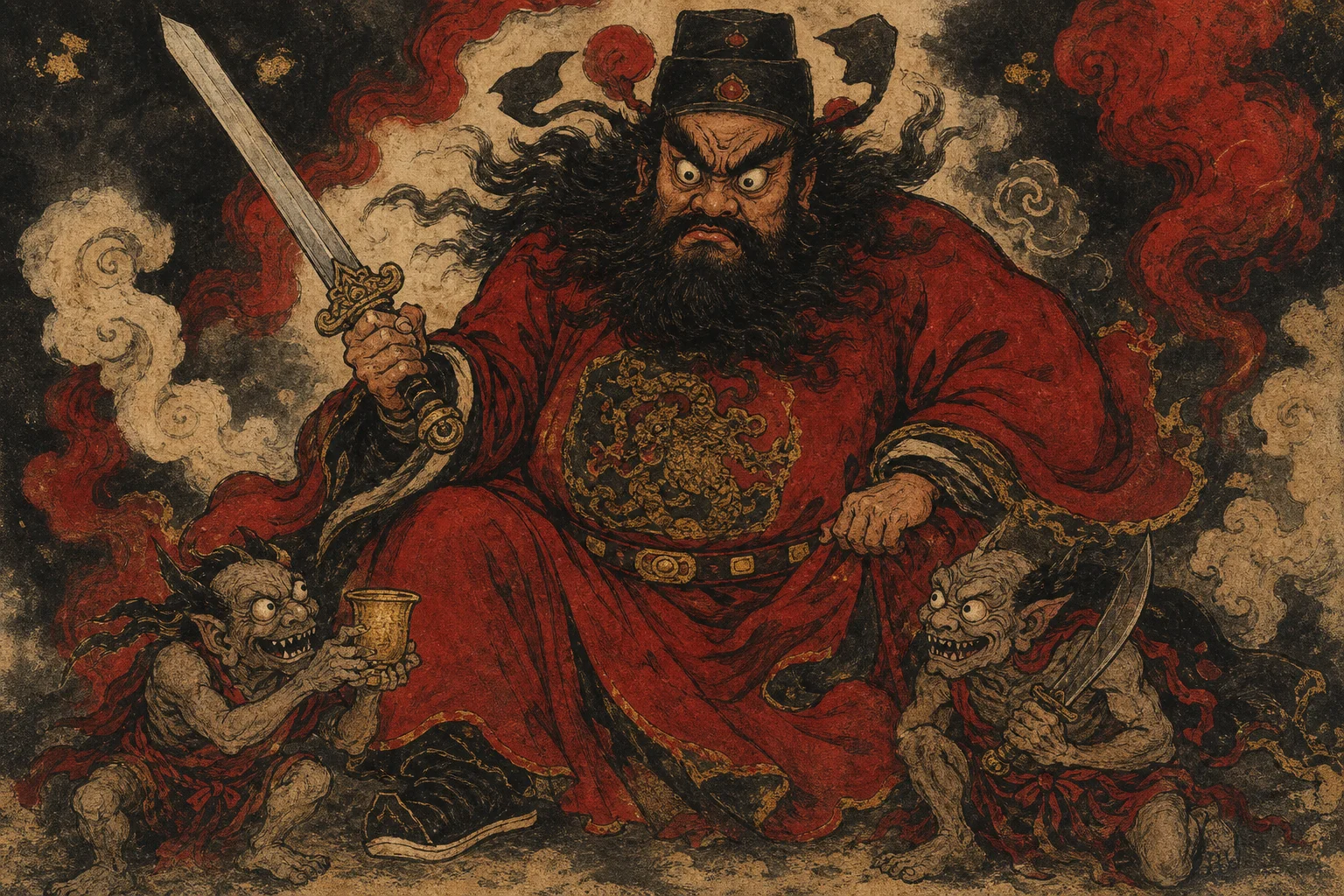
A large blade for executing demons. In the Gamescom 2025 teaser, lesser ghosts carry the sword before he takes it — a classic motif of spirits serving the exorcist who mastered them.
Companions
Servant ghosts & tiger 小鬼 · 虎
Small demons hold his wine cup, carry his sword, or get kicked aside. Sometimes he rides a tiger — another symbol of ferocious authority over the wild and the dead.
Why Chinese families still hang his picture
Zhong Kui is not locked in ancient history. He is a living folk practice. People hang his image when they want protection — especially at moments when the boundary between the human world and the spirit world feels thin.
Door gods and home protection
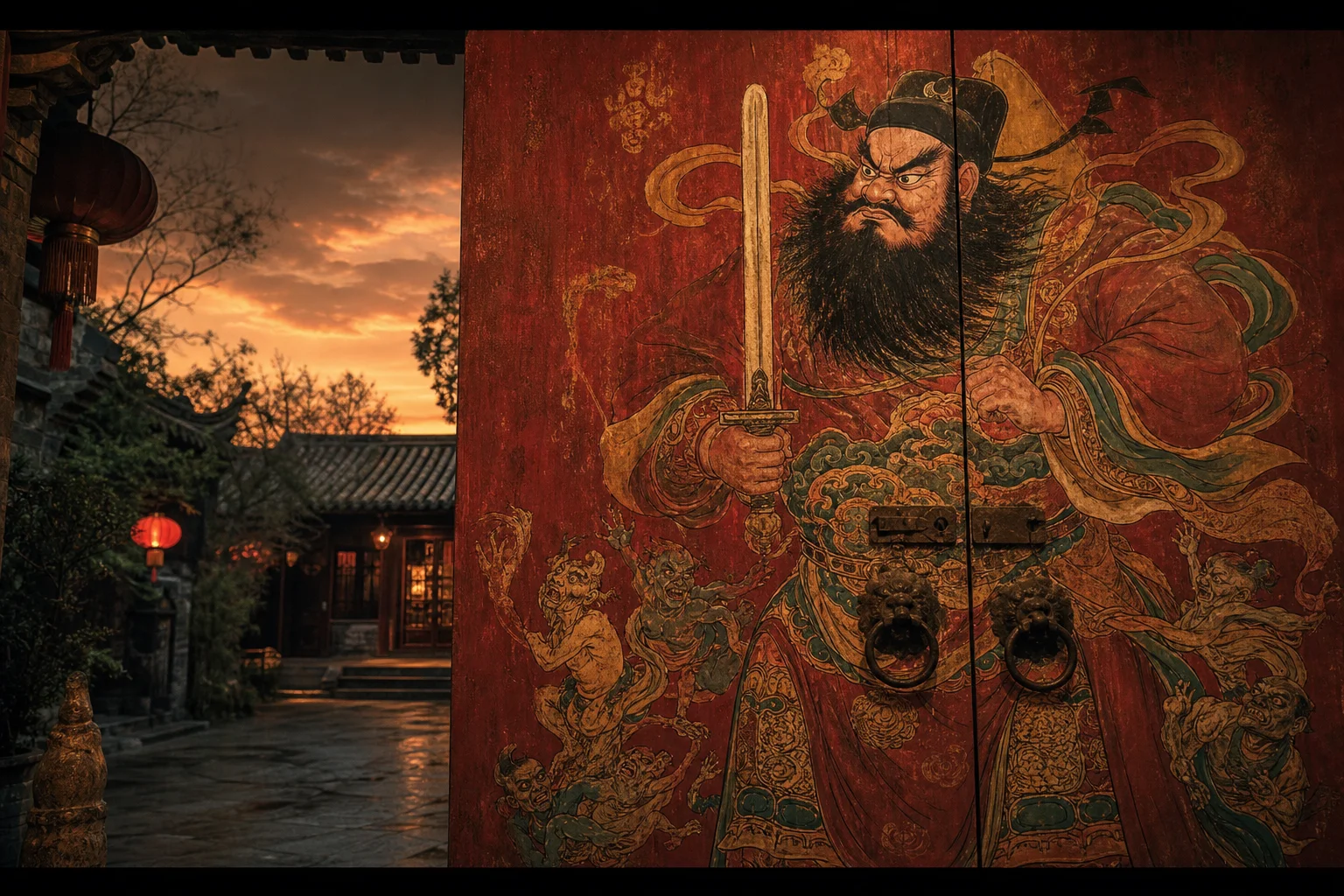
Paired with other guardian figures, Zhong Kui appears as a door god (门神, ménshén): a portrait pasted on gates and doors so malign spirits cannot enter. The logic is simple — if a ghost sees Zhong Kui waiting inside, it leaves.
New Year and festival customs
His face shows up in New Year prints (年画, niánhuà) and seasonal exorcism customs, including traditions around the Dragon Boat Festival (端午节) when people seek relief from summer illness and “evil qi.” Different regions, different timing — but the function stays the same: keep the uncanny out of the house.
Stage, scroll, and screen
You will find Zhong Kui in Peking opera, regional drama, ink painting, and countless internet memes. The figure is flexible: terrifying in one scene, comic in the next, righteous throughout. That range is part of why artists and game designers keep returning to him.
Why it matters for Black Myth: Zhong Kui
Game Science's second Black Myth title is explicitly rooted in this folklore. The official announcement describes a single-player action RPG inspired by the ghost-catching traditions surrounding Zhong Kui and by zhiguai — China's long literature of strange tales where ghosts, fox spirits, and ordinary people collide in unsettling ways.
This is a different creative foundation from Black Myth: Wukong, which drew on the novel Journey to the West. There is no single 100-chapter book to read before launch. Instead, the game appears to be building from a cloud of stories: the examination legend, underworld cosmology, exorcism rituals, and the darker aesthetic of classical strange tales.
The first CG teaser (Gamescom 2025) already signals the tone: heavy armor with Tang-era architectural details, a tiger in the rain, ghosts in attendance, and a hero who raises his blade to “judge wrong and right.” The project is still in early development — treat every visual as inspired by folklore, not confirmed plot.
How to read along before release
- → Zhong Kui is a cultural figure, not a copyrighted character with one official backstory.
- → When trailers show ghosts, swords, or underworld imagery, ask which folk motif they echo — not which chapter they adapt.
- → Continue with our next primer on the underworld and Chinese ghost cosmology.
Key terms to remember
Bookmark these four — they will recur across Black Myth: Zhong Kui coverage and the rest of this culture series.
| English | Chinese | Meaning |
|---|---|---|
| Zhong Kui | 钟馗 | The demon-quelling folk hero at the center of the game's inspiration |
| Ghost catching / demon quelling | 捉鬼 | The core activity — hunting and subduing harmful spirits (cf. Zhong Kui Slaying Ghosts / 钟馗捉鬼) |
| Zhiguai | 志怪 | “Records of the strange” — a literary tradition of supernatural short tales |
| Door god | 门神 | Protective deity pasted on doors; Zhong Kui often serves in this role |
| Imperial examination | 科举 | The civil service test at the heart of Zhong Kui's most famous origin story |
| Ghost-slaying sword | 斩鬼剑 | Zhong Kui's signature weapon in folklore and the teaser imagery |