Review info: Post-launch Steam build (June 2026) · PC (Steam app 3117820, RTX 4070 / Ryzen 7 7700) · ~42 hours played (multiple runs, several endings, Fate Point meta) · Light spoilers (mechanics and themes only)
Read this first: Store links, platforms, and tags live on the Game Hub. This review focuses on whether the Steam PC version is worth your money today.
When Sultan's Game launched in March 2025, Chinese players already knew Double Cross's demo could hook you with one cruel idea: draw a Sultan Card every week, complete its sin within seven days, or face the executioner. Western players arriving in mid-2026 get the full picture — a narrative card survival RPG with CRPG attribute checks, party management, 50+ endings, and roughly 1.4 million words of court intrigue, cosmic horror, and Faustian bargains dressed in Arabian Nights finery. The question is not whether Sultan's Game is distinctive — the red-and-black UI and Muqam-influenced score make that obvious — but whether you want a text-heavy, RNG-tolerant RPG that asks you to break cards by breaking people.
Seven Days or the Axe
Double Cross (双头龙工作室) shipped Sultan's Game through 2P Games on March 31, 2025 for Windows, macOS, and Linux — Steam Deck Verified, premium-priced, no microtransactions. You play a lowly minister serving an insane Sultan in a fantasy empire inspired by One Thousand and One Nights. A mysterious sorceress introduces the Sultan to a deck of cursed cards; soon you are trapped in the same game — weekly draws, seven-day deadlines, and consequences that ripple through every relationship you still have left.
If you wanted another Reigns swipe-fest, adjust expectations. Sultan's Game is closer to Cultist Simulator plus Crusader Kings court drama plus CRPG dice checks — but with a party you can train, equip, and send to morally repulsive errands. Our review focuses on whether that hybrid plays as well as it reads.
From Double Cross to a Court of Cards
Double Cross spent years on a demo that spread through Chinese streaming culture before the full release topped Steam's regional bestseller list. The native language is Simplified Chinese; Traditional Chinese, English, and Japanese localizations ship on Steam. We tested the English UI and subtitles on PC — terminology stays consistent (Sultan Card, Carnality, Extravagance, Conquest, Bloodshed), though the sheer text volume means occasional stiff phrasing compared to the Chinese reference. Copy was self-purchased; no review code was provided by the publisher. Premium pricing holds at $24.99 USD on Steam (often discounted) — no season pass, no cosmetic shop. Store links live on the Game Hub.
The Weekly Loop: Draw, Break, Survive
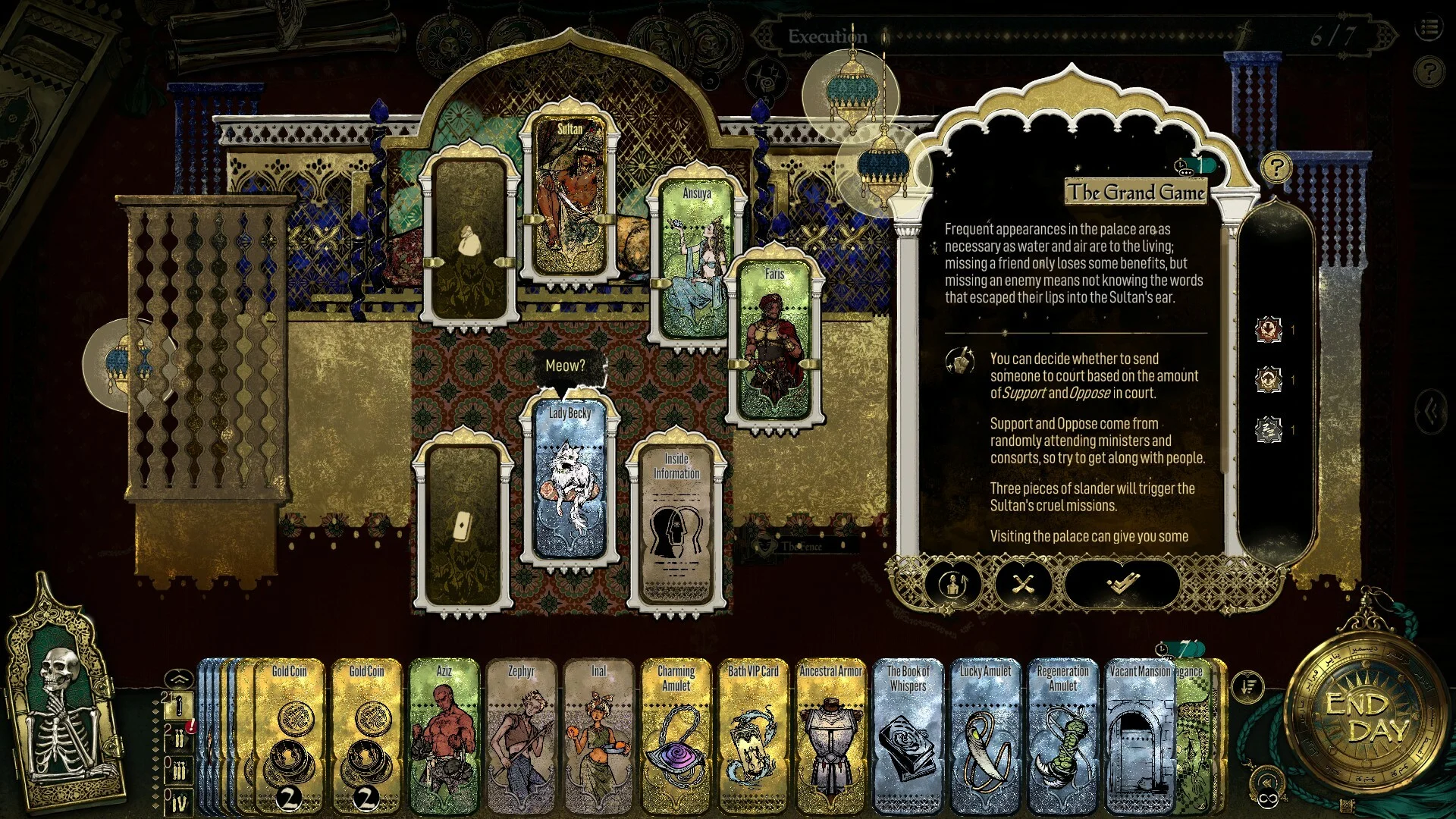
Once tutorials finish, your calendar reads: draw one of four Sultan Cards → spend seven in-game days allocating allies, gold, and items → break the card by completing its sin → earn Fate Points → repeat until you die, win, or trigger an ending. "Breaking" a card means fulfilling its demand — a Carnality challenge might force an affair; Bloodshed might demand a murder you cannot undo. The Execution counter in the UI is not decorative. Miss the deadline and the run ends. That pressure converts abstract morality into schedule management — the rare game where procrastination literally kills you.
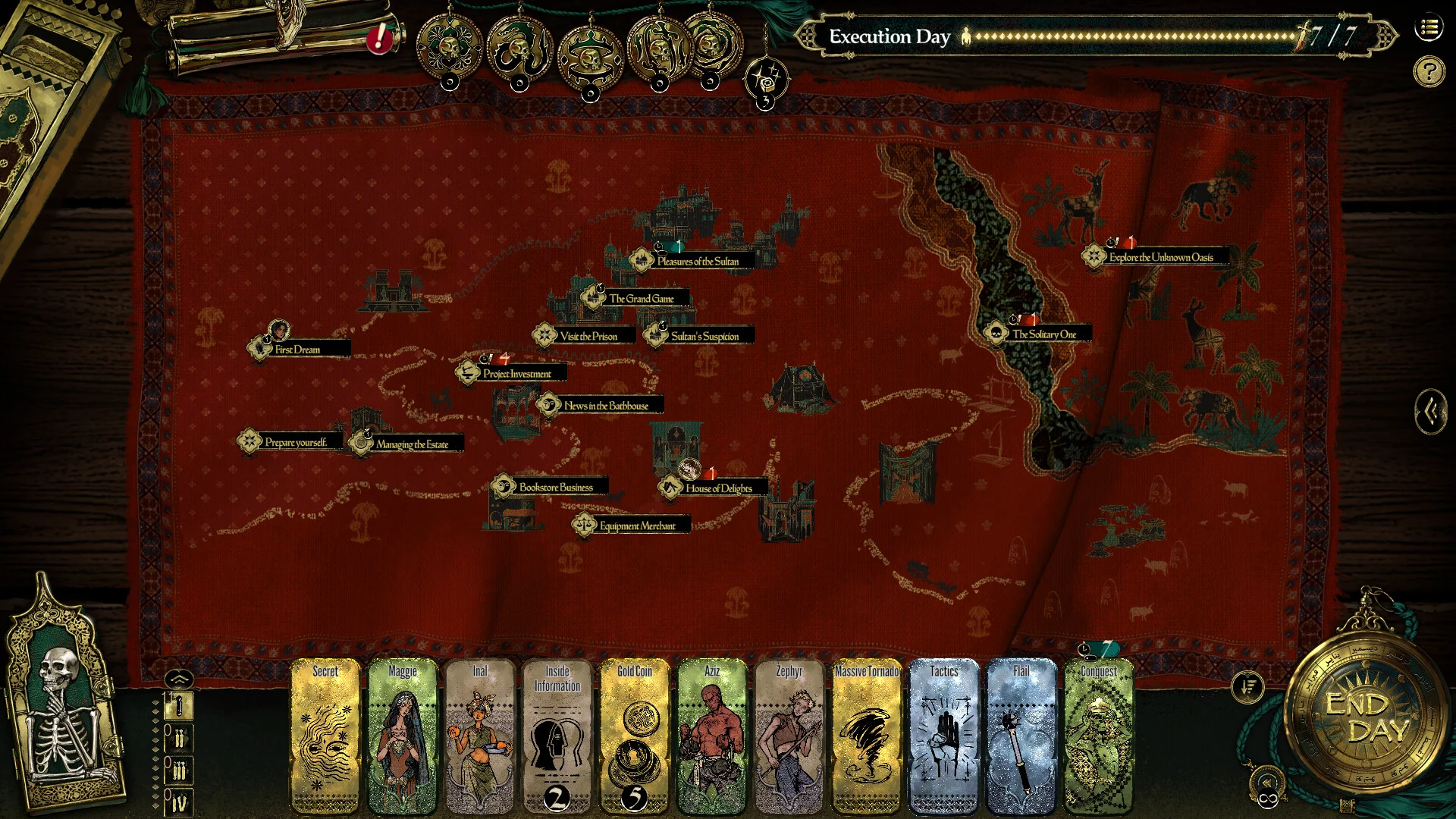
A clean first run can finish in 12–15 hours if you know the systems and the cards cooperate. Chasing multiple endings, unlocking cosmic routes, and buying Fate Ledger boons pushed our account past 40 hours before we stopped counting. The loop rewards planning: which follower handles which stat check, which event chain might break your current card, and whether you can afford to ignore the Sultan's personal requests this week.
Four Sins, Twenty-Eight Cards
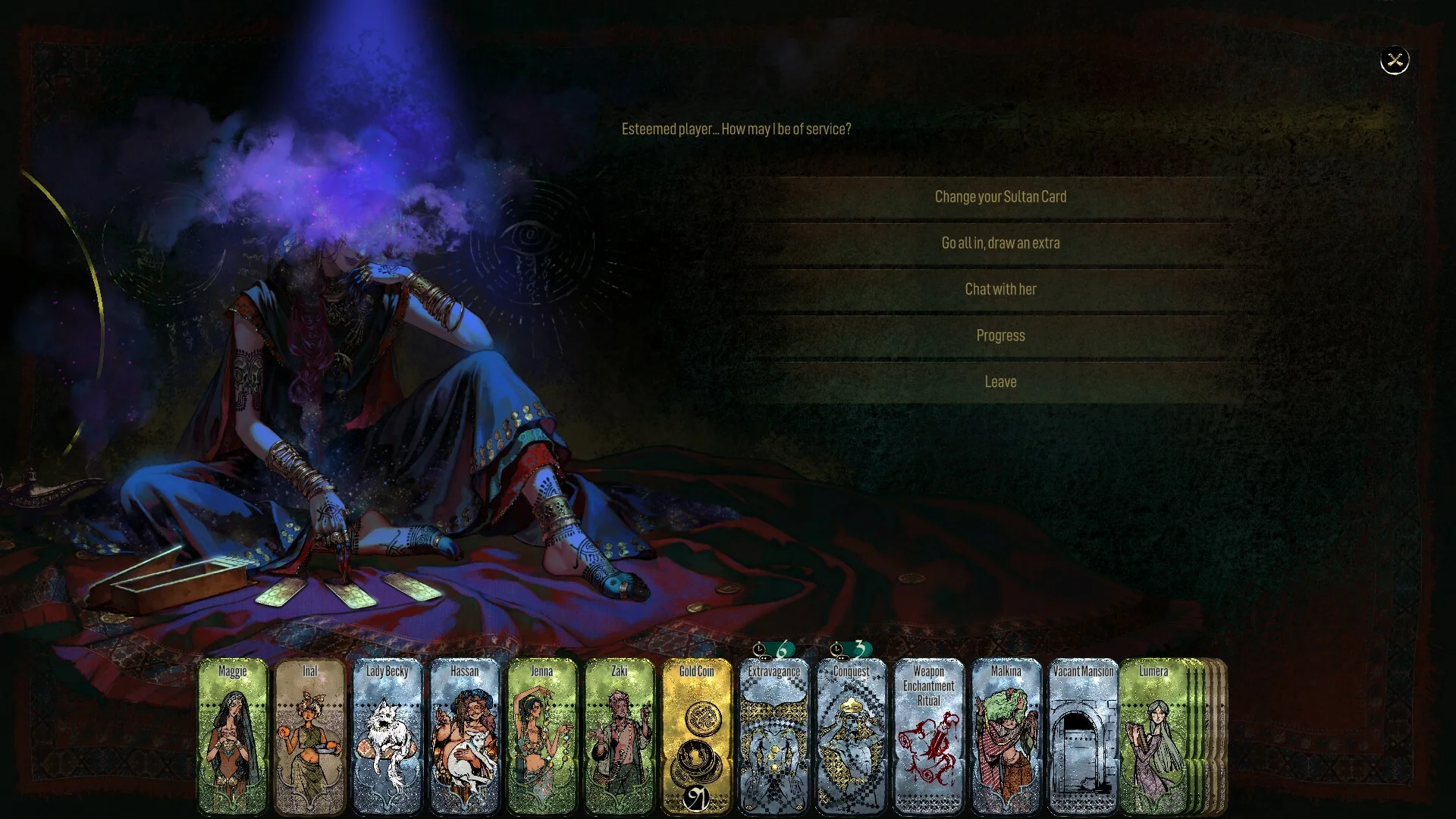
Sultan Cards divide into four sins — Carnality, Extravagance, Conquest, and Bloodshed — each tiered from rock through bronze, silver, and gold. The full deck holds 28 cards; broken cards leave the pool permanently, but draw order is random. Gold-tier cards, especially an early Conquest draw, can derail a run because the event windows that satisfy them are narrow and easy to miss. That RNG spike is the game's loudest mechanical flaw — and the reason veterans keep a reroll mentality for the first in-game month.
What saves the system from pure cruelty is variety: the same sin type plays differently depending on tier, your party, and which court threads you have unlocked. Extravagance might drain your treasury on a vanity project; Bloodshed might pit you against someone you recruited two weeks earlier. Strategy matters — but so does the hand the sorceress deals you.
Party Stats, Dice Checks, and Court Assets
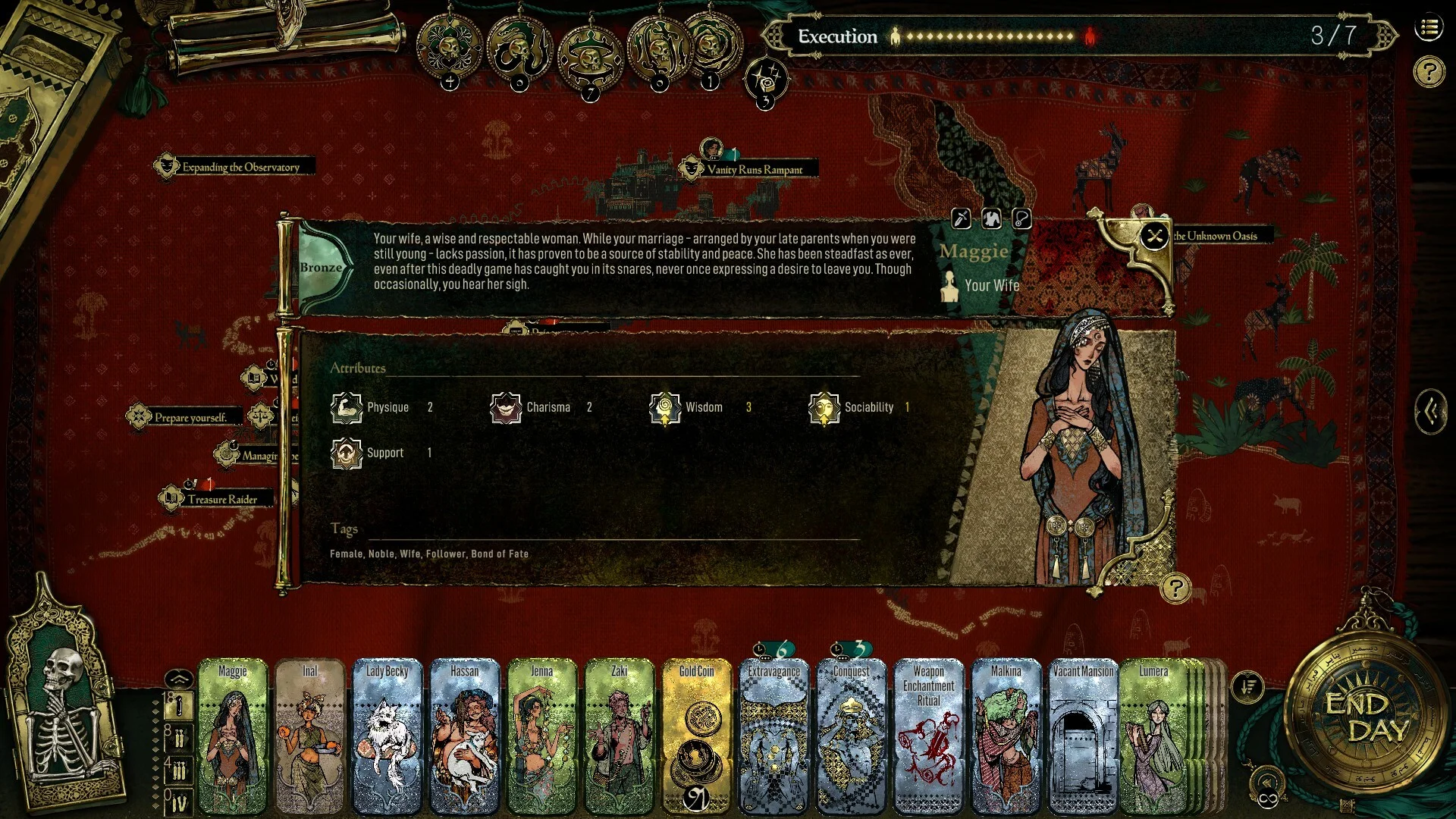
Where Cultist Simulator keeps the lens on a lone occultist, Sultan's Game gives you a roster — Maggie, Hassan, Lady Becky, and dozens more — with combat, physique, wisdom, charisma, and magic stats that gate event outcomes. Send the wrong ally to suppress bandits and the dice roll fails; send the scholar to manage your estate and gold flows in. Equipment, bookstore purchases, and personal event chains level followers the way a CRPG party would expect, except your "combat" is often a scheduled appointment on a rug-map.
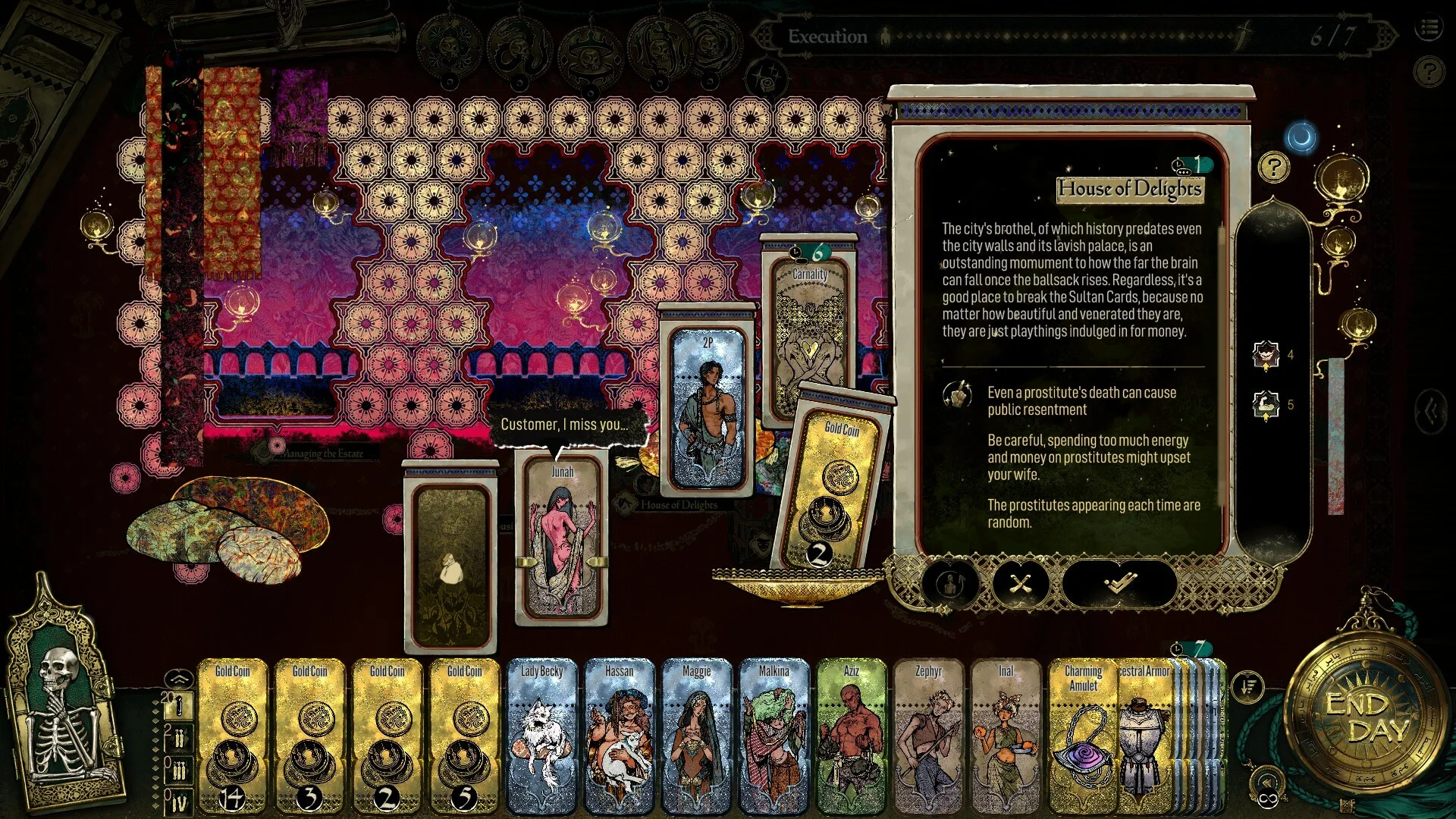
The Sultan himself adds secondary orders — supply a woman for his pleasure, pit warriors against lions, humiliate generals — that reinforce the power fantasy inverted: you have agency, but only within someone else's sadism. That dynamic is the game's ethical engine. You are not watching a villain; you are budgeting complicity.
Ponder, Event Webs, and Fate Points
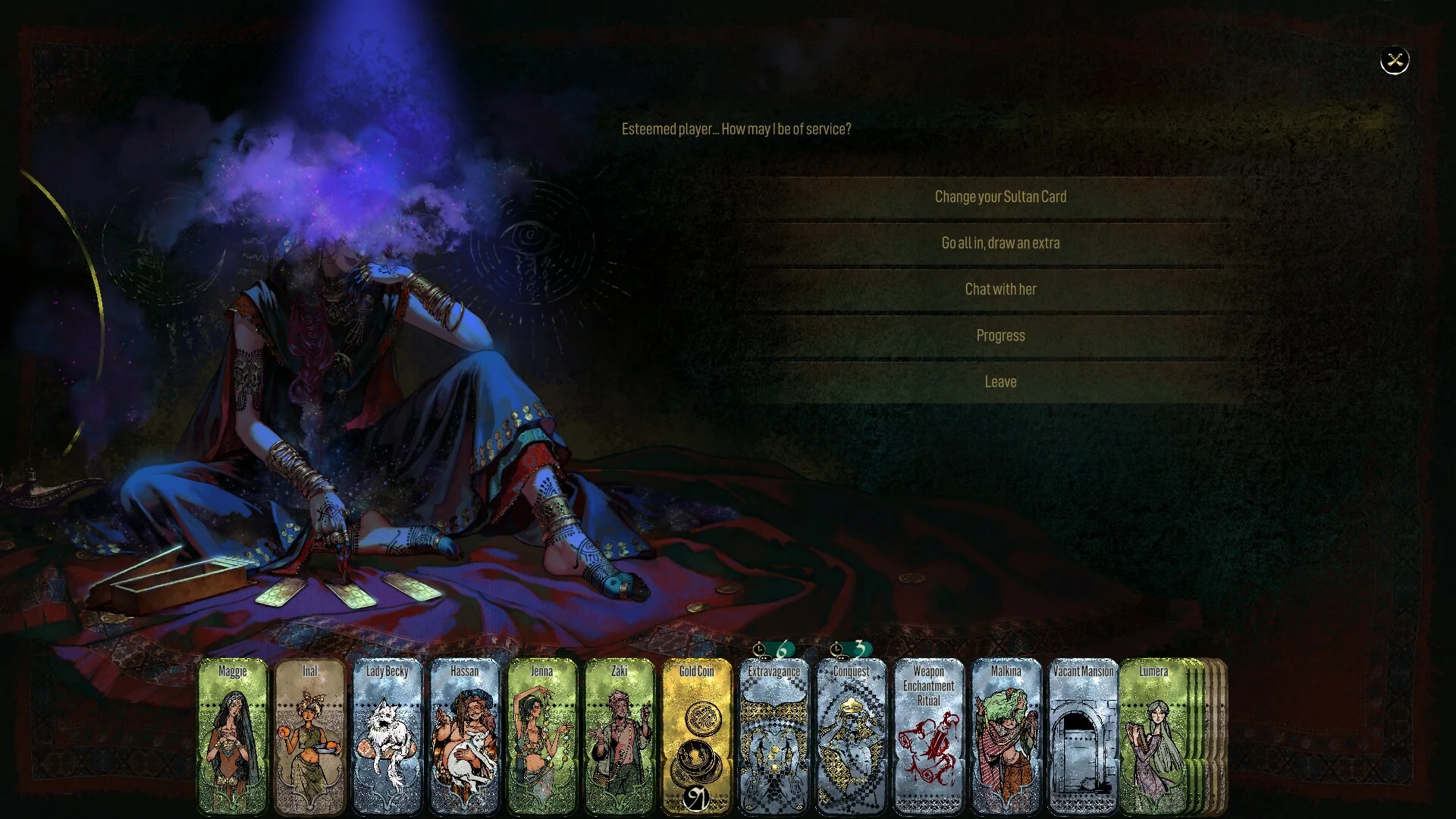
Stuck on a card? The Ponder (俺寻思) system lets you slot your active Sultan Card into a brainstorming UI to spawn new event hooks. When it works, Ponder is the anti-softlock valve that keeps unknown draws playable; when it does not, you get a thin flavor line and little actionable direction. We learned to treat Ponder as a backup — primary progress still comes from exploring map nodes, follower quests, and cross-linked story flags the game never fully documents in a traditional quest log.
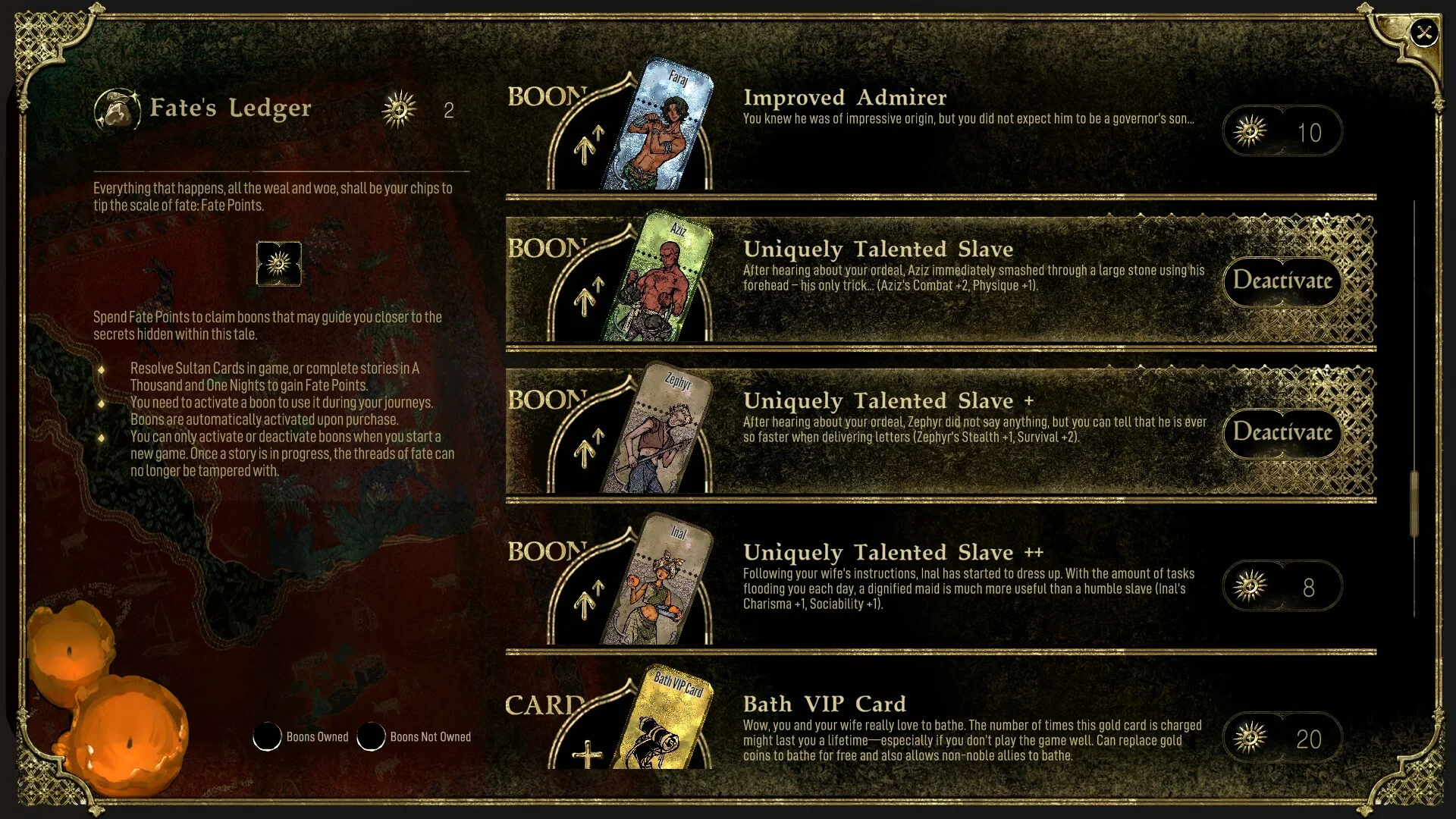
Between runs, Fate Points unlock the Fate Ledger — permanent boons such as stronger starting followers, bonus cards, or stat head starts. This roguelike-style meta layer makes repeat play feel purposeful even when narrative branches punish you for ignorance on run one. By hour 30, you are not grinding cards; you are curating which sins you can survive next time.
Fifty Endings and Cosmic Horror
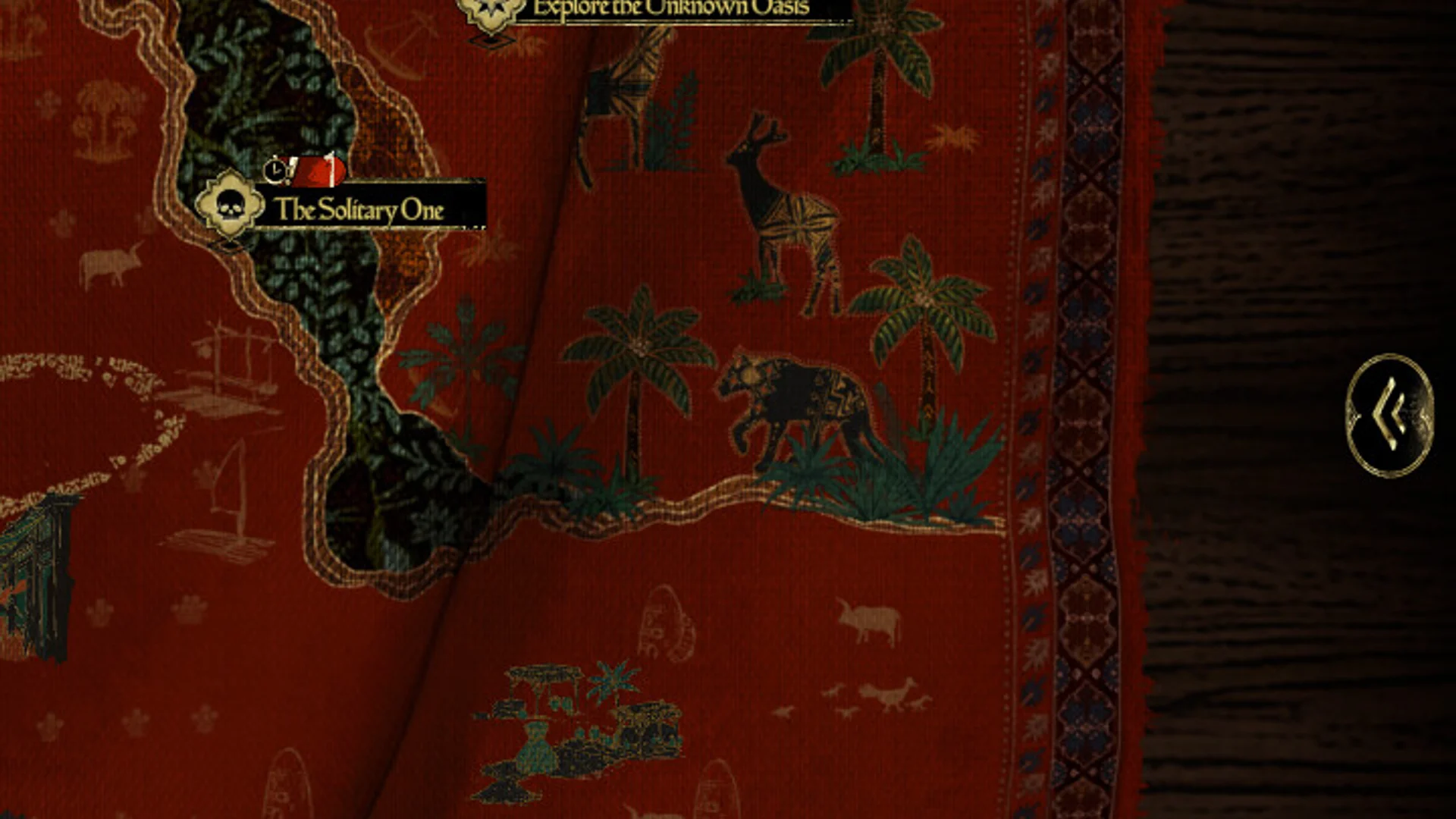
Double Cross advertises 50+ endings, and our runs bore that out — loyal sycophant, regicide, dragon slayer, apocalyptic god-slayer, and smaller tragedies in between. We will not spoil route names or who dies where; the spoiler policy stays light. What we can say is that finale arcs earn their weight: many endings include a multi-day preparation phase where daily text ratchets tension before a last confrontation or choice cascade. Cosmic threads — ancient gods watching from beyond the palace — require substantial Fate Point investment and prior knowledge to unlock, which gives the late game a mythic escalation beyond court politics.
The writing is the star: 1.4 million Chinese characters according to the studio, dense event chains that remember your cruelties, and a mature content warning that undersells how much psychological discomfort the text delivers. Descriptions of violence and desire are textual, not graphical — but the imagination fills in what Live2D portraits imply. Players who want constant voiced dialogue may chafe; players who treat branching prose as gameplay will find few 2025 indies this generous.
Live2D, Muqam, and Red-and-Black UI
Presentation runs on Live2D for key character moments, layered over hand-painted backgrounds and ornate Persian-rug map boards. The red-and-black palette — sin cards, execution timers, blood-splatter motifs — keeps visual identity coherent even across hundreds of event screens. Audio blends Uyghur Twelve Muqam traditions with Chinese pipa, yangqin, and flute against Western orchestral beds — a cross-cultural score Western players rarely hear in fantasy RPGs.
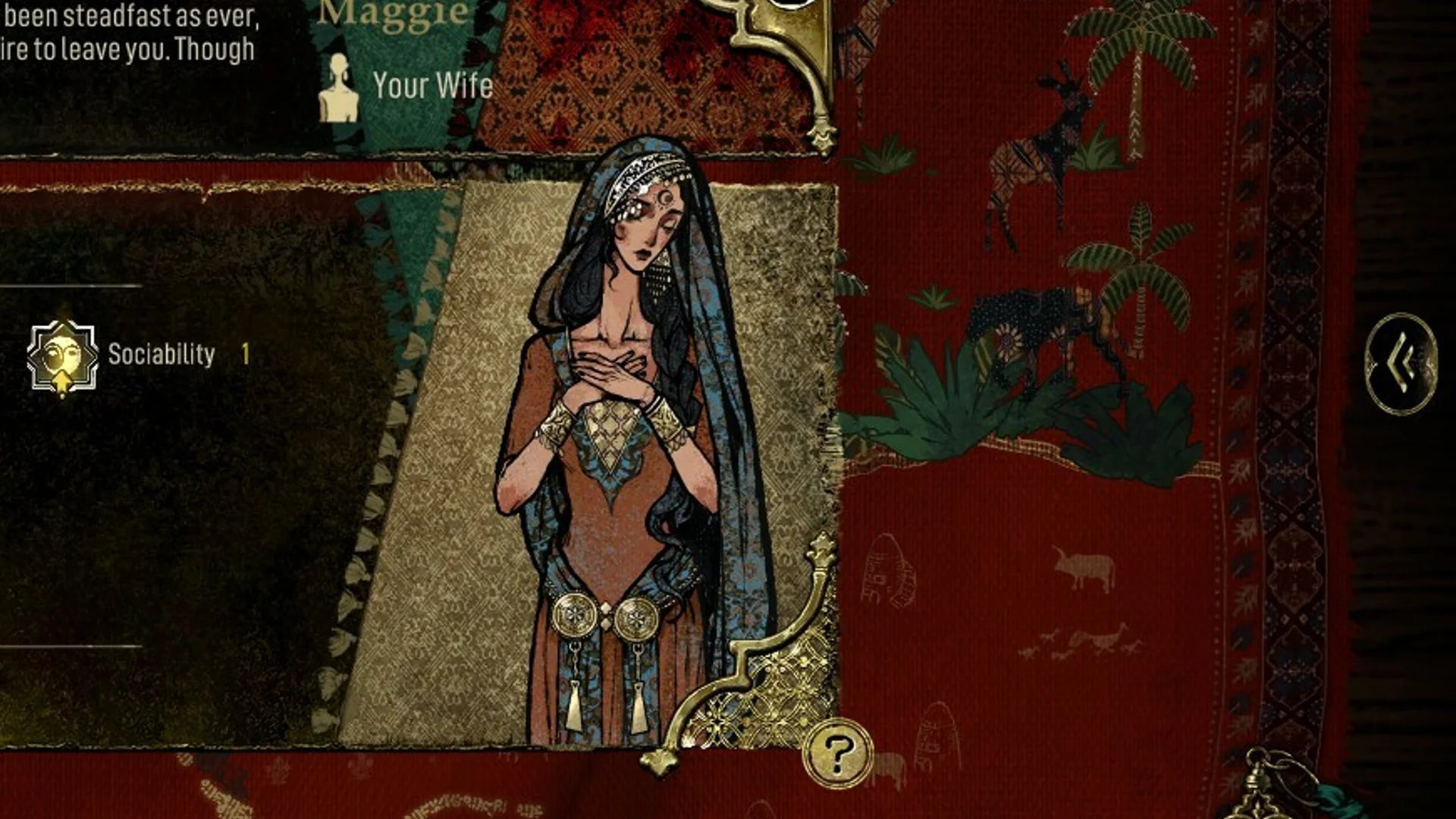
English localization is readable throughout; occasional idioms land flat compared to Chinese VO when present. UI density is high — expect scroll panels, nested tooltips, and a card hand that grows unwieldy late run. Accessibility options are minimal; font size and contrast are fixed. Steam Deck Verified status holds for portable reading sessions, though long text blocks reward a desk setup.
PC Performance and Steam Deck
This is a 2D/Live2D management game with modest spec demands — not an UE5 spectacle. Performance was never the conversation; stability and readability were. We saw occasional launch-period text overflow bugs in early patches; by June 2026 our Steam build ran cleanly on desktop and Deck.
PC notes at a glance (RTX 4070, Ryzen 7 7700, 32 GB RAM, 1440p)
Frame rate: Locked 60 fps at 1440p windowed; Live2D transitions stay smooth with no meaningful GPU load.
Steam Deck: Verified — readable at native resolution; long sessions benefit from the desktop text scale if you mirror to a monitor.
Storage: Under 5 GB installed; loads are near-instant on NVMe.
Known issues: Rare UI text clipping in English on narrow aspect ratios; no game-breaking crashes across three full runs on our hardware.
Minimum practical PC spec: Matches Steam's floor — GTX 560-class GPU, 4 GB RAM, SSD. Any modern laptop handles this comfortably. Recommended: Any 1080p–1440p panel with a comfortable reading distance matters more than GPU tier.
Hours, Price, and Replay Value
A focused first clear took us roughly 14 hours; pursuing alternate endings, Fate Ledger unlocks, and cosmic routes pushed past 42 hours. At $24.99 USD (frequently 10–20% off on sale), that compares favorably to Cultist Simulator plus its DLC stack for less total content — though genre fans may own the latter already. There is no multiplayer, no daily login, and no premium currency. Replay value is narrative, not mechanical grind: new cards, new sins, new betrayals.
Who Should Buy, Wait, or Skip
Buy now (full price or small discount): Narrative CRPG fans who enjoy branching text, court intrigue, and morally ugly choices; players comfortable with RNG card order and wiki-adjacent note-taking; anyone curious about Arabian Nights dark fantasy with a distinctive Muqam score and Live2D presentation.
Wait for a sale or demo refresh: Players who hate rerolling after bad opening draws; action-first buyers expecting combat arenas; readers sensitive to mature themes involving coercion, violence, and sexual politics — the game integrates them, not skirts them.
Skip: Pure tactical card battler seekers; players who want Reigns-length sessions only; anyone unwilling to read novel-scale word counts to see the best endings.
Sultan's Game lands as one of 2025's most ambitious narrative indies — a Faustian court simulator where cards are calendar entries and sins are survival skills. RNG spikes and an early event pool that takes hours to widen keep it from perfection, but the writing, endings, and party-driven CRPG checks justify the investment for patient story hunters. Start at the Game Hub for store links, then budget a week in-game — the Sultan always collects on day seven.